
Thought I'd have a bash at podcasting in 2015. Fun, but shitloads of hard work for zero reward, so I don't know how many more I'll be doing.

The 3M test: how to upgrade your bullshit detector
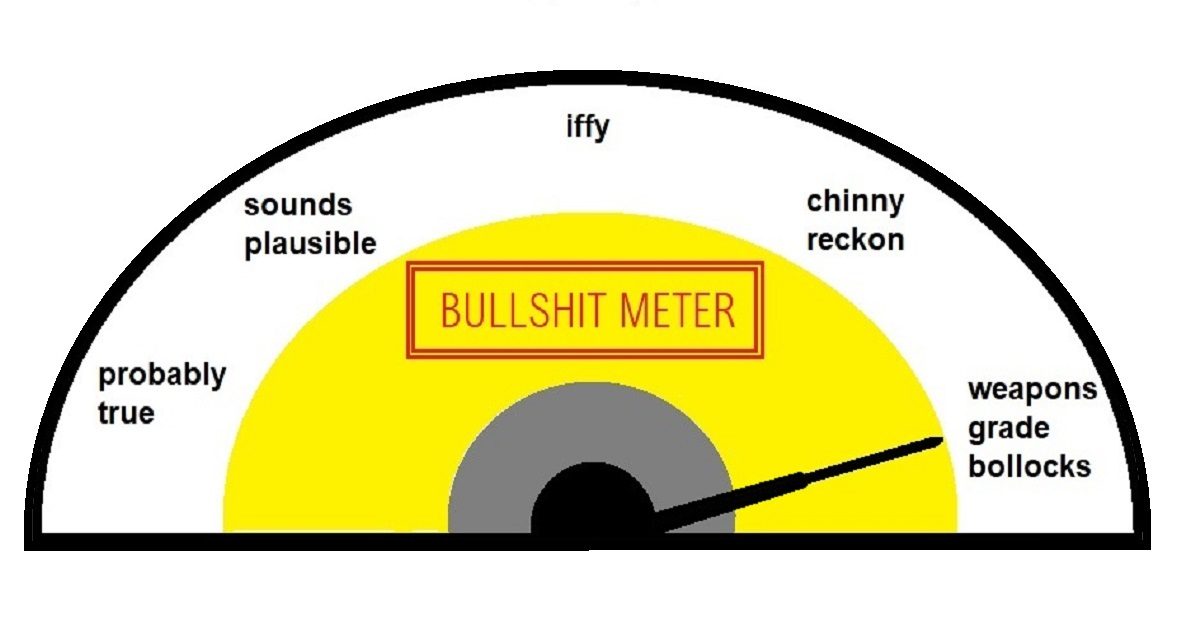
Graphic: bullshit meter

In the time of coronavirus, the ability to tell good info from bad is more vital than ever. How do you sort the gold from the garbage?
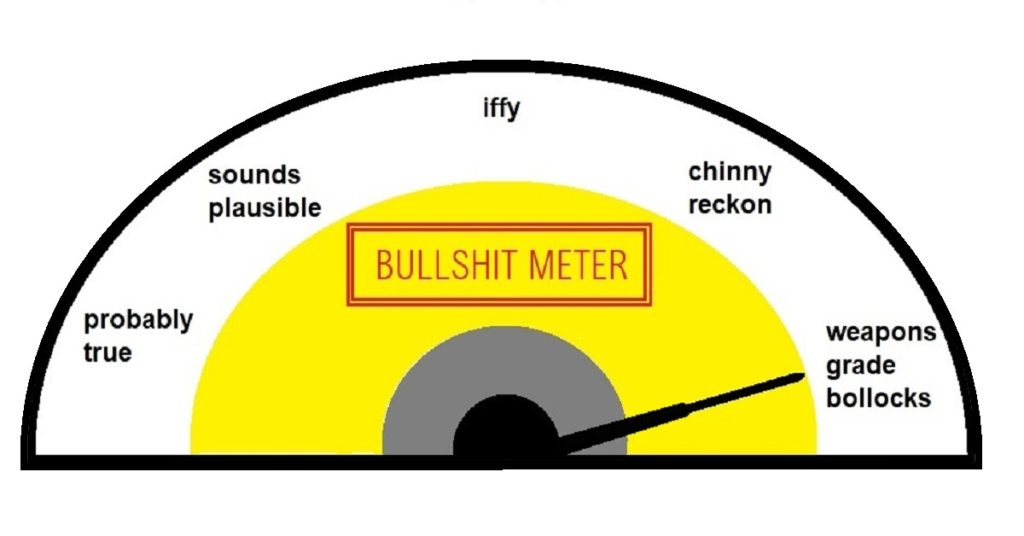
Graphic: bullshit meter

Minds greater than mine have been grappling with the reasons for society’s gaping divisions for years. Convincing cases have been made for the role of shorter attention spans, echo chambers, smaller families and spoiled kids and “me” culture, inequality, consumerism, the rise of lowest-common-denominator infotainment at the expense of grown-up news.

But from my perspective – a language graduate who has spent 30 years working in media and communications – the main problem is bullshit.

As individual, ephemeral human beings, we can’t possibly find out all the information we need at first hand. We have to rely on input from other sources: parents, teachers, friends, newspapers, TV, social media. But a lot of that input is contradictory. Some sources are clearly more reliable than others. In the time of coronavirus, the ability to tell good info from bad is more vital than ever. So how do you sort the gold from the garbage?

NBC report: 5G mobile phone masts set on fire amid bogus coronavirus theories
Not content with waging economic warfare on innocent civilians, Putin’s goons have now upgraded to biological warfare.

In the SnapChattin’, TikTokin’, Lyftin’, Zoomin’, Zooskin’ 21st century, whenever we come across a piece of new information, we tend to respond in one of two ways: automatic belief (“Yeah, that sounds about right, retweet”) and automatic disbelief (“Bollocks, obviously biased/brainwashed/stupid, block”).

That’s your system 1 brain – your primeval, emotional, semi-automatic brain – barging to the front and bellowing, “Don’t panic, everyone, I’ve got this, piece of piss,” when you should, it hasn’t and it isn’t. New information is precisely what your system 1 brain sucks at.

If you want to navigate your way through the morass of conflicting input, you’ve got to cast off this binary good/bad mindset, and prod your system 2 brain into activating a process called scepticism.

Scepticism (from Greek skepsis, “inquiry, doubt”) involves suspending your belief and disbelief and looking at things neutrally. (That’s as distinct from cynicism, which is closer to the wholesale rejection of everything.) Scepticism means checking, comparing, investigating – essentially, asking questions. And the questions you need to be asking when you encounter new information you find fall into three categories: medium, message, and marketplace.

Medium (the source, or context)

Believe it or not, there was a time not so long ago when most media, and even most politicians, could broadly be trusted. They might screw up; they might have vague ideological leanings one way or another. But they’d rarely blatantly tell you, with a straight face, that black was white or up was down.

Then the cutthroat chase for advertising revenue and votes and clicks began, leading to a rapid erosion of standards. Formerly august news organs gave us the Hitler diaries, the Sun’s reporting of the Hillsborough disaster, phone hacking and the fake Abu Ghraib torture photos, and trust in the “mainstream media” withered away. At the same time, ever larger numbers of news organisations fell into the hands of unscrupulous, openly partisan kleptocrats, who whittled the concept of editorial independence to the bone.

Paradoxically, this paved the way for even more unreliable purveyors of “news” – thinly disguised state-sponsored propaganda outlets, contrarian tweeters and YouTube demagogues – who snapped the bone clean in two. Accountable to no watchdog, bound by no editorial code, subject to no scrutiny, untouchable by law, never compelled to publish corrections or give right of reply, they used the shield of “free speech” to publish what they goddamn pleased. The increasingly erratic, sometimes biased, but still mostly principled news organisations had been abandoned in favour of shamelessly partisan hucksters.

In theory, it’s wrong to dismiss information purely on the basis of its source. That’s the crux of the ad hominem fallacy: it’s logically unsound to state that someone’s character or history has any bearing on the value of what they say. Just because Tony Blair says two plus two equals four, doesn’t mean the real answer is nine.

But in practice, we don’t have the means to verify every assertion. And some individuals and organisations have such abysmal track records with the truth, and such transparent agendas, that it is now not just permissible but a damn good idea to inspect the messenger as carefully as the message.

So the first thing you should do when you come across new information is check where that information came from. If it’s an article, find out who owns the newspaper or website. Are they widely trusted? Do they have a clear political agenda? Is all or most of their output devoted to a narrow range of subjects? (How can anyone who stumbles across one of those cesspit Twitter accounts that consist of nothing but retweets of negative stories, real and fabricated, about Muslims, really think they’re curated in good faith?)

If you’re looking at a post on a random social media account, check the author’s bio. Does it seem authentic? Does it mention where the story came from – the original source (the urtext)? If not, place it firmly in the holding category labelled “DODGY AF”. In the absence of verification, a news “story” is just that: a fable.

If you can find the ultimate source, ask the same questions you would of a news organ. How long has the platform been around? Is it approvingly cited by other respected media outlets?

Now do your due diligence on the writer, if one is credited. What else has this person written? Do they have any experience of or expertise in the field they are writing about? What are their credentials other than a glib turn of phrase and a cool byline pic?

Reminder: columnists are commentators. Radio shock jocks are commentators. Vox-popped pensioners in seaside towns who voted for Brexit are commentators. Representatives of thinktanks are commentators. Populist politicians, because they listen only to the advice they want to hear, from the lickspittles they surround themselves with, are no better than commentators. And commentators are not experts. They might have a way with words, but they have no such dominion over facts; they deal in opinions, and those opinions are often based solely on what sounds or feels good.

If we’re talking about an epidemic, I want to be hearing from epidemiologists. If we’re talking about international trade, I want to be hearing from economists. Not from failed fucking fashion students.

If you can’t quickly establish the identity, background and financing of a source, then suspect (but don’t assume) the worst. No reputable media organisation has any reason to withhold where their money comes from – if you’re acting on behalf of private interests, then you’re not acting in the public interest – and most journalists would happily take credit for a fart at a funeral.

Lastly, is your source Donald Trump? Well, if you’ve decided to give the slightest credence to that 50-faced, triple-chinned, flint-hearted, atom-brained, snake-tongued, gossamer-skinned, matchstick-spined, lily-livered, mushroom-cocked lardass, then the chances you’re reading this – or indeed anything – are infinitesimal; but in that vanishingly unlikely event, know this: Trump’s mis- and disinformation has already killed people, and may yet kill tens of thousands more.

Message (the story, or text)

The focus of your inquiry, of course, should be on the information itself. Putting the content aside for a moment, you can garner some clues from the presentation. Is this a polished, professional product, or does it feel … tossed off somehow?

Are the spelling and grammar of a high standard? (Again, it’s a mistake to write something off solely because of a stray “your” for “you’re”, but if someone is sloppy with something as simple as an apostrophe, it does raise a question mark over the accuracy of their statements.)

Is the tweet or article or passage of speech delivered clearly, accurately and succinctly, with specifics rather than generalisations? Are the words all used in their correct senses?

Is the use of language fresh and original, or cluttered with clichés and buzzwords? Is the meaning clear and unambiguous? Does the author or speaker illustrate their point with relevant examples? Does the piece contain any obvious inaccuracies, or things you know or suspect to be untrue? Is it internally consistent?

If the author uses statistics, are they sound? (I know it’s hard for those without the appropriate background to rigorously examine any particular numerical claim. And unfortunately, since even most trained journalists and interviewers don’t know their bell curves from their bell-ends, they’re not often a great help either. My next post will deal with a few of the most common abuses of statistics.)

Have any of the people mentioned been approached to give their side of events (this is regarded as good practice by traditional news outlets)? Have any dissenting voices been quoted? Has the background to the developments been fully expounded?

If there are any pictures or video accompanying the story, are they attributed to anyone? (Photographers and filmmakers, even amateur ones, are no shier about taking credit for their work than writers.) Has this picture or video been used elsewhere, and if so, are there any differences between the two versions? If not, has it independently been verified as authentic?

Yep, they tried to claim that Obama was a Black Panther.

Now look more closely at the language used. Is the piece relatively free of adjectives, adverbs and otherwise emotionally loaded words? It is a reporter’s job to tell readers what has happened, not what opinion to have on what has happened; they’re reporters, after all, not explainers or influencers. When someone is introduced as “terrorist sympathiser Jeremy Corbyn”, you can be fairly sure you’re not listening to a neutral voice.

Good news organisations take great care to draw a thick line between objective news reporting and subjective interpretations of the news. Opinion pieces are clearly badged as such, and published in a separate section of the paper or website.

But bad practice is proliferating, and more and more media outlets, particularly those under the control of moguls, are beginning to see as their duty as being not to inform, but to influence. They, the openly partisan “news” operations funded by God knows who and self-appointed champions of truth like Tommy Robinson and Paul Joseph Watson have abandoned all pretence of balance and neutrality.

Good news reporting is not fun or edgy or stylish or provocative; it is dry. Functional. Dull, even. The text should have no subtext. Scroll to the end for some recent examples.

If you don’t have time to go through this rigmarole every time you come across new information – and let’s face it, you don’t – one little short cut will often point you in the right direction. Read the story, and re-read the headline. Now do your best to consider this objectively: does the headline accurately reflect the content of the story?

Once upon a time, headlines had a single purpose: to pithily summarise the words beneath it. But as the media ecosystem became more competitive, headlines evolved. Accuracy was no longer enough; they had to be quirky, grabby, funky. The Sun enjoyed some success for a while by crowbarring in terrible puns (but trust me, guys, that era is long past). Meanwhile, the Mail (and all newspapers, to some extent) got round the problem by stretching, or sometimes breaking, the truth. Take this gem from last August.
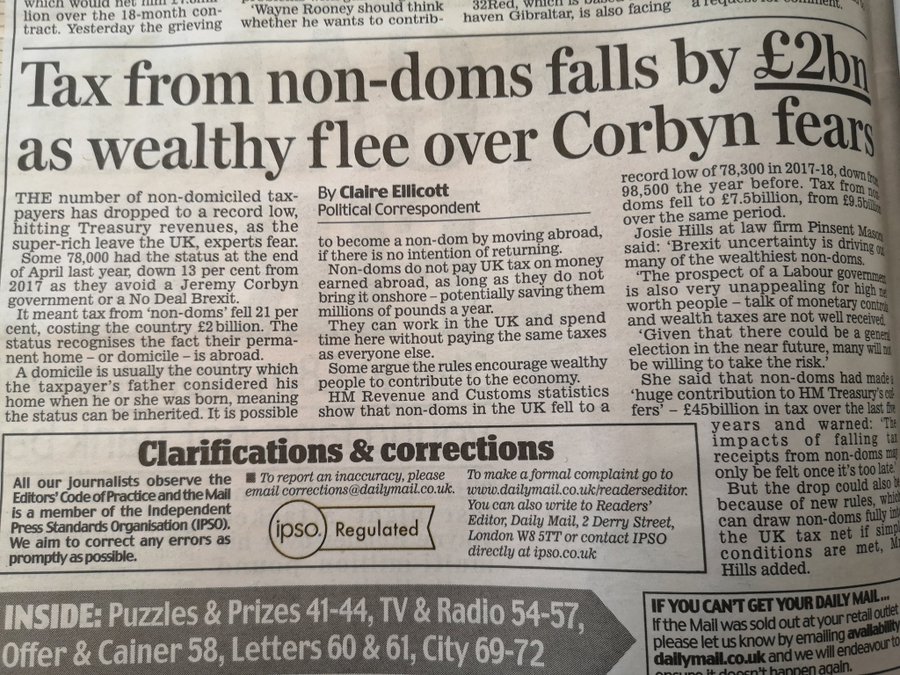
If you read the article, the reasons for the billionaires’ departure are, in fact, purely the opinion of a single lawyer – and her exact words are, “Brexit uncertainty is driving out many of the wealthiest non-doms … The prospect of a Labour government is also very unappealing to high net worth people.” So Corbyn isn’t even mentioned, and fears about Labour (in the opinion of this solitary lawyer) are only a secondary factor in capital flight. The headline grossly misrepresents the article, to the benefit of the Mail’s anti-left agenda.

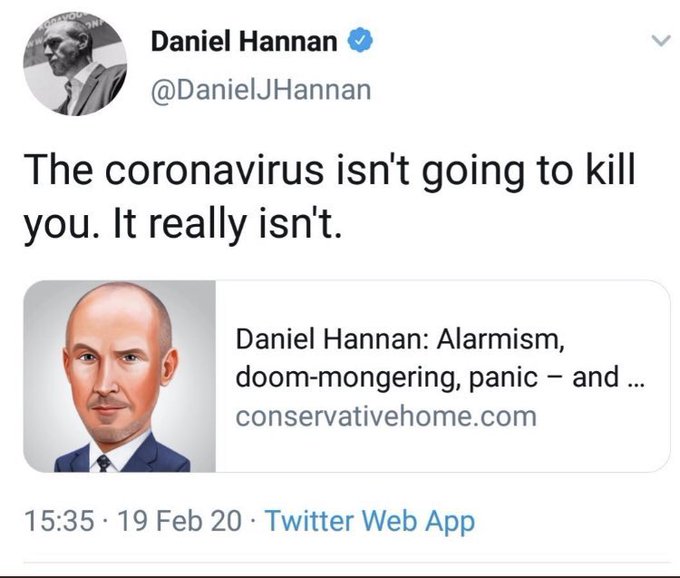
Much as I hate to be even glancingly fair to the chuntering ninnyhammer that is Daniel Hannan, his recent wankpiece for ConservativeHome, headlined “Alarmism, doom-mongering, panic – and the coronavirus. We are nowhere near a 1919-style catastrophe”, wasn’t quite as irresponsible as it first seemed. The text actually reads, “You’re unlikely to die of coronavirus,” which is quite true – if perhaps not the most useful message to be sending to society at this time.

But to return to being deservedly harsh on the chuntering ninnyhammer that is Daniel Hannan, he then chose to tweet the following link to his own story, with a headline of his own devising that said something completely different, purely in the interest of harvesting more clicks. Instead he harvested widespread vilification, and deleted the tweet.
Just before the 2016 EU referendum, InFacts did a round-up of the most misleading stories on the issue published in the rightwing press. In most of the cases, the offence involved not an outright untruth, but a duplicitous headline.

But the last word in headline shenanigans goes to this Express story from 2016, to which I dedicated an entire post (and for which trouble I was threatened with legal action). Accurate headlines are more important today than they’ve ever been because much of the time, people simply don’t read any further – and even when they do, the headline is what they take away with them.

One more little thing to look out for: if what you’re reading is online, has the author provided any external links to something that might corroborate it? If someone believes their information is legit, they’ll be happy to share their source. (It should go without saying that links to opaque websites with clear political agendas don’t count.)

The marketplace (the metatext)

So, you’ve carried out a full background check on the potato salesman. You’ve examined his potatoes. Now you need to check to see what other consumers are saying about his potatoes, and how rival tradesmen’s potatoes compare.

First, look to your fellow spud seekers. What rating have people given the merchant on ChipAdvisor? If it’s a tweet, what are people saying in the replies? If it’s an online article, what are they saying in the comments underneath? If it’s an interview, did the interviewer challenge the remark, or ask any follow-up questions?

One-word responses can be safely ignored. “Bollocks”, “Nonsense”, “Twat”: that’s just the opposing side’s system 1 brigade reflexively rubbishing the point because it threatens their world-view. Pay no more heed to those trying to dismiss the article with reference to the platform or writer. “Typical Remoaner”, “You expect me to believe something published in the Guardian?!!”, etc.

The comments worth considering are the detailed, level-headed, rational ones: people pointing out factual errors, highlighting contradictory evidence, logical flaws, providing relevant context. Pay special attention to those who can actually back up their points with evidence from a reputable third-party source. Do these responses, individually or collectively, cast any doubt on any of the claims in the original article or post?

Now consider the rival salesmen. If there’s any substance to a story, then the chances are, other individuals or news outlets will have picked up on it. So hunt down some other versions. (Word for word repetitions don’t count. What you’ve found there is not a separate source, but one source copying a second one, or two sources copying a third, which suggests an orchestrated propaganda campaign rather than an independently verified scoop.)

Now, how reliable is this source? Is its information usually of high quality? Once you’re satisfied that it has no connection with the first source and upholds basic journalistic standards, compare the two takes. Do any of the details in the new version contradict any of those in the first? Does it omit any details, provide any additional context, or interpret them differently? Why might that be?

Let me stress: none of these red flags, in and of itself, is sufficient reason to dismiss any piece of information outright. But each one should push the needle on your bullshit-meter further to the right.

I know this seems like an awful lot of work do to just to establish some approximation of the truth; but the truth is under attack as never before, and it’s the only weapon we have short of actual weapons against the dark forces of illiberalism and authoritarianism. And while Finland’s response to fake news has been to launch a nationwide campaign to educate and protect its citizens, their British counterparts have instead chosen to become its most prolific purveyors.

The task of saving democracy falls to you and you alone.

Starmer chameleon

Now let’s put those principles into practice and examine the different approaches of various media outlets to the same news item. On the day I went out to mass-buy the papers, April 4th, one of the main non-coronavirus stories was the news that Keir Starmer was poised to win the Labour leadership election.

Guardian: Keir Starmer poised to be announced new Labour leader

(900 words, page 27 of 35 news pages)
Thrust of story: Starmer likely to win, Corbyn supporters fear they will be purged
Introduced as: Keir Starmer
Referred to subsequently as: Former director of public prosecutions, shadow Brexit secretary
Background/context: Age (57), election defeat, antisemitism inquiry, forthcoming NEC elections, efforts to unify party wings, likely shadow ministerial appointments
Other people cited: Unnamed allies of Starmer, unnamed allies of Corbyn, one former Corbyn aide, Tulip Siddiq, associate of Rebecca Long-Bailey
Subjectivity: “Devastating 80-seat defeat to Boris Johnson”
Errors: “After … an ongoing inquiry”, incorrect dashes, “Starmer’s had successfully targeted”
Bullshit factor: 2

Daily Mail: Sir Keir and a question of cowardice

(2,700 words, p32/45; badged as “special investigation”)
Thrust: Starmer has not done enough to combat antisemitism in the Labour party, according to several conversations with unnamed party sources and a cursory analysis of 340 online articles
Introduced as: Party figure more moderate than Jeremy Corbyn
Referred to subsequently as: Shadow Brexit secretary, hot favourite to succeed Corbyn, Sir Keir, QC and former DPP
Background/context: Starmer’s Jewish family, leadership candidates’ records on condemning antisemitism, first elected to parliament in 2015
Other people cited: Unnamed sources in Jewish community and on far left of party, “a friend of a rabbi”, “a source”, “a source at the Jewish Chronicle”, “another Jewish former Labour politician”, “one former Labour MP”, “prominent members of the Jewish community”, “a friend of Luciana Berger”, “one of Starmer’s former colleagues”. In an article 2,700 words long, consisting mostly of quotations, not a single source is named
Subjectivity: “Cowardice”, “troubling issue”, “Sir Keir’s surprise promotion of his previously discreet Jewish ties”, “desperate for leadership votes”, “deeply disillusioned Jewish membership”, “cosy interviews”, “hardly gladiatorial tone”; “these mild critiques”; “sympathetic interview”, “Left-leaning New Statesman magazine”, “previously shrouded Jewish ties”, “Sir Keir replies, no doubt sadly”, “habitual fence-sitting”
Errors: Incorrect punctuation around speech; missing quotation mark; missing final full stop
Bullshit factor: 8/10

Sun: Labour’s Keir and present danger

(p24/36 news/celebrity gossip pages, 230 words)
Thrust: Corbyn will cause trouble from back benches
Introduced as: Millionaire barrister Keir Starmer
Referred to subsequently as: Former chief prosecutor
Background/context: Age; a podium has been sent to Starmer’s house so that he can practise his acceptance speech
Other sources cited: “A source”, Jeremy Corbyn’s Facebook page
Subjectivity: “Bitterly divided party”; “Marxist policies”
Errors: “While we exist on lockdown”, “bitterly-divided”, stray full stop
Bullshit factor: 7/10, plus a bonus 1 for that godawful must-pun-at-all-costs headline

Times: Labour’s women will rise again under Sir Keir

(p18/31, 400 words)
Thrust: Several MPs who were overlooked or declined to serve under Corbyn are likely to be called to the shadow cabinet
Introduced as: Sir Keir Starmer
Referred to subsequently as: Sir Keir, exclusively
Background/context: Shadow cabinet will not meet in person until social distancing rules relaxed; Corbyn allies will be discarded
Other people cited: Lord Wood of Anfield. Lots of speculation couched in terms of “X might/could/is expected to …”
Subjectivity: Article is basically all guesswork
Errors: None
Bullshit factor: A surprising 3/10

Telegraph: Corbyn plans ‘farewell tour’ as Starmer takes reins

(p16/20, 400 words)
Thrust: Corbyn may become Tony Benn-style thorn in Starmer’s side
Introduced as: Sir Keir Starmer
Referred to subsequently as: Sir Keir, former director of public prosecutions
Background/context: Starmer’s efforts to rebuild relations with marginalised elements of party; rebellious tendencies of Benn and Corbyn
Other people cited: Corbyn, “close ally of Angela Rayner”, “one insider”
Subjectivity: Purports to know Starmer’s vision for party; idea of “farewell tour” appears to be invention of reporter
Errors: Double “as” in opening sentence
Bullshit factor: 4/10

Tweet: Kier Starmer is a charmless posh sod
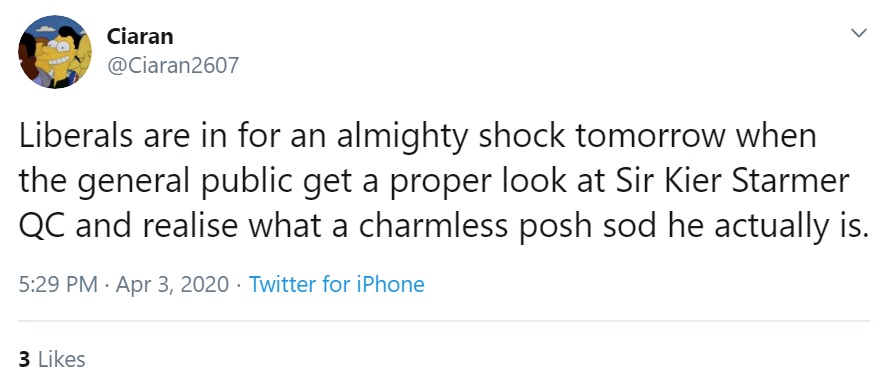
(31 words)
Thrust: Keir Starmer is a charmless posh sod
Introduced as: Sir Kier Starmer QC
Background/context: Former director of public prosecutions
Other people cited: None
Subjectivity: All of it
Errors: Can’t even spell the guy’s fucking name right
Bullshit factor: 10/10


Statistricks, part 5: the remainder

“Statistical thinking will one day be as necessary for efficient citizenship as the ability to read and write” – Samuel S Wilks, 1951

Authority figures can no longer be trusted to tell the truth. And since most of the news media is now in the hands of private owners with conspicuous agendas, and the few remaining outlets with a shred of integrity are running on fumes, journalists can no longer be relied upon to catch those authority figures out.

Which means there’s really only one gatekeeper left to protect you from disinformation: you.

The lies we’re most familiar with – and therefore the best at seeing through – are the verbal kind: sequences of words that bend, break or obfuscate the truth. But as I hope my last few posts have illustrated, those who wish to mislead us are just as adept at manipulating sequences of numbers, and it turns out we’re not half as good at spotting that.

This is a problem. And since these lies have real, measurable impact (if they didn’t, no one would bother lying), it’s your problem.

No one’s asking you to sign up for a master’s in statistics. You just need to know enough to be able to spot the red flags. So my last post on this subject will be a recap of my previous warnings on the subject, plus a wee list of other common examples of statistical chicanery.

Beware big numbers

We can all easily imagine what 10 items looks like. With a bit of effort, 100. And most of us can probably conjure a vague picture of 1,000 things. But when it comes to millions and billions and trillions, our mental gearboxes just seize up. This is what the propagandists are counting on.

The example I chose, because it is arguably one of the best known and certainly one of the most damaging, was the “£350m a week” claim by the Brexit campaign.

The Remainers were quick, ish, to point out the falsehood. But the battle was already lost. People were no less outraged by the true figure of £150m a week, because all that mattered was that it was a bafflingly large amount.

Big numbers in isolation are meaningless to the average person. To get an idea of their true significance, we need context: in this case, the cost of things of a comparable scale, like, say, the NHS budget (£2bn a week), or defence spending (£1bn a week). Most of all, we needs to know exactly what that money bought. Sure, EU membership cost a lot of money, but did it offer value for that money?

Since its wildly successful field test in the Brexit debate, this tactic is deployed on a daily basis. Whenever something within state competence is revealed as being even slightly less than ideal, the response from the state press officers is the same: trot out a big number.

“A spokesperson for the DfE said education was a top priority for the government, with an extra £2bn for schools for each of the next two years included in the autumn statement.”

Ooh, two billion! That’s a lot! Everything must be fine then.

But without the proper context, this means nothing. An extra £2bn on top of what? Was the annual increase in base funding, if it existed at all, in line with inflation? How does the total compare with the funding levels last year, or 10 years ago? How much is being spent per pupil, and how does this compare with other countries’ efforts? Most importantly of all, is this money enough to meet the current needs of the education system?

To sum up, don’t let your brain switch off when it sees big numbers. If anything, it should move to high alert.

Be on your guard against glitter

Advertisers have long made liberal use of “glitter” – words or phrases that make things sound superficially attractive, but are devoid of substance. Two of the more popular zingers are “more than” and “over”. I once saw a billboard ad for a breakfast cereal that proudly proclaimed: “Contains more than 12 vitamins!”

The reason this works (on the unwary, anyway) is the anchoring effect: the tendency of the human brain to evaluate everything with reference to the first value it encounters. In this case, the anchor value is 12, and “more than 12” signals the set of all numbers greater than 12 – loads! – when a moment’s reflection will tell us that the true figure is 13.

Now it seems politicians and journalists have learned a trick or two from copywriters, and no figure is deemed complete unless it comes with a side of comparatives or superlatives.

Recently, in the course of my subediting duties, I happened across an (unedited) article containing the line “the family were awarded over £8,129 11s 5d in reparation”. My God! Are you telling me those lucky sods received compensation of 8,129 pounds, 11 shillings and six pence?

Another word that sounds great but never survives scrutiny is “record”.

“That is why, despite facing challenging economic circumstances, we are investing a record amount in our schools and colleges.”

Well, Department for Education, I should hope you were investing a record amount every year, given that the population rises every year and that inflation is a thing.

One of the truth-twisters’ favourite buzzwords in the early days of Brexit was “fastest-growing”. Never mind those tired old European countries; we’re going to concentrate on trading with countries that actually have a future!

Here again, crucial context is missing, and the context is that these wonderful new trading partners are growing so fast because they’re starting from a much lower base. As even one prominent Brexit advocate once admitted (about a year before it became their favourite go-to gotcha), the real meaning of “fastest-growing” is “tiny”.

“Of course, if you start from nothing, it’s not hard to become the ‘fastest-growing’ campaign” – Isabel Oakeshott, 20/11/2015

Look at the IMF’s predictions for 2024.

The top five performers on this metric are Guyana (GDP $15bn), Macao ($24bn), Palau ($233m), Niger ($15bn) and Senegal ($28bn).

The GDP of the EU (even without the UK that it desperately needed to survive) is $17.2 TRILLION. That’s more than 200 times the GDP of those five countries combined. Not to mention that they’re all a lot closer and they make a lot more things that British people actually want to buy. Who is it more important to have barrier-free trade with?

Reporters and politicians are still making this same blunder today (“Next PM likely to inherit improved economy after UK growth revised up”).

If this were a sustained trend, it might tell us something significant. But the period over which the data was measured is three months. This is more likely just a course correction after a rough patch for the UK economy than a sign of sunlit uplands. At the very least, we should wait a while before leaping to any conclusions.

Be vigilant with visuals

Graphical representations of information – data visualisations, or datavis – are useful ways of communicating a lot of information quickly. And because creating them requires a modicum of expertise, they are often deployed as gotchas: “Quiver, mortal, as I blow your puny argument out of the water with my BAR CHART!”

The trouble is, in the wrong hands, datavis is as susceptible to abuse as any other mode of expression.

Be sceptical of surveys

Polling firms are businesses. Businesses serve the needs of customers. And customers have political, or commercial interests, which do not necessarily align with yours, or society’s. (Moreover, it seems an increasing number of polling firms have agendas of their own.)

Pollsters regularly use samples that are too small, fail to publish their methodology, and use daft or leading questions. Even broadly decent organisations like the WHO are not above such silliness.

One of the questions in the survey was “Have you ever tried alcohol?” 57% of 15-year-olds in the UK said they had. The WHO then quoted this answer, in the press release (which is all most time-strapped journalists ever read), under the heading “Alcohol use widespread”.

Suddenly, sipping a shandy once on a family visit to a pub garden is lumped in together with downing a bottle of Jack Daniel’s a day. Furthermore, we have no way of knowing whether these answers were completely honest. How many British 15-year-olds would be embarrassed to admit they’d never tried booze?

Polls can be tools to shape opinion as much as reflect it, first because they can influence government policies, and second because waverers in the general populace can be won over to what they perceive to be the majority view.

I could caution you to be wary of surveys that aren’t upfront about their methodology, surveys with a small sample size, surveys conducted by firms with murky political connections, or surveys whose funding is not declared. But to keep things simple: ignore polls.

Are those figures really significant?

Something else that should set the alarm bells ringing, along with big numbers, is long strings of numbers, as seen in this article.

“The data released on Monday, from the Chinese ministry of public security, showed the number of new birth registrations in 2020 was 10.035 million, compared with 11.8 million in 2019.”

The second figure in this sentence is expressed with three significant figures: 1, 1, 8. So why is the first given to five significant figures? Did data collection methods become a thousand times more reliable in a year?

Most sums bandied around in the public domain – especially those derived from polls, but also anything involving average values, like fuel prices, which are also estimated using samples– are only approximations to begin with. That is, the true value may deviate from the estimated value by 1% or more.

Say 78.5% of 1,000 people surveyed think Dominic Cummings is a giant Gollum-faced twat, and about a third of those want to punch him in his stupid Gollum face. A sizeable proportion of reporters these days would whip out their calculators and proudly conclude that 26.1666666% of all people want to assault Specsavers Boy. While that’s mathematically precise, it’s not accurate (it can’t be, unless there’s a fraction of a person out there somewhere who wants to lay Cummings out). To say anything beyond 26% is meaningless and misleading.

Similarly, if you’re performing an operation on a quantity that’s already been rounded, then it’s senseless to use more significant figures for the result.

“A slew of commercial and critical hits, including The Super Mario Bros Movie, which made $1.36bn (£1.094bn) at the global box office, has led to market experts comparing them to Marvel adaptations.”

Long strings of numbers are invariably a sign of false precision. If a politician, journalist or broadcaster is being hyper-precise with their figures in this way, they’re not necessarily consciously lying to you. But they are conveying an important truth: while they may know how to to type numbers on a keypad, and even use basic mathematical operations, they haven’t a clue how statistics works, and therefore can’t be trusted to properly understand, verify or convey the information they’ve been given.

On a related point, thanks to the uncertainty inherent in big data, running news stories about a “rise” or “fall” in something when the change is infinitesimal is just. Plain. Wrong.

In January 2018, the BBC published an article claiming that unemployment in the UK had fallen by 3,000 to 1.44 million.

That’s a whopping drop of 0.2%. But there’s no way there isn’t at least 0.5% room for error in these figures – so it may well be the case that unemployment has risen slightly. What you’re looking at here is not a news story; it’s a rubber-stamped government press release.

Why aggregates don’t add up

A few years ago, a newspaper I worked for (rightly) banned the practice of adding together jail sentences in the headlines of articles on court cases with multiple defendants. You know the sort of thing: “Members of Rochdale paedophile ring sentenced to total of 440 years”. The reasoning was that it was a) sensationalist and b) meaningless.

Because, uh, how many people were involved? (Sure, you could work it out by reading the article, but that’s an extravagance that fewer and fewer people seem to willing to stretch to.) Moreover, how do those numbers break down? If 48 people were involved, did four get put away for 55 years, and the other 44 for five? Or was the punishment more evenly spread, and they got just over nine years each?

Similar practices, however, still abound in other areas.

“UK homeowners face £19bn rise in mortgage costs as fixed-rate deals expire”

Wow, that’s going to put a dent in the holiday fund! Oh wait, they mean all UK mortgagors combined. But … context. How many people even have mortgages in the UK?

Recent figures suggest about 15.5 million homes in England and Wales are occupied by their owners, of which just under half are mortgaged. (There are separate figures for Scotland and Northern Ireland, but they’re relatively small and for our current purposes can be disregarded.) That means on average, mortgage payments would rise by about £2,600 per year per household, or £217 a month. Woop. That’s how much my rent just went up by.

A deeper dive into the figures reveals that fewer than a million households were facing monthly rises of £500 or more by 2026. Not half as sexy as the £19bn figure (and certainly not deserving of the lead slot on the front page of a global news provider), but twice as informative.

Unhappy mediums

People toss the word “average” around a lot, but as you may dimly recall from your schooldays, in the mathematical sphere, there are three distinct types: the mean, the median, and the mode. While they often give similar results, there’s sometimes significant divergence, and one kind of average is often more useful than another.

Take wages. Using the mean on a given group of people (adding up all the salaries and dividing that figure by the number of subjects) isn’t always terribly informative, because if the variance in wages is high, extreme figures skew the picture. Let’s say you have 10 people: two earn £10,000 a year, seven earn £20,000 a year, and one earns £200,000 a year. Calculating the mean would give you ((2 x £10,000) + (7 x £20,000) + (1 x £200,000))/10 = £36,000, which is a million miles from what any of the participants actually earn. The median, however – the figure in the middle if you line them up from smallest to largest – gives you £20,000, which is a much better reflection of the situation. (The mode – the figure that occurs most frequently – in this case gives the same result.)

So it’s vital to know, when someone is talking about averages, which kind they median.

Pushing your panic buttons

Barely a week goes by without the Daily Mail’s health pages shrieking about the latest thing that gives you cancer. They’re usually drawing on a “landmark report” – that is, a press release from a no-mark university – and they’re almost always lying with numbers.

The headline “Eating bacon increases your chances of getting cancer by 18%” is quite alarming, but remember, this is a relative risk, compared with the chances of someone who doesn’t eat bacon. It turns out that the absolute probability of succumbing to cancer among non-bacon eaters is pretty low – about six in 100 will get bowel cancer in their lifetimes – so an 18% increase on that doesn’t actually represent that big a jump. The unimaginable will strike only seven in 100 bacon eaters.

(There’s a fab and doubtless far from complete list of everything the Daily Mail says can give you cancer here, although the links are a bit screwy.)

Proportional misrepresentation

Some news organisations have improved their efforts in this department lately, but it’s a pit they still fall into depressingly often.

Before it was spotted and corrected, an article published in 2021 about the impact of Covid on education said: “While there was an across-the-board fall of a fifth in the proportion of children working at a level consistent with their age, those pupils in year 1 in 2019-20 appear to have suffered the most significant losses … 81% of year 1 pupils achieved age-related expectations in March 2020 … by the summer of 2020, this had dropped to 60%.”

The reporter is starting from the wrong baseline. The actual numbers are irrelevant, but for the sake of argument, let’s say there were 100 kids. If 81% of them (ie 81 kids) met the requirements in March and only 60% in June, that’s a fall of 21 percentage points, not 21 per cent. Comparing the new figure with the baseline, 81, gives a drop of a quarter rather than a fifth.

If you lack confidence in your ability to check percentages, use an online percentage checker, like this one: https://percentagecalculator.net/

Unusual? Suspect

I’m singling out the Mirror here, but virtually all the major news outlets reported this story in the same uncritical fashion. “The Royal National Lifeboat Institution has raised more than £200,000 in a single day … Its donations had increased by 2,000% from Tuesday, when it raised just £100.”

The alpha numerics among you will notice that the Mirror – and most other news providers – got their basic maths wrong here: £200,000 is an increase of not 2,000%, but almost two hundred thousand per cent on £100. But that’s not my main gripe.

The Mirror reporters (or should I say, the writers of the RNLI’s press release) have compared the latest figure with the figure from the day before – which ordinarily would not be a problem. However, we’re dealing here with not one, but two highly unusual days. Later in the piece, we discover that the average daily donation to the RNLI is not £100 (a very low outlier for the lifeboat folk), but £7,000 – a much more instructive figure against which to stand today’s total.

The most useful way to present the information would be “£200,000, around 30 times the average daily donations that RNLI receives”– but once again, the drive for a sexy headline has trumped all considerations of sense.

Finktanks

It doesn’t matter if it’s a study, a survey, a graph or a sweetie. Show nothing but scorn to anything that comes from a self-declared “thinktank” that refuses to declare its funding. The list currently includes, but is by no means limited to, the TaxPayers’ Alliance, the Adam Smith Institute, Civitas, Policy Exchange, the Centre for Policy Studies and the Institute for Economic Affairs. All, front organisations set up to advance the cause of neoliberal economics by whatever means necessary, are proven experts in weasel words, sharp practice and low-quality “studies”.

Things that should make you go “Hmm”

If you’re baffled as to why I’ve spent so much time droning on about this tedious statistics malarkey, it’s because it’s really fucking important to know when people are lying to you with numbers.

An awful lot of what’s wrong with the UK today – high prices, low pay, crumbling services, the erosion of workers’ rights, medicine shortages, rivers full of shit – has come about at least in part because people have failed to robustly challenge the falsehoods and of politicians, thinktanks and the media.

Some will shrug and say, “Meh, politicians have always lied, and things have always worked out OK.”

But disinformation is now being pumped out on a scale beyond anything we’ve ever seen. Whereas just a few years ago, politicians would do the honourable thing and resign if they were caught lying, now they’re happy to do so repeatedly, on TV, on social media, in parliament.

Campaign organisations and rogue nations are pouring unprecedented resources into their propaganda ops, much of it targeting people directly through social media and thus bypassing all scrutiny. Soon AI will be churning this stuff out faster than checkers can find it, never mind check it. All at a time when our traditional defences against disinformation are collapsing.

And because of our lack of confidence with numbers, it’s the statistical lies that are most likely to slip through.

If that sounds scary … well, good. You should be scared. But don’t panic. What I’ve been trying to communicate with these posts is that spotting this sort of deviousness isn’t as hard as you think. 

Just bear the above points in mind. Don’t assume that something’s true just because a source you personally approve of published or repeated it. Is the source reliable? Does this claim tally with what others say? Do these numbers support a particular political agenda rather too neatly?

Or to boil it down to one rule of thumb: if a number seems too good or too interesting to be true, it almost certainly is. 

After 30 years, I too have left London. Can you guess why? Oh, go on. It’ll be fun

Burnt-out car in Rio favela

Middle-class wanker moves out of city, genuinely believes this will be of interest to others

Burnt-out car in Rio favela
London, 2026. Well. So the disinfo bots would have you believe. It’s actually from the favela do Penha in Rio, Brazil, 2025. Photograph: Aline Massuca/Reuters

Joy. Another white, middle-aged, middle-class, middlebrow media wanker unaccountably convinced that the mundane minutiae of his life will somehow be fascinating to anyone outside his family, as if 6,000 people didn’t move house in the UK every day.

Another smugly self-deprecating, unedifying example of the “lifestyle journalism” that is to Woodward and Bernstein what potato prints are to Picasso. Another irreverent, irrelevant addition to the weekend magazine hall of lame that also brought you The Pavements Near Our House Aren’t Wide Enough For Our IVF Triplets’ Stroller, Our Cleaner’s Retirement Has Halved Our Number Of Black Friends, and I Boiled My Wooden Spoons (hey, why rack your brains dreaming up columns of eye-watering banality when Adrian Chiles exists?).

Why I left London, the city I loved
Why I had to leave London
Why I left London
Why I left London (for good)
Why I left London and I’m never going back
I moved to the coast – now I’m back in London
Leaving London was a wrench, but Coventry has so much more to offer (!)
Live in London? No thanks, I’m happier in Bath

Since I am indeed a white middle-class media wanker, there will inevitably be an element of that. The difference here is that I’m not publishing this with a view to dazzling all and sundry with my whimsical observations on the trivial tribulations of my otherwise immaculate life, but (hopefully) to throw some light on a topical issue.

Because there is a small but extremely vocal group of people out there who (should they, uncharacteristically, be seized by the desire to read something longer than a meme) will be breathlessly scrolling down this page hoping to find a motive for my move something like the following:

I’m leaving London … because London has fallen.

Yes, the once great capital of this once great nation, a thousand years proudly uninvaded, has finally succumbed to the howling Muslim hordes and the legions of Quisling woke warriors who gave them covering fire.

After a final brutal assault at Waterloo, despite the sterling rearguard action of the regiments of Beefeaters, black cab drivers, pearly kings and queens, estate agents and tour guides, and for all the noble sacrifices of field commanders Nigel Farage and Tommy Robinson, leading fearlessly, as ever, from the front, the capital of the United Kingdom is now in enemy hands.

And, since former mayor, now caliph, Sadiq Khan, hoisted the crescent-and-star over Buckingham Palace, change has blown across the city like the sirocco.

Sharia law has been rolled out across No-Go Zones 1-6; the Tower of London has been fitted with a dome and renamed the London Minaret; Seven Sisters has become Seven Sleepers; West Ham has been declared haram; and the Emirates Stadium is, well, an emirate.

No words could more trenchantly convey the sense of loss than this ballad from our beloved war poet:

The Warning
By A B dP Johnson
I warned you. I said, “Stop the boats!
Keep Winston on our five-pound notes!”
And now our bowler-hatted workers
Have swapped their bowler hats for burkas.

One could instantly disprove this nonsense, of course, by asking any of London’s 9 million residents, 2 million daily commuters or 35 million annual tourists instead of blindly accepting the word of an anonymous Facebook account. Only one of the throng who’ve inflicted their relocation woes upon us mentioned the Islamisation of London even in passing (prize for guessing where that was published: a six-month subscription to the Spectator), and it certainly had nothing to do with my decision.

But the fact that the forces of darkness have now persevered with their absurd disinformation campaign for several years suggests they think it’s cutting through.

It’s certainly reached the point where British politicians have raised alarm bells, warning of possible damage to tourism and foreign investment.

The inconvenient facts are as follows. In the 2021 census, 41% of Londoners identified as Christian, down from 58% in 2001 (a change that mirrored the picture across the country), while 15% gave their religion as Islam, up from 8.5% in 2001.

I lived in two of the areas of London with the highest concentration of Muslims – Harrow and King’s Cross – for a total of 17 years, and not once was I menaced or warned off entering a street or charged the jizya tax. The only people who ever tried to convert me to their ways were a pair of Jehovah’s Witnesses and a slightly inebriated West End actor in the back of a cab.

But if the Great Replacement is still some way off, why are so many people – and more importantly, me – defecting to the Countryside Alliance? In 2022 alone, it’s estimated that 125,000 people forfeited their city slicker status (although that probably had a lot to do with Covid, and about 66,000 others made the opposite journey).

I thought my own move might be an opportunity to examine whether some of the many preconceptions about London are still, or were ever, true.

It’s not safe

The “Londonistan” posts are often found in close proximity to another trope, this one more effective for having some basis in truth. Bots and far-right fearmongers often portray the city as a giant, lawless favela, a jungle of shattered glass and graffitied concrete whose streets, piled high with burning tyres and syringes, are patrolled by gangs of machete-wielding rapist crack dealers while the Metropolitan police dance for tourist photos. It’s a tableau particularly beloved of the Daily Mail (headquartered in Kensington, London), the Daily Telegraph (Victoria, London), the Daily Express (Canary Wharf, London) and more recently GB News (Paddington, London).

Unarguably, for much of its history, London has had its dangers. But times change. While one or two of the other City quitters did mention safety fears in their reasons for leaving, none reported anything more traumatic than having their bag nicked. Personally, I was a victim of crime exactly once in 30 years (randomly headbutted in a pub by an ex-marine with PTSD).

And the statistics bear us out. London’s murder rate, having fallen consistently for years, now stands at 1.07 per 100,000 people, one-fifth of the rate for the US as a whole. It’s a similar story for other serious offences: in the 12 months to March 2025, the rate of violent crime with injury in London was 26.40 per 1,000 population, well below the UK average of 31.88.

London does comfortably top the national rankings on theft, but this is almost all attributable to a huge recent spike in mobile phone snatching from tourists outside tube stations that seems to be the work of a few highly organised gangs (there’s a useful list of hotspots here).

And while rural drivers are more likely to stop to let pedestrians cross (sometimes even when there’s no crossing), they’re also more likely to run them over. About 100 people are killed on London’s roads each year, which works out at half the national fatality rate.

It’s so grim

I’ll admit it: the air around my new home is sweeter than it was in King’s Cross. The walks are more scenic and hygienic, the local waterways are a slightly lighter shade of brown, and the Northern lights are a definite improvement on 737 landing lights.

But these were all incidental bonuses rather than the primary pull factor, because, frankly, London’s much less grey and greasy than it used to be.

No city is without its less salubrious districts. But one of the remarkable things about London is its capacity for renewal. In my 30 years there, dozens of areas were transformed from uninhabitable to unaffordable in a matter of years: the gentrification of Islington was almost complete when I arrived in the early 90s, and was soon followed by Hackney, Brixton, Shoreditch, Walthamstow and New Cross.

Weatherwise, too, London’s reputation is undeserved. Its average rainfall of 550mm a year makes it drier than Toulouse, Bordeaux, Vienna, Lisbon, Monaco, Florence and Istanbul. Temperatures rarely dip below freezing, and it’s one of the UK’s brightest cities, getting more sunshine than Brussels and Berlin.

With 8 million trees and 3,000 parks, London also has plenty for the chlorophyllophile. While its tapwater is some way down the national league tables, it’s quite safe to drink. And it’s really time it shook off the old Big Smoke moniker, given the huge improvements in air quality courtesy of initiatives largely implemented by Sadiq Khan: LEZ, ULEZ and Low-Traffic Neighbourhood schemes, the School Streets Initiative, Clean Air Zones, the Healthy Streets planning framework, the provision of more protected cycling space, the rollout of electric vehicle charging points, zero-exhaust buses and zero-emission-capable taxis, the Air Quality Fund and anti-engine-idling awareness campaigns. (Many of which schemes were, needless to say, vociferously opposed by the same entities who slag off London today.)

People are part of the environment too, and the picture there is more mixed. While London is far and away the wealthiest area of the UK, with dozens of billionaires and around 200,000 millionaires, it’s also home to some of the worst poverty. Unemployment stands at 7%, two percentage points above the national average. Six per cent of residents are on benefits, as compared with 4% across the UK. Twenty-six per cent of Londoners are below the poverty line, the highest proportion in the country, and 200,000 people were reckoned to be without a permanent home in 2025, 12,000 of whom slept rough.

The sporadic pangs of guilt aren’t pleasant, but let’s be real: no one ever ran to the hills because of someone else’s misfortune.

It’s so pricey

One’s own misfortune, of course, is a different matter, and several middle-class wankers brought up the money thing. (It should be noted in passing that if London had truly fallen to invaders, then rents and prices would presumably have fallen commensurately, which plainly is not the case.)

Retail prices aren’t the problem. If rent is excluded, the cost of living in the big city is only about 25% higher than in the rest of the country, a difference handily covered by London salary weightings (the median is £10,000 above the UK average).

The key phrase here is “if rent is excluded”. Londoners have to shell out 40% of their monthly income on accommodation, compared with 30% nationally, and it’s getting worse, fast. Shortly before I left, my landlord raised the rent on my mouldy shoebox in Harrow by 12%, citing market rates. (By “market rates”, of course, he meant he was raising the rent not because he had to, but because he could; because he could rake in more money for no additional investment or work.)

Yes, being able to fully open my oven door without it banging into the washing machine in my new abode is a nice bonus. But it still wasn’t the driving force behind my departure. In a city with so much to do, I rarely needed my home to be much more than a ceiling over a bed.

It’s full of wankers

With a small town, a small city and a seaside resort on my residential CV as well as the capital, I can report that yes, Londoners may, at first glance, appear a little aloof – it’s a self-defence mechanism that kicks in in all large concentrations of people – but underneath, they’re as likely to be angels or arseholes as anyone.

It’s true, I’d learned all my neighbours’ names within an hour of moving into my new place, whereas in London all I ever found out about them next door was their favourite future-funk tunes and the average duration of their intercourse.

Similarly, in all my many hours in London cafes, no one once sat at the next table and struck up a conversation. If they had, though, they probably wouldn’t have opened with “This is a lovely little town, isn’t it? At least, it was, before all the immigrants.” (The population here is 95% white British. A few dozen asylum seekers are being housed locally, none of whom, to date, has caused a nuisance.)

The world beyond the M25 can be a bit local-shop-for-local-people. The flag density around my new abode is noticeably higher, and I share a postcode with a regional HQ for Ukip. It’s early days, but so far it really does seem that the metropolitan elites are a bit more, well, cosmopolitan.

It’s full of tourists

While Londoners generally don’t hate immigrants, because we’ve met some, there is one invasion we’re less crazy about.

Standing on the wrong side of the escalator in defiance of the clearly marked signs. Stopping at the top of the escalator to get their bearings. Barging into crowded trains at rush hour with Zeppelins strapped to their backs. Breezily ambling three abreast on the pavement, forcing anyone coming the other way to dive into the path of traffic. Demanding directions to the Harry Potter shop they’re standing outside.

Saying goodbye to London’s tourists may not have be the hardest thing I’ve done, but they were hardly grounds for evacuation.

It’s so hectic

We might now, judging by the murmurings of the other wannabe Wurzels, be nearing the nub of it. Many have written of their desire for a change of pace, a need to escape London’s relentlessness. (Although in many cases, one suspects this is code for free grandparental childcare.)

I have sympathy. Big-city buzz is all very well, but when you can’t switch it off, it starts to feel like tinnitus. And there comes a point when you realise that although you have a smorgasbord of treats on your doorstep, you just don’t smorgas much as you used to.

Even so, it wasn’t the pursuit of peace that drove me out. I did a reverse Dick Whittington once before, in my late 30s, to live with my partner in Leeds and then Devon, and in both locations, the discussion about how to fill the evening all too often took the form “Pub or DVD?”. Getting away from it all means exactly that: as well as pressure and stress and noise, you’re giving up pizzazz, razzmatazz, and all that jazz.  

Please, just tell us already

Obviously, I didn’t move to pastures greener in pursuit of better employment prospects or superior retail opportunities. Nor was I drawn here by the awesome transit system. (I have overheard locals talk in hushed tones of a supernatural entity dubbed the “Omni-Bus”, a cuboidal beast standing fully three men high, which swallows its victims whole, only to regurgitate them slightly closer to their desired destination. I’ve even seen signs along the road warning of when these creatures are likely to appear. But since I’ve yet to clap eyes on one, I must assume they are an old wives’ tale.)

None of us middle-class wankers moved out of London to escape the traffic, first because public transport obviates the need for driving, and second because while snarl-ups do occur – on the all-too-regular occasions when London Underground staff go on strike – congestion levels have remained steady at 20 billion vehicle-miles per year for 30 years, despite a 40% increase in population.

And only a fool would self-rusticate in the hope of improved mobile phone reception, higher broadband speeds or the reduced chance of flooding.

That’s it. I give up. I’m going to watch a cat video instead

The truth is, no one ever moved out of London because London changed. Change is what London does. Middle-class twats are upping sticks for the sticks because we have stopped changing. London is a place for plastic minds and elastic bodies, and once rigor mortis starts setting in, you’re no longer a good fit.

Those who know me, or who have followed the blog, will know I have a health condition that affects my strength, stamina, and, on thankfully rare occasions, continence. When I was young and fit, I barely noticed the almost total absence of public benches and public toilets in the capital. But recently, those deficiencies have become impossible to ignore.

London has its problems. Of course it does. But by my reckoning – and by just about every statistical metric – things are getting better, not worse. It’s still a fantastic city. It’s just a fantastic city with nowhere to sit and nowhere to shit.