The fascists on social media don’t have a following. They’re trying to build one
That’s about the size of it.
The rise of the alt-right is undoubtedly a concern; but perhaps not as big a concern as you feared. And you can stop it getting any bigger without leaving your front room.
A year of interacting with fascists on social media has taught me a few things. First off, a lot of them are bots, automated accounts set up by … well, that speculation’s for another day.
Second, many of them are the same people operating several accounts. Most haven’t even made the effort to conceal their multiple personas, using similar handles and profile pictures. Even those that have soon give themselves away by using the same boilerplate phrases, or making the same grammatical mistakes.
Why do they bother? Well, the first lesson of movement-building 101 is to create the impression that your constituency is bigger than it really is. There are a lot of weak-minded people around, and a lot more who like the idea of being part of a club. If they think everyone else is becoming a fascist, FOMO might lead them to sign up. And the bigger a movement appears, the more likely it is that those who disagree will be cowed into silence.
Sure, 17 million Brits voted Leave and 60 million Americans voted for Trump. But the vast majority weren’t fascists. Many were disillusioned, protesters, people misled by the media. On the whole, they voted for change – not violent revolution.
The reason the fascists have taken to Twitter and Facebook is precisely that they haven’t found enough people in the real world who support their ideas. They don’t have a following; they’re trying to build one.
And the good news for decent folk everywhere is that they’re shit at it. Today’s fascists are, broadly speaking, as dumb as posts. They communicate almost exclusively in slogans and memes, are barely conversant in their native language, and can rarely muster followers in double figures. This generation of Nazis couldn’t organise a putsch in a beer hall. And most of them are either atrophied virgins cowering in their mummy’s basement, pensioners who wouldn’t last a second in a fight, or nihilistic trolls who only believe what they write for as long as it takes to rattle a liberal. Any far-right action right now would basically consist of few fat shaven-headed football fans on Stella, hoping for a ruck.
Nigel Farage cancelled his march on the Supreme Court in December not on security grounds, but out of fear of an embarrassingly small turnout. Though it may not seem like it at times, decent folk outnumber these cowardly shits by a factor of hundreds to one, and they’re generally younger and brighter to boot.
While I don’t think the fascists have the courage or the numbers to take to the streets at this point, that might not always remain the case. But we need not let things get to that point. Nazification is not inevitable.
All decent folk have to do to prevent any further rise of the alt-right is speak up. Stop pretending they’ll go away; start objecting, resisting. If enough voices combine in a huge shout of “NOT ON MY WATCH”, they will remain fragmented, disorganised, disheartened.
Wars and intolerance and hate have been a blight on human history. But the direction of progress is unmistakable. The more tolerant we are, the more successful we are. The more we cooperate, instead of competing, the more safe and prosperous and happy we become. Humanity has achieved its dominance of this planet precisely as a consequence of its humanity.
So, by all means, block a Nazi today. But make sure you (metaphorically) punch him in the face first. Let him know that he is on the wrong side of history; that this petulant little burst of fascism, as Barack Obama put it last week, is a comma, not a period.
Words are the clothes we wear in the virtual world. And in the past year, they’ve helped me make some of my firmest friends
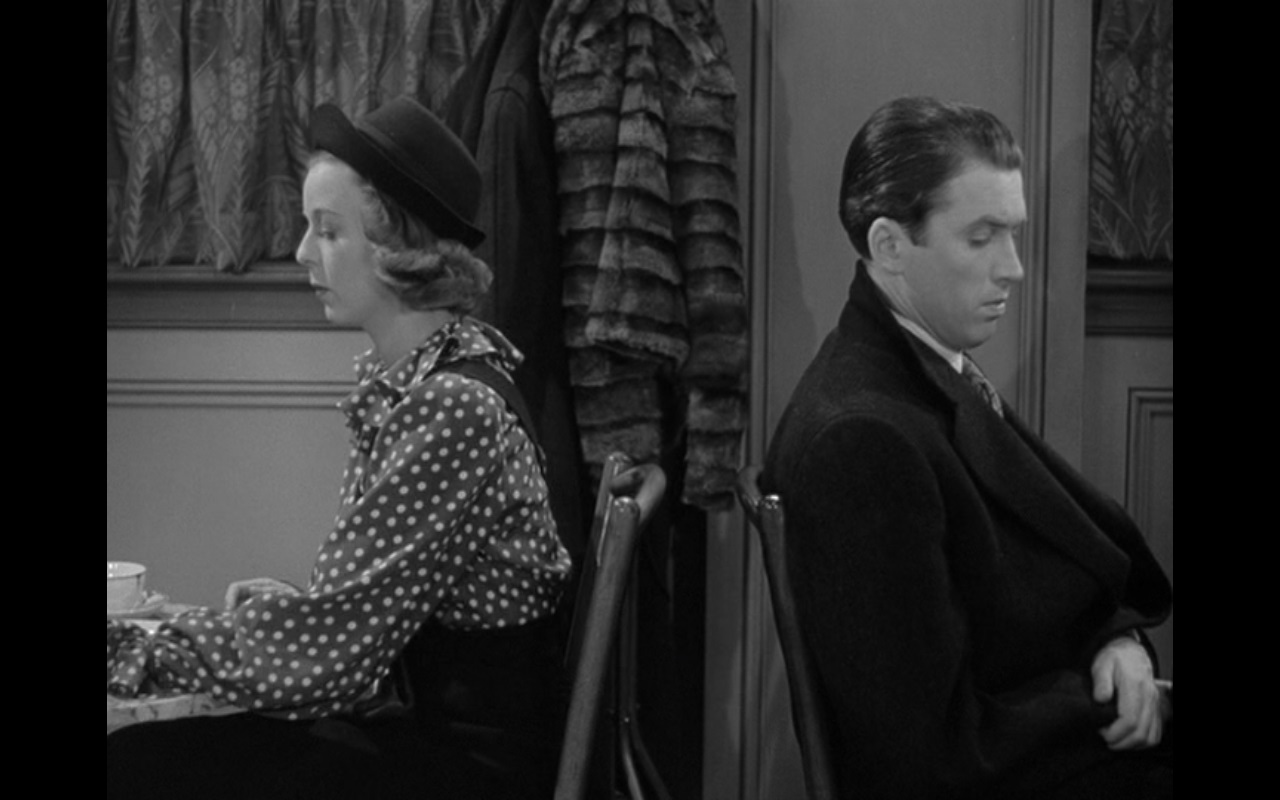
Margaret Sullavan and James Stewart in The Shop Around The Corner (exactly a zillion times better than You’ve Got Mail)
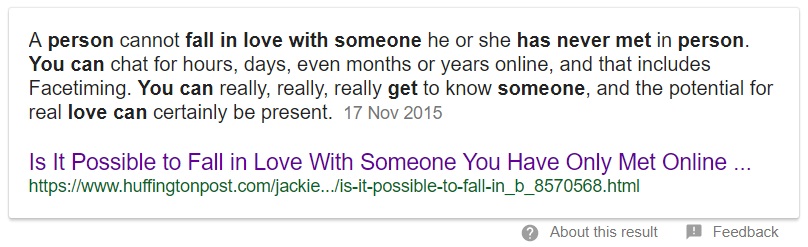
Can you love someone you’ve never met? Search engine says no:
A trawl of the net suggests this is the majority view. Human beings, after all, engage with the world and each other via their senses: sight, sound, touch, taste, smell (and at least four others, according to my QI Book of General Ignorance). All entail close proximity.
Besides, the internet is groaning with stories of how “I fell in love online but then we met in real life and he turned out to be 90/a ring-tailed lemur/a twat”. Love can only be real if you can be certain that the person is real, right?
Why, then, do literature and film offer so many tales of incorporeal love? Les Liaisons Dangereuses is a series of seductions by letter; ditto Rousseau’s La Nouvelle Héloïse. In Cyrano de Bergerac, Roxane is won over by the words of Cyrano (delivered by the oafish mouth of Christian). In Miklós László’s 1937 play Illatszertár – better known to most in the form of the 1940 Sullavan/Stewart romcom The Shop Around The Corner and the DEAR GOD WHY 1998 Hanks/Ryan remake, You’ve Got Mail – George and Amalia, two feuding employees in a Budapest gift shop, are each engaged in a romantic correspondence with a stranger. The twist, of course, is that they’re pen-fucking each other.
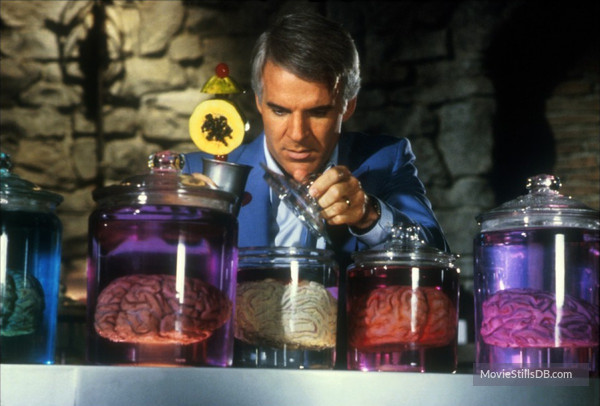
Steve Martin lusts after a cerebellum in a jar in The Man With Two Brains. Joaquin Phoenix goes all googly for a virtual assistant in Her (which I don’t quite buy, because while the idea of a woman who obeys your every whim and never complains is vaguely appealing, the idea of a partner who knows everything is not). And Beauty and the Beast and the Frog Prince are just two of countless fairy tales dealing with people falling for the intangible essence of a person rather than their physical self.
These are all fictions, but they are fictions that resonate, because we like to think that, deep down, we’re not shallow, and that we can love a person for their soul rather than their superficial, transient features.
In any case, it’s not as if remote romancin’ is a new phenomenon in the real world. Thanks to the social taboos around spending time alone with unmarried members of the opposite sex, love letters formed the greater part of the courtship process for centuries. Mozart and Constanza Weber, John Keats and Fanny Brawne, and Robert and Elizabeth Barrett Browning are just three of the more famous examples of loves forged or fortified in ink.
People have been holding torches for faraway souls – royalty, soldiers, actors, writers, Tannoy announcers – for as long as they’ve had imaginations, and the absent can get to you just as effectively as the present. This poor woman was so deeply affected by someone she met online that she ended up being prescribed the anti-anxiety drug Ativan.
***
The secret to this spooky action at a distance, of course, is humanity’s tour de force: language. With words, you can create a representation of yourself that is not confined to one point in space or time.
Some scoff at the idea that Russian- or Robert Mercer-sponsored Twitterbots and targeted Facebook ads might have influenced the EU referendum result and Donald Trump’s victory. To them, I mention only that half the human race still allow their every waking moment to be governed by diktats set down in books written 2,000 and 1,400 years ago.
Words are the clothes we wear in unreality. You don’t (often) get to make them, but you get to choose them, and how to combine them, and the “richer” you are, the wider the options open to you. With time, a spellcheck, maybe even a friend’s judicious eye, you can step out into the virtual world as if fresh from a Gok Wan makeover.
As the very existence of the field of forensic linguistics proves, your use of language is as unique to you as your fingerprint (assuming you’re not a copy-and-pasting Brexit fanatic). Your language reveals everything important about you: your values, your interests, your sense of humour, your level of education, and usually, despite your best efforts at airbrushing, your attitude to the world.
And it was precisely the discovery that others shared my values and humour that, over the last few months, brought together one of the most cherished groups of people I’ve been part of.
Me and ma buds, hangin’
For me, it’s been the sole silver lining to Brexit. After bonding on Twitter over the inanities of the far right, a few of us started a chat with a view to meeting up at the March for Europe in London in March 2017. Only a handful made it, and we didn’t actually hang out for that long, but the chat chuntered on, and slowly, as we found more like-minded souls, we added them. Boys and girls, straight and bi, from Manchester to South Africa to Moscow, liberal and anti-fascist, mostly of a similar age (with me as extreme outlier).
There have been six or seven meet-ups now. Drinks on general election night were followed by an Ethiopian meal, then a canalboat cruise, then an eggs benedict sleepover. Geographical distribution means I haven’t met them all yet, but I’ve checked off about half the group in six months.
But like I said, screw the real-world stuff. Mostly we talk shit. We share pictures and jokes and tweets that we love, as most groups do, but we also flirt, sympathise, praise, share intelligence on Nazis, and sometimes get wasted and stay up all night playing Twitter Countdown. Oh, and because we’re all snowflakes that melt at any temperature above -272C, the slightest ill-considered comment can send any of us hurtling out of the group, only to return after three days or so of grovelling and cajoling.
In what’s been an exceptionally difficult year for me, thanks to some serious health problems, the Tits have been an endless source of support, fascination and joy (and grief, but nothing comes without a price). Less spooky action at a distance, more strong nuclear force.
***
The argument that virtual interactions are plainly inferior to real weakens with every passing day. The ability to share pictures, audio and video has already narrowed the perceptual distance between us, and as the functionality of social media is slowly engineered to replicate real-world interaction (Facebook and Twitter likes are nods and smiles; retweets and shares are laughs; gifs, I guess, are goofy facial expressions), so our online and real-world experiences fall into ever closer step.
You can’t entirely trust those visual and auditory signals, of course – catfishing is a real problem – and you still don’t get any hormonal chemistry online, one of the principal components of attraction.
Well, not directly. Recent studies have shown that getting likes and retweets from an online crush can cause a similar spike in the “love hormone” to that caused by physical contact. How fucked up is that? A little character appears on your phone, as a result of someone you’ve never met typing something into their phone a thousand miles away, and causes an actual chemical change in your brain! People can change your mood, and your mind, and your heart, from afar.
Then of course there are the aspects of remote relationships that are superior to their physical equivalents. Objectivity. Disinhibition. Novelty. The thrill of the not-quite-known.
In fact, if I ruled the world, I might insist that all future human relationships be conducted on a virtual basis. Because based on my record, I’m better off keeping the flesh well out of it. I might have a shot at charming your pants off from 500 paces, but move me 499 paces closer and chances are I’ll just soil my own.
People are, after all, just an idea, even when they’re in your arms. Sure, your proximate senses give you a firmer grip on that idea, but ultimately, you have no way of knowing for sure whether they are real, whether the sensations in your fingertips haven’t just been planted there by some malign entity. You might be living in the Matrix.
Meanings change fast. We use the word “virtual” these days in opposition to the word “real”, forgetting that until very recently its only sense was “almost or nearly as described”, ie pretty much as good as the real thing. I’d argue that before long, its semantics might morph again, so that it comes to mean “better than the real thing”.
“Hold up, Bodle!” you cry, smirking. “This is all very well, but you’ve missed out one crucial element. If you never meet someone, you can’t have sex with them.”
The dwindling band of Brexit zealots are demanding that Remain voters stop ‘talking the UK down’ and get behind them. But do they mean it?
Reader, he married him.
It hasn’t all been doom and gloom since June 23rd 2016. For one thing, I’ve made some amazing new friends. But just as importantly, I’ve grown as a person. Thanks to hundreds of calm, rational and unfailingly polite debates with Brexit voters, I’ve learned more about the EU, economics, history, logic, and the valid concerns of my fellow countrymen than ever would have been the case had the UK chosen to remain.
Just my little drollery. The truth, of course, is that I’ve had a handful of vaguely enlightening discussions with Brexiters, but that the majority have gone one of two ways:
2) I post witty observation about Brexit; Brexiter screams blue murder at me; slanging match; block.
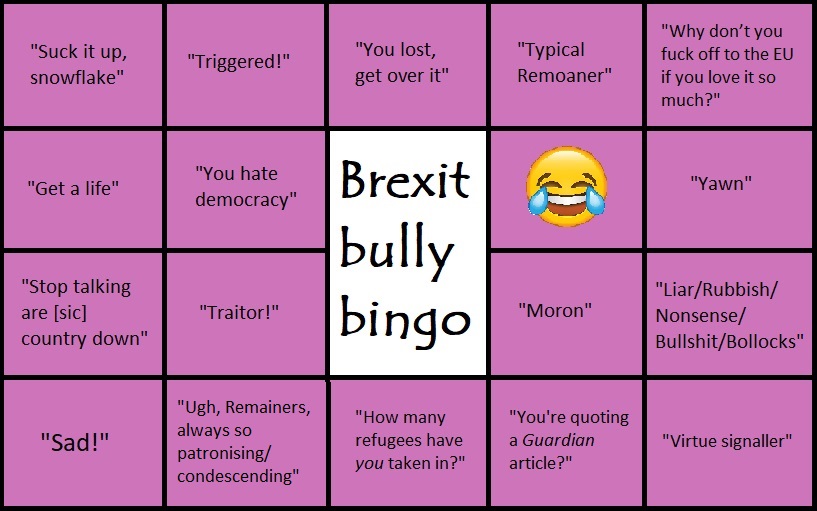
At a rough guess, in 21 months, I’d say the sentiments below, or some variation thereon, have made up 75%-80% of all the replies I’ve had from Brexit voters and supporters of the far right.
“Philistinism implies not only a collection of stock ideas, but also the use of set phrases, cliches, banalities expressed in faded words. A true philistine has nothing but these trivial ideas, of which he entirely consists” – Vladimir Nabokov
At first, I thought this was a silencing tactic – a bid to bully Remainers into accepting defeat and starting to help plan the UK’s future. After all, these jibes were, in the early stages, interspersed with cries of “Get behind Brexit!”
But something felt … off. Crowing and sneering aren’t traditionally the most effective ways of building consensus. Who among us, when taunted by the school bully, didn’t immediately go home and plot grisly revenge?
In my case, at least, these tired, incoherent, unimaginative slurs (the fact that they can’t be bothered to think of any new ones a year and a half on is insulting in itself), in both their tone and content, have had the opposite effect to the one ostensibly intended.
When I voted in the referendum, I was maybe 80/20 in favour of the EU (in part because some of the tabloid lies, like the “bloated bureaucracy” and “accounts not signed off” had penetrated even my critical faculties). But my pro-Remain position has hardened with every passing day; partly because every bit of research I’ve done has either vaporised an old EU myth or turned up yet another advantage of membership, but mostly because of the winners’ jeering and gloating. As of January 9 2018, you couldn’t detect any doubt in me about the rightness of my vote in the Large Hadron Collider.
If they really wanted to get us on side, surely the Brexiters would be using more conciliatory language? Something like, “Hey, look, Leave won. Sorry, let’s make the best of it”, or “Great match. Tough luck. Now, any suggestions as to what we do next?” But no; the majority persist with their playground taunts, using language (and emoji) specifically designed to alienate, to inflame, to enrage.
I usually divide Brexit trolls into three tribes. They’re not always easy to tell apart, and there’s overlap, but they are distinct breeds. (NB these archetypes are not intended to encompass all Brexit voters – just the annoying, inarticulate, abusive ones.)
1) Kevin
The good old-fashioned troll, the internet original, what we might once have called an imp, contrarian, or Devil’s advocate. A sad individual, deeply bitter about something – usually a glaring disparity between demand and supply of sex – and among the most likely to suit up and shoot up a school. Depending on his level of commitment, he can actually be halfway inventive in his use of language, and have done at least some superficial research on the subject at hand.
2) Drone
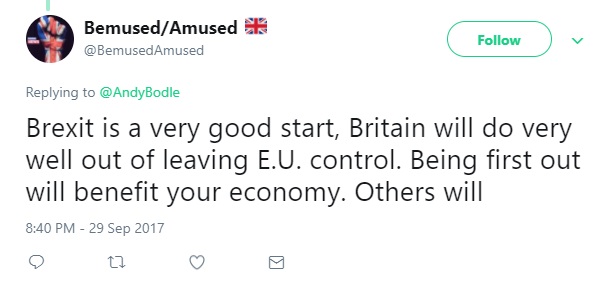
The paid troll; the Skopje/St Petersburg teenager with an iffy grasp of English idioms who sometimes forgets to turn off his location. Spreading disinformation, stoking dissent and generally increasing unhappiness in the west is his day job, but since it only pays about 250 roubles an hour, he’s not that committed.
Oopsie, Aleksandr. Why would a “UK patriot” be talking about “your economy”?
3) Gammonite
Finally, we have the hardcore Brexiteer, whose ferocious antipathy towards all things forrin and anything resembling a fact render him firmly committed, no matter what, to eating only produce grown in the British Isles, picked by British hands, and delivered by British McDonald’s employees (the white ones, natch).
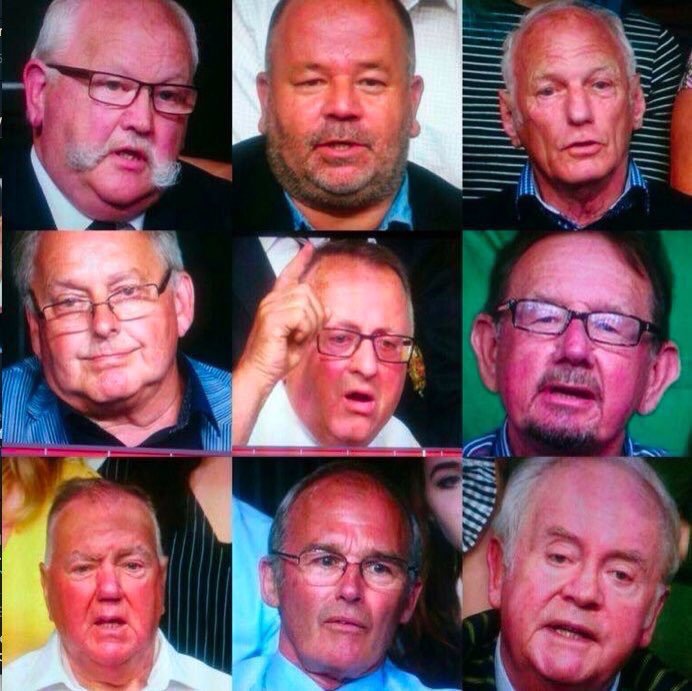
For the Gammonite (from the nickname for the pink and sweaty old racists who make up the average audience on the BBC’s Question Time – the Wall of Gammon), nothing less than an adamantium Brexit will do. After all, Britain is so fucking amazing (in spite of containing 48% Remainers, enemy-of-the-people judges, luvvies, students, women, gays, trans people, Labour voters, Green voters, Liberal Democrat voters, liberals, scroungers, immigrants, the BBC, the Guardian, vegetarians and disabled people), it doesn’t need to trade even on WTO terms. WE’LL TRADE ON OUR TERMS, OR YOU WILL SUCCUMB TO THE CANNONS OF HMS VICTORY, FORRINER!
I know – at least, I hope – that there are some Brexit voters out there who genuinely want us all to put our differences behind us and start working together on a new vision for the UK. (If you’re reading: hard pass here. Sort your own mess out.) But you really don’t hear a lot out of this group, if they exist. The most vocal, surviving exponents of Brexit only seem interested in mocking, shocking, and blocking.
And I’ve just figured out why. It doesn’t matter which of the three tribes you’re dealing with: none of them actually wants us to “get over it”. For their various reasons, they all want us to carry on moaning till the day we – or more likely they – die.
The first two groups’ motivations are obvious. Kevin’s sole raison d’etre is to cause and enjoy pain in others. If Brexit is cancelled, he’ll probably just switch sides and start taunting the defeated Brexiters.
The drones have no more interest in ending hostilities. Their function is to sow division, to widen the cracks in western society. Of course they want the conflict to continue. The prospect of the UK suddenly coming together, holding hands and vowing to make a success of Brexit is their worst nightmare (well, second worst, after Brexit being cancelled).
But what about the Gammonites, the dwindling band of Brexit zealots who would rather eat a hundredweight of horseshit than learn a word of French? What do they have to gain from prolonging the fighting?
These are, it would seem, people with precious little experience of success. They tend to be older, balder, and unhappier than most; they didn’t go to university, they married someone they didn’t like, if they married at all, and they haven’t travelled extensively or otherwise ticked any boxes on their bucket list. So, in the first place, they want to wring every last possible drop of joy from this rare thing in their lives: a victory.
Moreover, Brexit for them is a victory without a trophy. It has brought them nothing concrete, so far, barring more expensive holidays and 10% on their monthly food bills. And you can’t exactly flaunt that to the grandkids. Yeah, so in a few months’ time they’ll have some shiny blue passports, and maybe even some stamps, to help them jubilate. But in the meantime?
Sad tweets by liberals and students! OK, they’re not tangible, as such – Schadenfreude is no Jules Rimet trophy – but you can, in a pinch, print them out and wank joylessly over them.
(The most remarkable moment of Trump’s presidency win in the US for me was not the win itself, but his supporters’ chosen manner of celebration. No one seemed excited about the sunlit uplands that would magically materialise under Donnie’s rule; all that mattered to them was … liberal tears. It wasn’t the victory in itself that was important; it was their perceived enemy’s defeat.)
(Don’t click on that link. It’s Infowars. It’s just there as a sop to journalistic rigour.)
Finally, I think, despite their bullish idealism, most Brexiters know, deep down, that their victory is as empty as a Ukip youth rally. The referendum was their first taste of success; but if Brexit is pursued to its logical conclusion, it’s likely to be the last success that any of us, barring a handful of non-dom billionaire disaster capitalists, enjoys for at least a generation.
The reason they’re still doing a victory lap 19 months after winning a trophy made of shit in a rigged three-legged race is simple: they know, as soon as they stop, two of those legs will be chopped off.
Well, trolls, I have excellent news for you. We Remainers have no intention of moving on, or getting it over it. We won’t stop “crying” or “moaning” or pointing out the flaws in your risible attempts at a plan until Brexit is reversed, and we have our tolerant, open, compassionate, brave country back.
Middle-class wanker moves out of city, genuinely believes this will be of interest to others
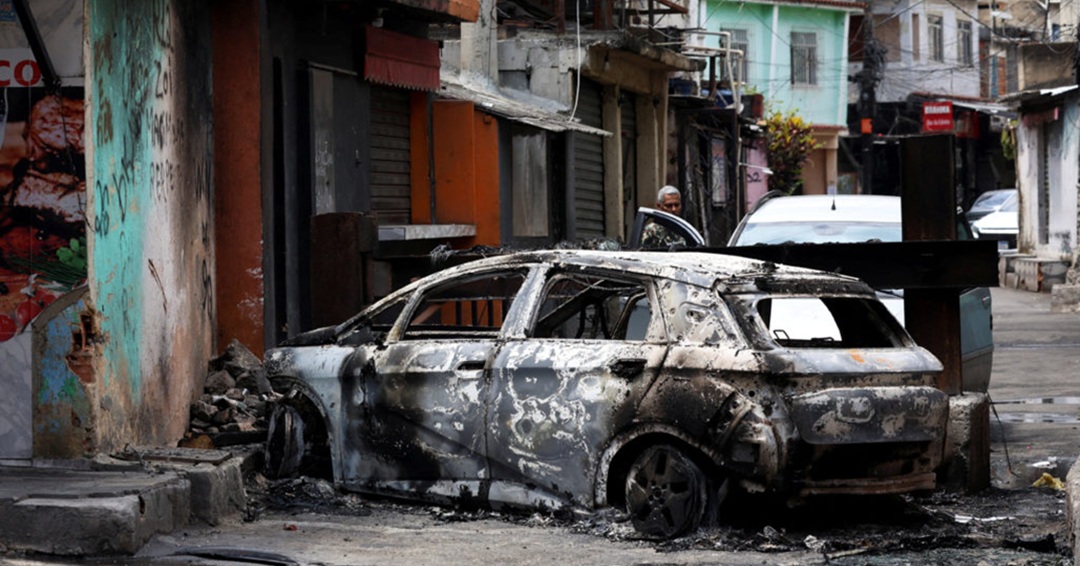
London, 2026. Well. So the disinfo bots would have you believe. It’s actually from the favela do Penha in Rio, Brazil, 2025. Photograph: Aline Massuca/Reuters
Joy. Another white, middle-aged, middle-class, middlebrow media wanker unaccountably convinced that the mundane minutiae of his life will somehow be fascinating to anyone outside his family, as if 6,000 people didn’t move house in the UK every day.
Another smugly self-deprecating, unedifying example of the “lifestyle journalism” that is to Woodward and Bernstein what potato prints are to Picasso. Another irreverent, irrelevant addition to the weekend magazine hall of lame that also brought you The Pavements Near Our House Aren’t Wide Enough For Our IVF Triplets’ Stroller, Our Cleaner’s Retirement Has Halved Our Number Of Black Friends, and I Boiled My Wooden Spoons (hey, why rack your brains dreaming up columns of eye-watering banality when Adrian Chiles exists?).
Since I am indeed a white middle-class media wanker, there will inevitably be an element of that. The difference here is that I’m not publishing this with a view to dazzling all and sundry with my whimsical observations on the trivial tribulations of my otherwise immaculate life, but (hopefully) to throw some light on a topical issue.
Because there is a small but extremely vocal group of people out there who (should they, uncharacteristically, be seized by the desire to read something longer than a meme) will be breathlessly scrolling down this page hoping to find a motive for my move something like the following:
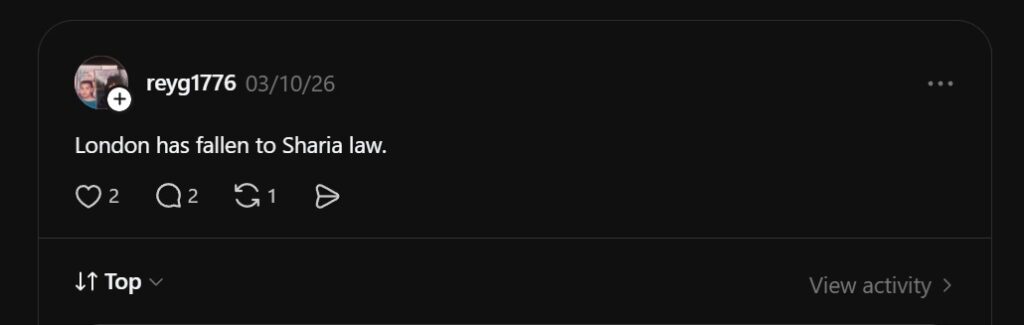
I’m leaving London … because London has fallen.
Yes, the once great capital of this once great nation, a thousand years proudly uninvaded, has finally succumbed to the howling Muslim hordes and the legions of Quisling woke warriors who gave them covering fire.
After a final brutal assault at Waterloo, despite the sterling rearguard action of the regiments of Beefeaters, black cab drivers, pearly kings and queens, estate agents and tour guides, and for all the noble sacrifices of field commanders Nigel Farage and Tommy Robinson, leading fearlessly, as ever, from the front, the capital of the United Kingdom is now in enemy hands.
And, since former mayor, now caliph, Sadiq Khan, hoisted the crescent-and-star over Buckingham Palace, change has blown across the city like the sirocco.
Sharia law has been rolled out across No-Go Zones 1-6; the Tower of London has been fitted with a dome and renamed the London Minaret; Seven Sisters has become Seven Sleepers; West Ham has been declared haram; and the Emirates Stadium is, well, an emirate.
No words could more trenchantly convey the sense of loss than this ballad from our beloved war poet:
The Warning By A B dP Johnson I warned you. I said, “Stop the boats! Keep Winston on our five-pound notes!” And now our bowler-hatted workers Have swapped their bowler hats for burkas.
One could instantly disprove this nonsense, of course, by asking any of London’s 9 million residents, 2 million daily commuters or 35 million annual tourists instead of blindly accepting the word of an anonymous Facebook account. Only one of the throng who’ve inflicted their relocation woes upon us mentioned the Islamisation of London even in passing (prize for guessing where that was published: a six-month subscription to the Spectator), and it certainly had nothing to do with my decision.
But the fact that the forces of darkness have now persevered with their absurd disinformation campaign for several years suggests they think it’s cutting through.
The inconvenient facts are as follows. In the 2021 census, 41% of Londoners identified as Christian, down from 58% in 2001 (a change that mirrored the picture across the country), while 15% gave their religion as Islam, up from 8.5% in 2001.
I lived in two of the areas of London with the highest concentration of Muslims – Harrow and King’s Cross – for a total of 17 years, and not once was I menaced or warned off entering a street or charged the jizya tax. The only people who ever tried to convert me to their ways were a pair of Jehovah’s Witnesses and a slightly inebriated West End actor in the back of a cab.
But if the Great Replacement is still some way off, why are so many people – and more importantly, me – defecting to the Countryside Alliance? In 2022 alone, it’s estimated that 125,000 people forfeited their city slicker status (although that probably had a lot to do with Covid, and about 66,000 others made the opposite journey).
I thought my own move might be an opportunity to examine whether some of the many preconceptions about London are still, or were ever, true.
It’s not safe
The “Londonistan” posts are often found in close proximity to another trope, this one more effective for having some basis in truth. Bots and far-right fearmongers often portray the city as a giant, lawless favela, a jungle of shattered glass and graffitied concrete whose streets, piled high with burning tyres and syringes, are patrolled by gangs of machete-wielding rapist crack dealers while the Metropolitan police dance for tourist photos. It’s a tableau particularly beloved of the Daily Mail (headquartered in Kensington, London), the Daily Telegraph (Victoria, London), the Daily Express (Canary Wharf, London) and more recently GB News (Paddington, London).
Unarguably, for much of its history, London has had its dangers. But times change. While one or two of the other City quitters did mention safety fears in their reasons for leaving, none reported anything more traumatic than having their bag nicked. Personally, I was a victim of crime exactly once in 30 years (randomly headbutted in a pub by an ex-marine with PTSD).
And the statistics bear us out. London’s murder rate, having fallen consistently for years, now stands at 1.07 per 100,000 people, one-fifth of the rate for the US as a whole. It’s a similar story for other serious offences: in the 12 months to March 2025, the rate of violent crime with injury in London was 26.40 per 1,000 population, well below the UK average of 31.88.
London does comfortably top the national rankings on theft, but this is almost all attributable to a huge recent spike in mobile phone snatching from tourists outside tube stations that seems to be the work of a few highly organised gangs (there’s a useful list of hotspots here).
And while rural drivers are more likely to stop to let pedestrians cross (sometimes even when there’s no crossing), they’re also more likely to run them over. About 100 people are killed on London’s roads each year, which works out at half the national fatality rate.
It’s so grim
I’ll admit it: the air around my new home is sweeter than it was in King’s Cross. The walks are more scenic and hygienic, the local waterways are a slightly lighter shade of brown, and the Northern lights are a definite improvement on 737 landing lights.
But these were all incidental bonuses rather than the primary pull factor, because, frankly, London’s much less grey and greasy than it used to be.
No city is without its less salubrious districts. But one of the remarkable things about London is its capacity for renewal. In my 30 years there, dozens of areas were transformed from uninhabitable to unaffordable in a matter of years: the gentrification of Islington was almost complete when I arrived in the early 90s, and was soon followed by Hackney, Brixton, Shoreditch, Walthamstow and New Cross.
Weatherwise, too, London’s reputation is undeserved. Its average rainfall of 550mm a year makes it drier than Toulouse, Bordeaux, Vienna, Lisbon, Monaco, Florence and Istanbul. Temperatures rarely dip below freezing, and it’s one of the UK’s brightest cities, getting more sunshine than Brussels and Berlin.
With 8 million trees and 3,000 parks, London also has plenty for the chlorophyllophile. While its tapwater is some way down the national league tables, it’s quite safe to drink. And it’s really time it shook off the old Big Smoke moniker, given the huge improvements in air quality courtesy of initiatives largely implemented by Sadiq Khan: LEZ, ULEZ and Low-Traffic Neighbourhood schemes, the School Streets Initiative, Clean Air Zones, the Healthy Streets planning framework, the provision of more protected cycling space, the rollout of electric vehicle charging points, zero-exhaust buses and zero-emission-capable taxis, the Air Quality Fund and anti-engine-idling awareness campaigns. (Many of which schemes were, needless to say, vociferously opposed by the same entities who slag off London today.)
People are part of the environment too, and the picture there is more mixed. While London is far and away the wealthiest area of the UK, with dozens of billionaires and around 200,000 millionaires, it’s also home to some of the worst poverty. Unemployment stands at 7%, two percentage points above the national average. Six per cent of residents are on benefits, as compared with 4% across the UK. Twenty-six per cent of Londoners are below the poverty line, the highest proportion in the country, and 200,000 people were reckoned to be without a permanent home in 2025, 12,000 of whom slept rough.
The sporadic pangs of guilt aren’t pleasant, but let’s be real: no one ever ran to the hills because of someone else’s misfortune.
It’s so pricey
One’s own misfortune, of course, is a different matter, and several middle-class wankers brought up the money thing. (It should be noted in passing that if London had truly fallen to invaders, then rents and prices would presumably have fallen commensurately, which plainly is not the case.)
Retail prices aren’t the problem. If rent is excluded, the cost of living in the big city is only about 25% higher than in the rest of the country, a difference handily covered by London salary weightings (the median is £10,000 above the UK average).
The key phrase here is “if rent is excluded”. Londoners have to shell out 40% of their monthly income on accommodation, compared with 30% nationally, and it’s getting worse, fast. Shortly before I left, my landlord raised the rent on my mouldy shoebox in Harrow by 12%, citing market rates. (By “market rates”, of course, he meant he was raising the rent not because he had to, but because he could; because he could rake in more money for no additional investment or work.)
Yes, being able to fully open my oven door without it banging into the washing machine in my new abode is a nice bonus. But it still wasn’t the driving force behind my departure. In a city with so much to do, I rarely needed my home to be much more than a ceiling over a bed.
It’s full of wankers
With a small town, a small city and a seaside resort on my residential CV as well as the capital, I can report that yes, Londoners may, at first glance, appear a little aloof – it’s a self-defence mechanism that kicks in in all large concentrations of people – but underneath, they’re as likely to be angels or arseholes as anyone.
It’s true, I’d learned all my neighbours’ names within an hour of moving into my new place, whereas in London all I ever found out about them next door was their favourite future-funk tunes and the average duration of their intercourse.
Similarly, in all my many hours in London cafes, no one once sat at the next table and struck up a conversation. If they had, though, they probably wouldn’t have opened with “This is a lovely little town, isn’t it? At least, it was, before all the immigrants.” (The population here is 95% white British. A few dozen asylum seekers are being housed locally, none of whom, to date, has caused a nuisance.)
The world beyond the M25 can be a bit local-shop-for-local-people. The flag density around my new abode is noticeably higher, and I share a postcode with a regional HQ for Ukip. It’s early days, but so far it really does seem that the metropolitan elites are a bit more, well, cosmopolitan.
It’s full of tourists
While Londoners generally don’t hate immigrants, because we’ve met some, there is one invasion we’re less crazy about.
Standing on the wrong side of the escalator in defiance of the clearly marked signs. Stopping at the top of the escalator to get their bearings. Barging into crowded trains at rush hour with Zeppelins strapped to their backs. Breezily ambling three abreast on the pavement, forcing anyone coming the other way to dive into the path of traffic. Demanding directions to the Harry Potter shop they’re standing outside.
Saying goodbye to London’s tourists may not have be the hardest thing I’ve done, but they were hardly grounds for evacuation.
It’s so hectic
We might now, judging by the murmurings of the other wannabe Wurzels, be nearing the nub of it. Many have written of their desire for a change of pace, a need to escape London’s relentlessness. (Although in many cases, one suspects this is code for free grandparental childcare.)
I have sympathy. Big-city buzz is all very well, but when you can’t switch it off, it starts to feel like tinnitus. And there comes a point when you realise that although you have a smorgasbord of treats on your doorstep, you just don’t smorgas much as you used to.
Even so, it wasn’t the pursuit of peace that drove me out. I did a reverse Dick Whittington once before, in my late 30s, to live with my partner in Leeds and then Devon, and in both locations, the discussion about how to fill the evening all too often took the form “Pub or DVD?”. Getting away from it all means exactly that: as well as pressure and stress and noise, you’re giving up pizzazz, razzmatazz, and all that jazz.
Please, just tell us already
Obviously, I didn’t move to pastures greener in pursuit of better employment prospects or superior retail opportunities. Nor was I drawn here by the awesome transit system. (I have overheard locals talk in hushed tones of a supernatural entity dubbed the “Omni-Bus”, a cuboidal beast standing fully three men high, which swallows its victims whole, only to regurgitate them slightly closer to their desired destination. I’ve even seen signs along the road warning of when these creatures are likely to appear. But since I’ve yet to clap eyes on one, I must assume they are an old wives’ tale.)
None of us middle-class wankers moved out of London to escape the traffic, first because public transport obviates the need for driving, and second because while snarl-ups do occur – on the all-too-regular occasions when London Underground staff go on strike – congestion levels have remained steady at 20 billion vehicle-miles per year for 30 years, despite a 40% increase in population.
And only a fool would self-rusticate in the hope of improved mobile phone reception, higher broadband speeds or the reduced chance of flooding.
That’s it. I give up. I’m going to watch a cat video instead
The truth is, no one ever moved out of London because London changed. Change is what London does. Middle-class twats are upping sticks for the sticks because wehave stopped changing. London is a place for plastic minds and elastic bodies, and once rigor mortis starts setting in, you’re no longer a good fit.
Those who know me, or who have followed the blog, will know I have a health condition that affects my strength, stamina, and, on thankfully rare occasions, continence. When I was young and fit, I barely noticed the almost total absence of public benches and public toilets in the capital. But recently, those deficiencies have become impossible to ignore.
London has its problems. Of course it does. But by my reckoning – and by just about every statistical metric – things are getting better, not worse. It’s still a fantastic city. It’s just a fantastic city with nowhere to sit and nowhere to shit.