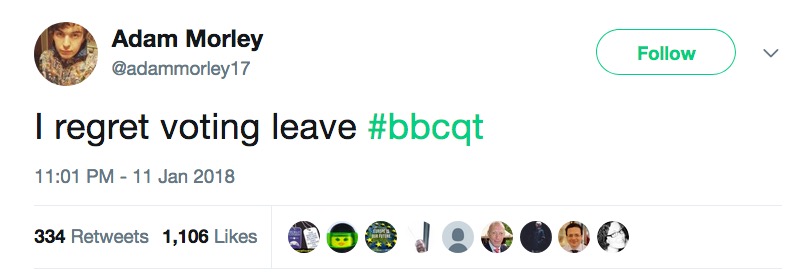
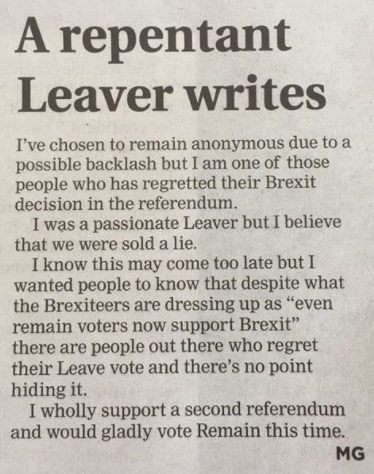
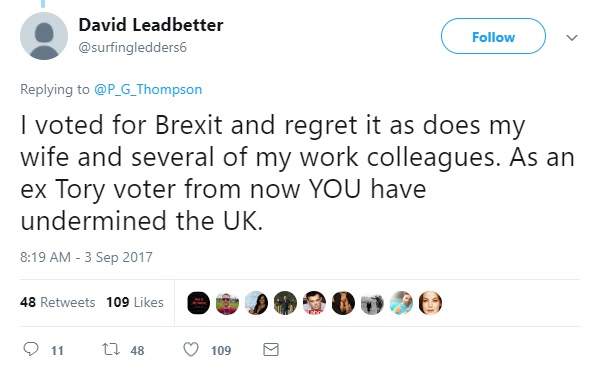
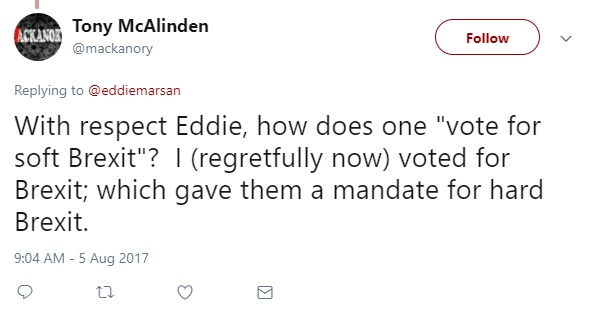
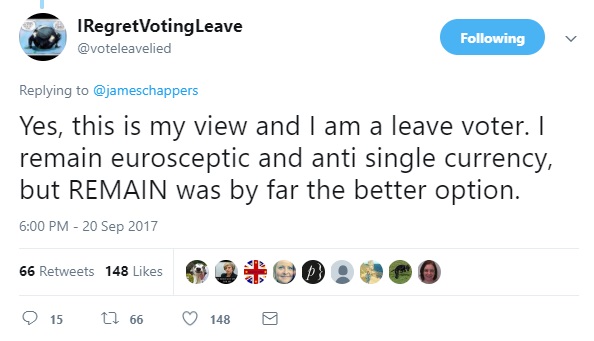
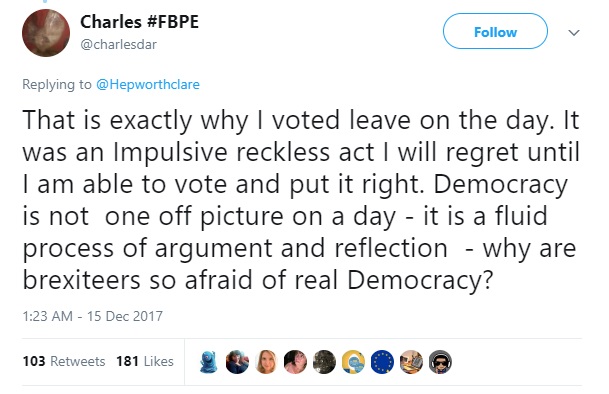
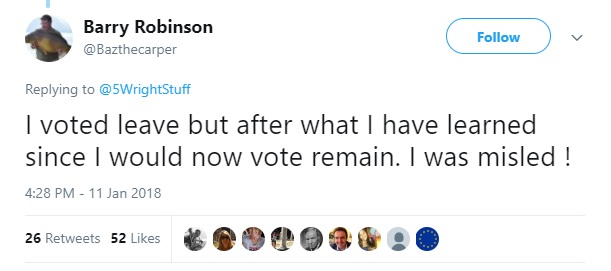
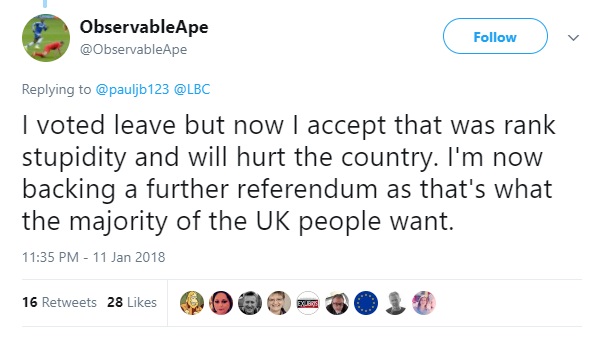
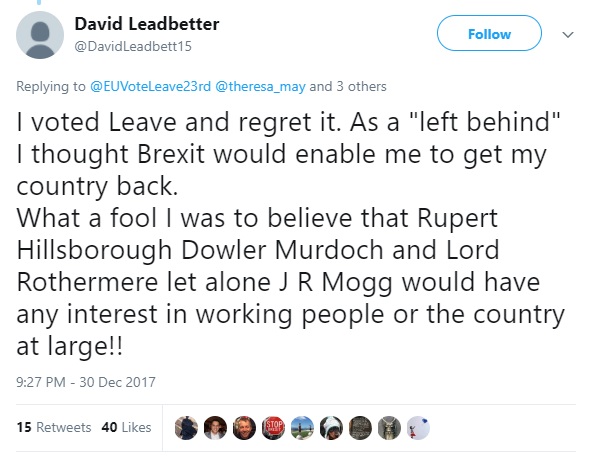
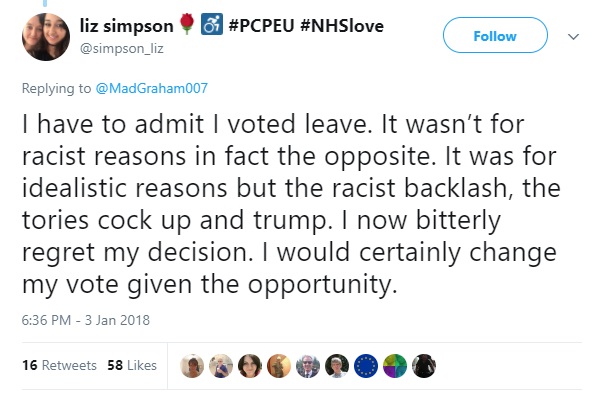
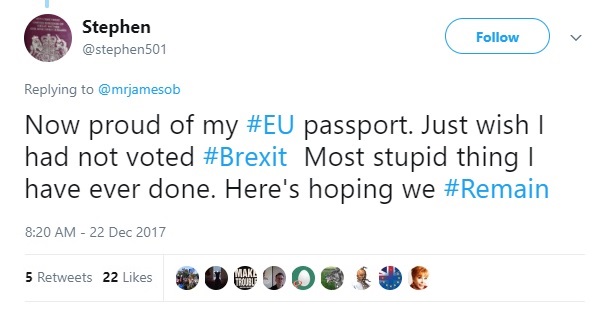
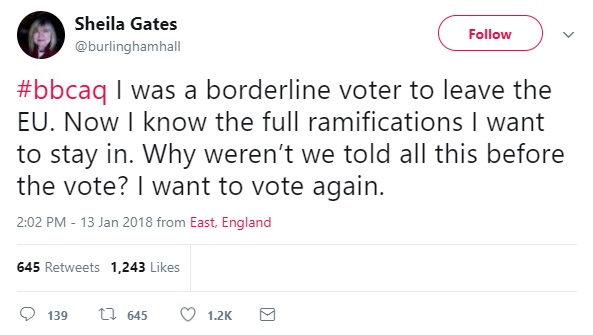
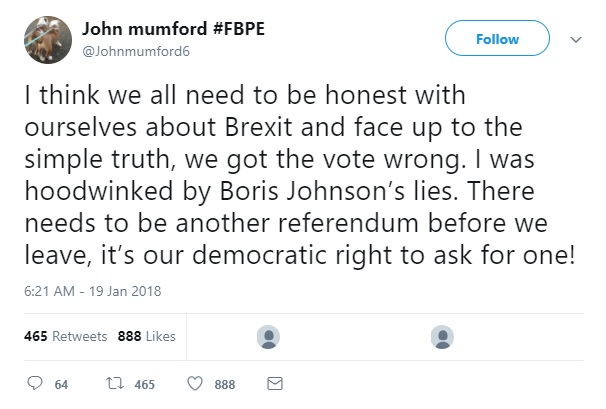
It takes courage to admit you were wrong. As Leave’s lies unravel, more and more Brexit voters – 310 and counting – are showing it
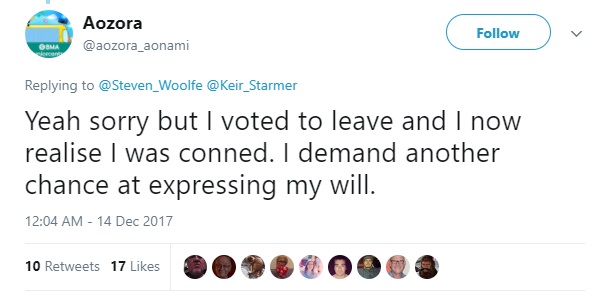
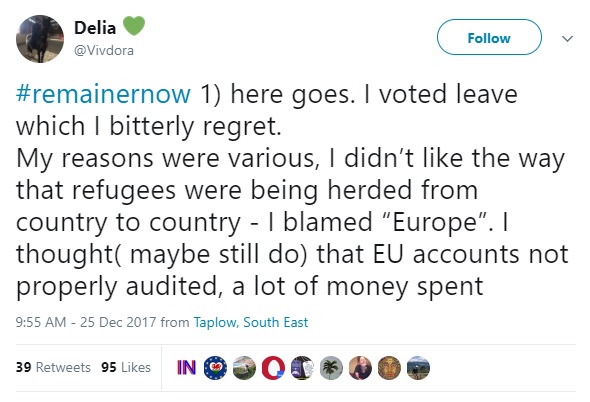
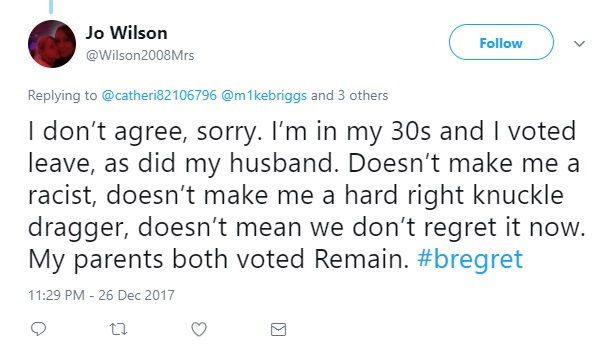
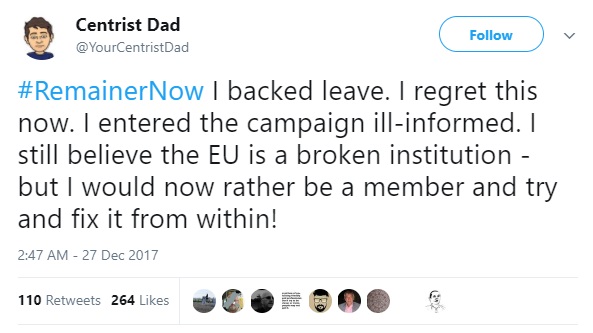
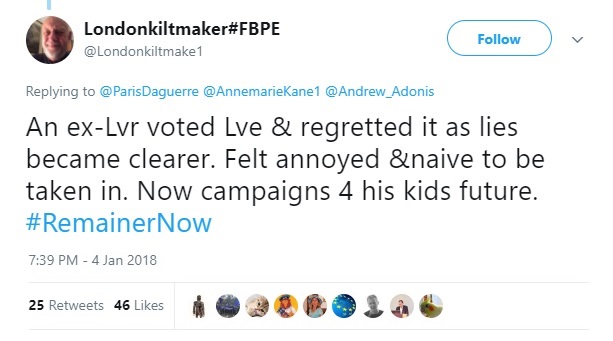
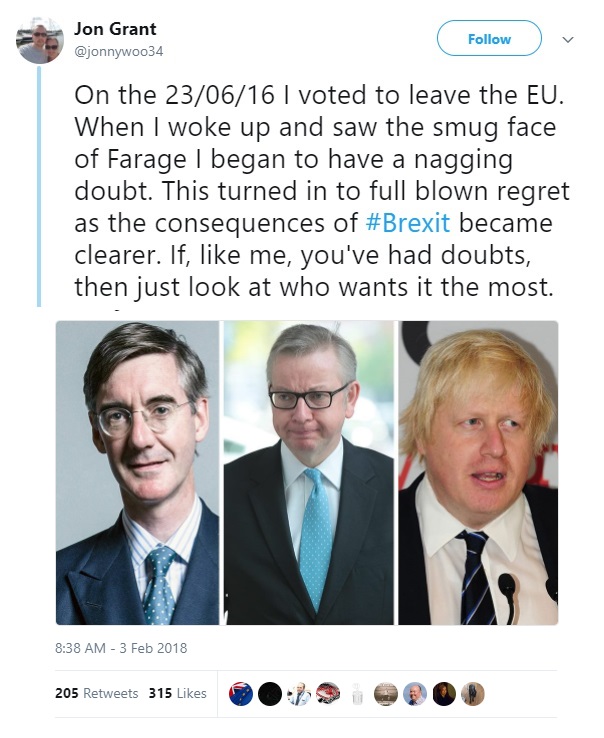
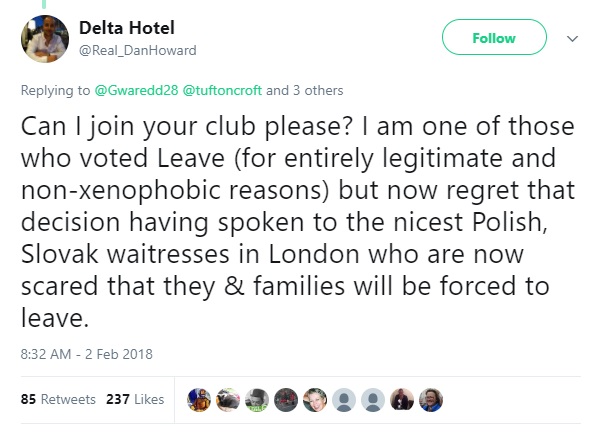
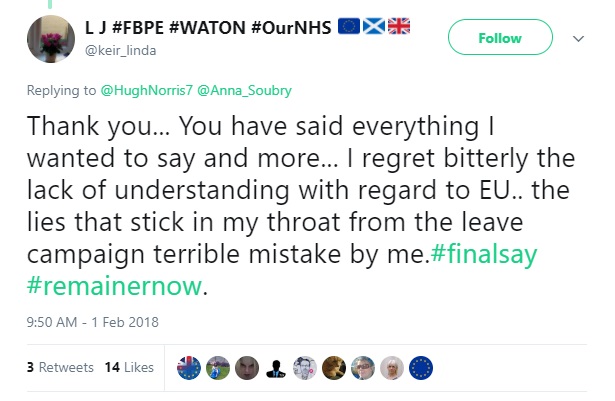
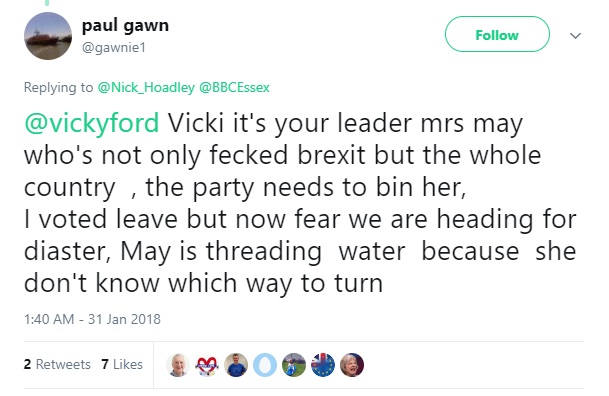
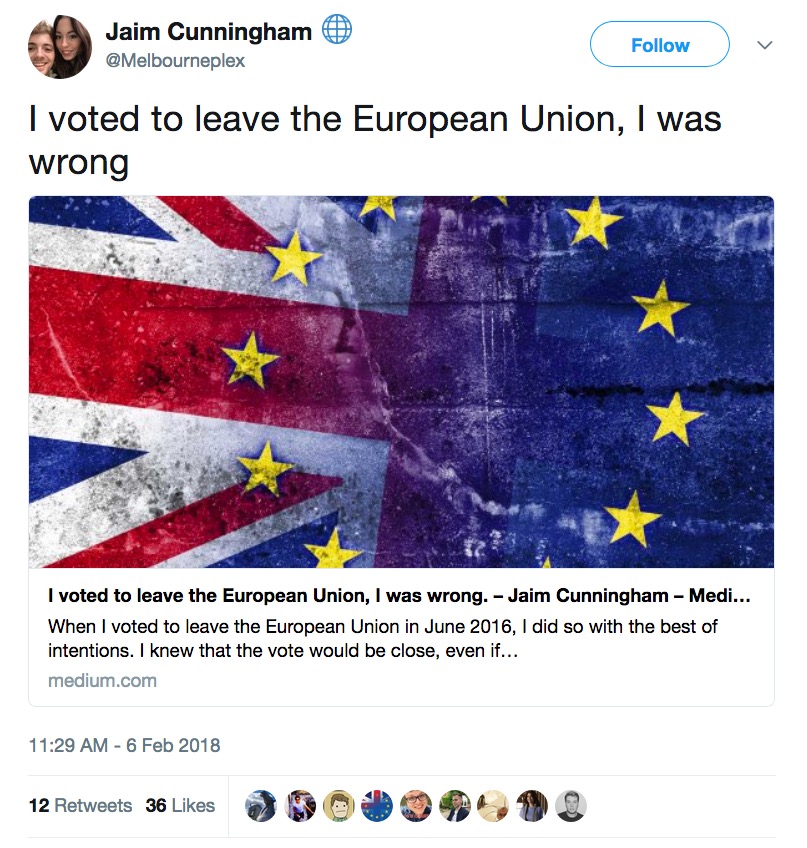
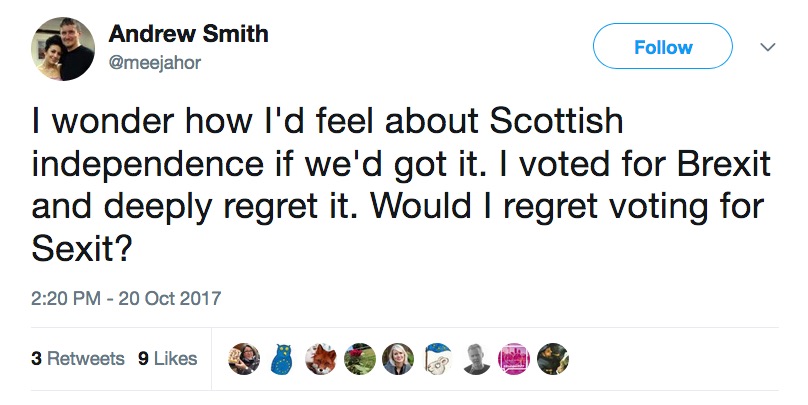
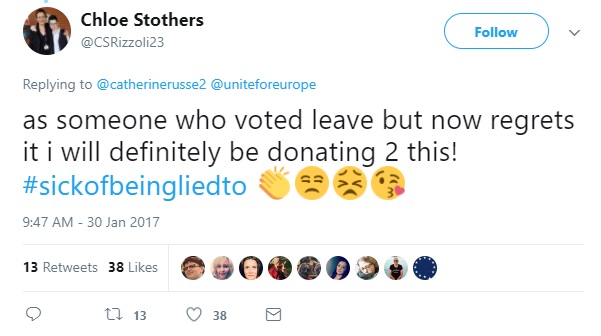
On 23rd June 2016, 17,410,742 people voted for the UK to end its 43-year membership of the European Union. They did so after a Leave campaign chock full of lies, distortions and scare tactics, many of which have been exposed as such in the days since the referendum.
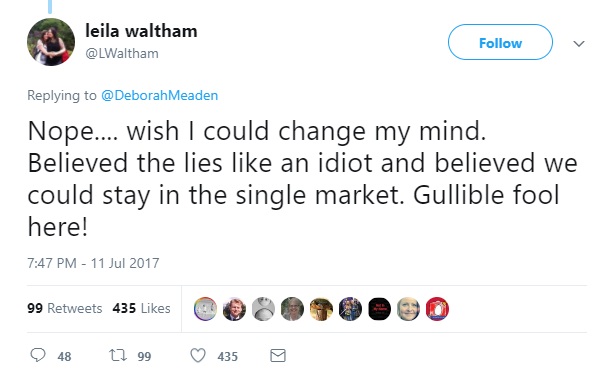
Bit harsh on yourself there, Leila – you’re far from alone. Many others have struggled with the idea that so many tabloid newspaper journalists and politicians could lie so brazenly, and so clearly contrary to the interests of the country, but it’s becoming increasingly obvious that this is what’s been happening.
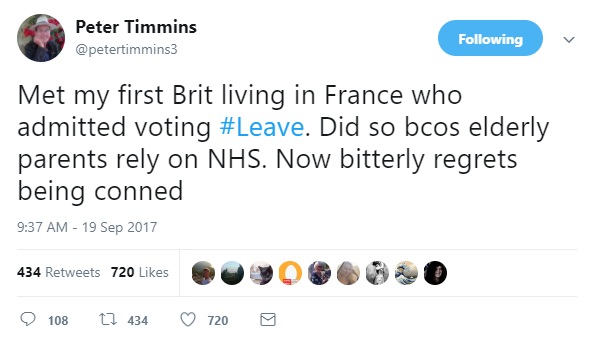
Welcome aboard the good ship Remain, Peter’s friend.
Like a reformed smoker, Michael’s now quite the virulent anti-Brexit campaigner.
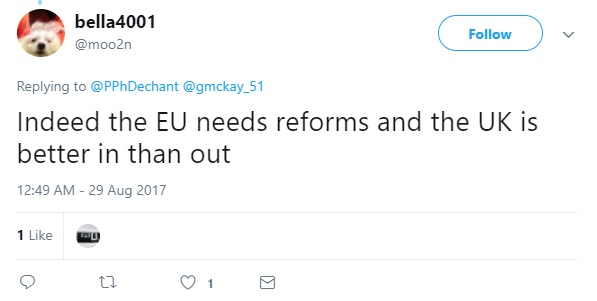
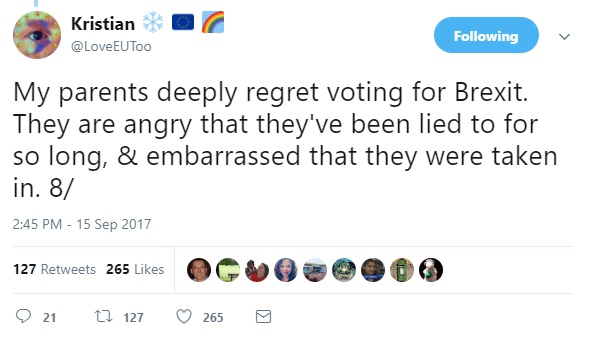
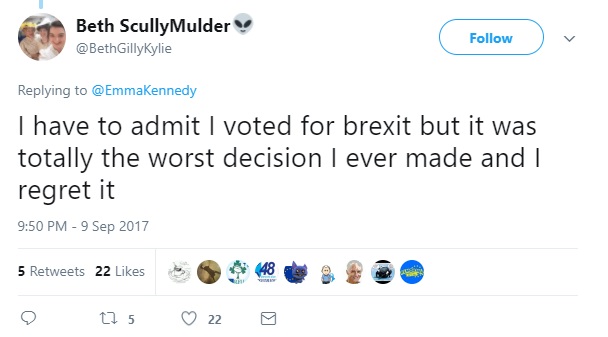
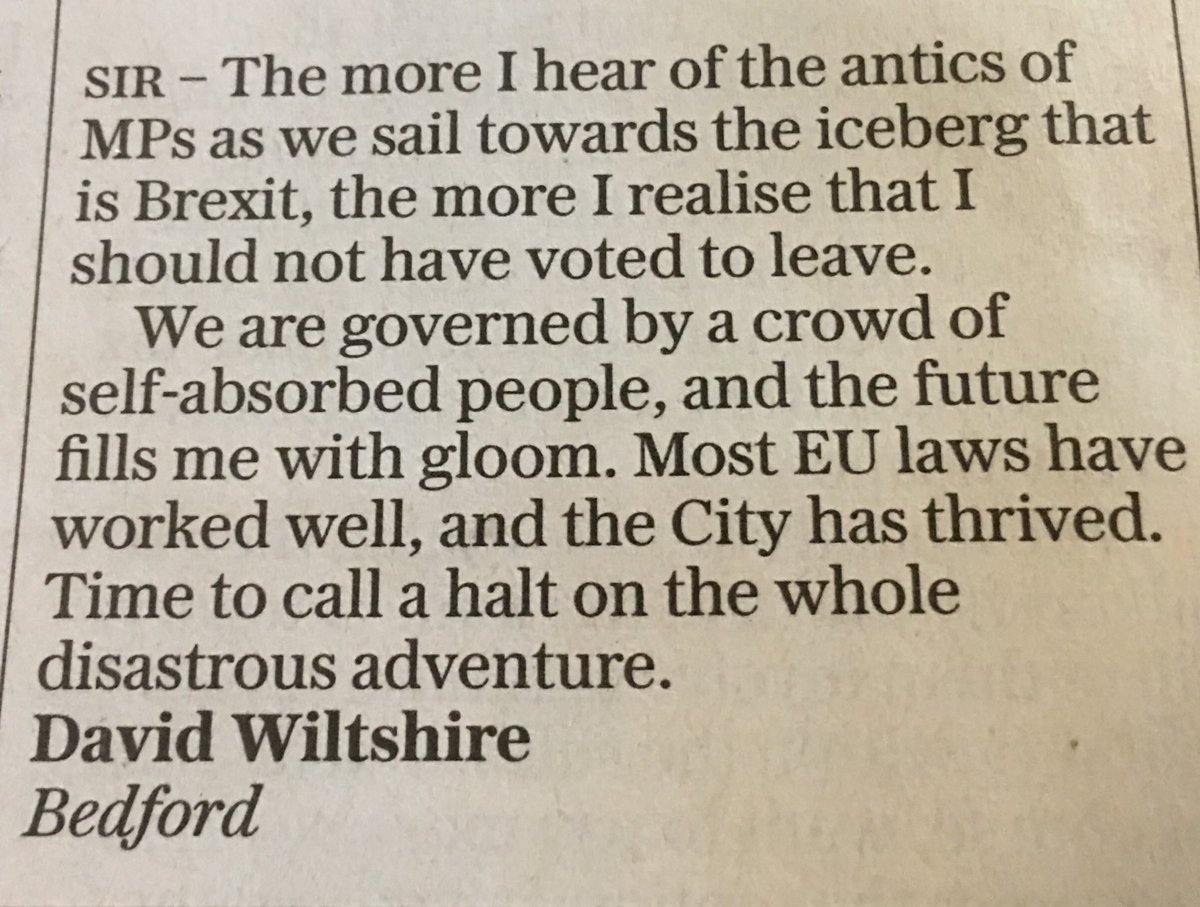
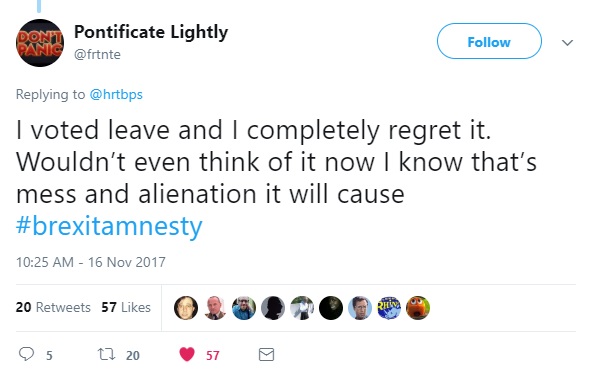
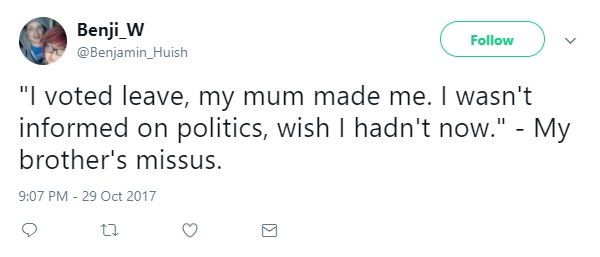
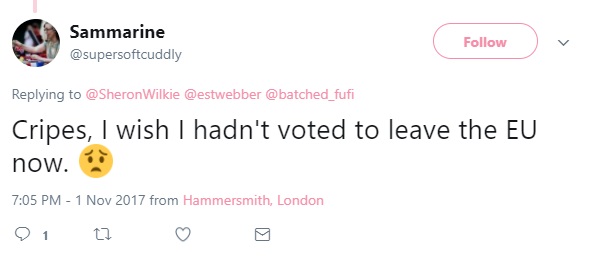
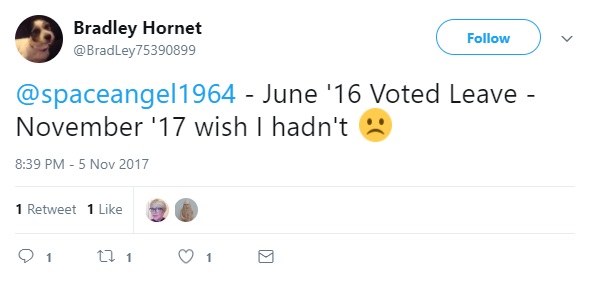
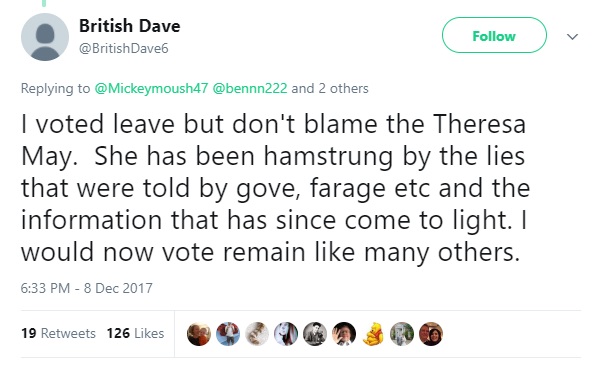
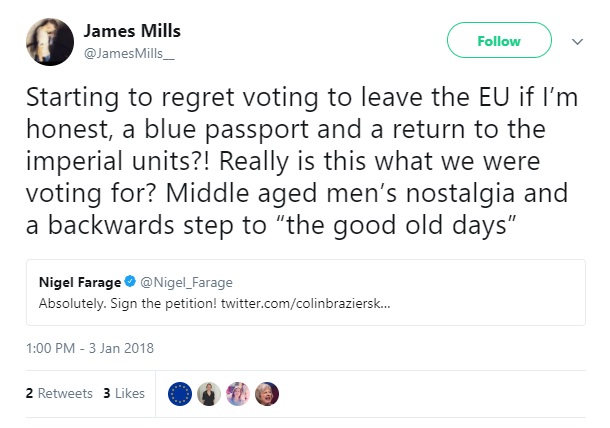
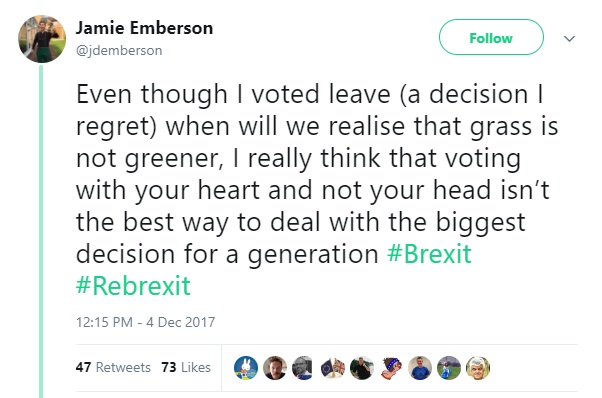
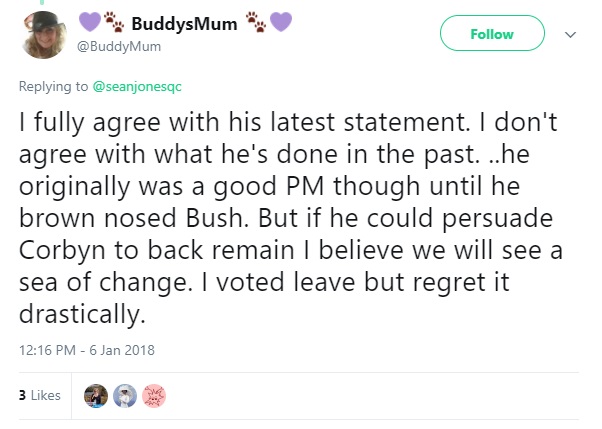
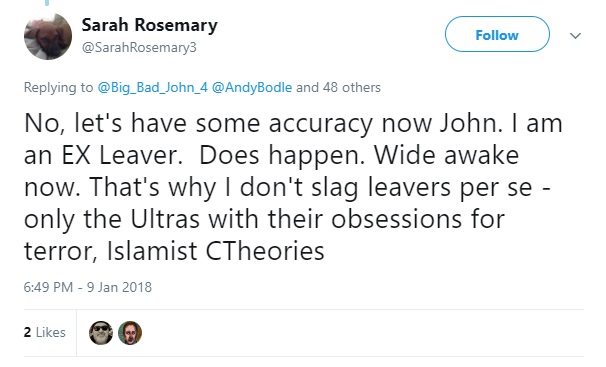
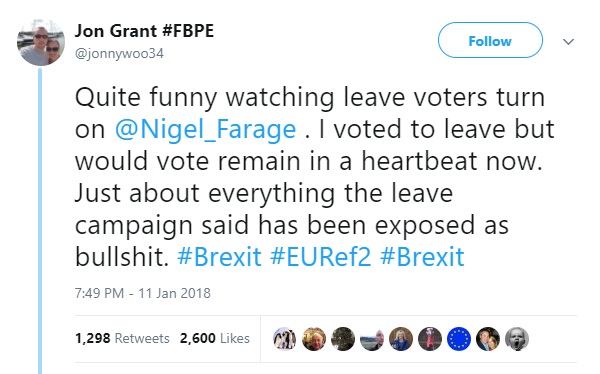
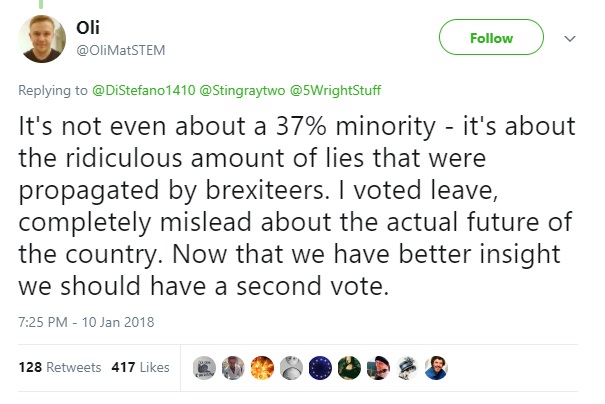
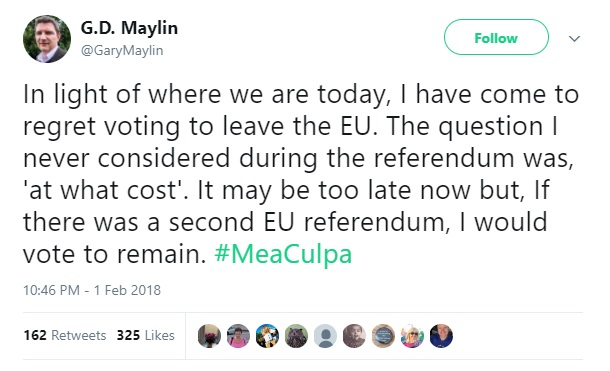
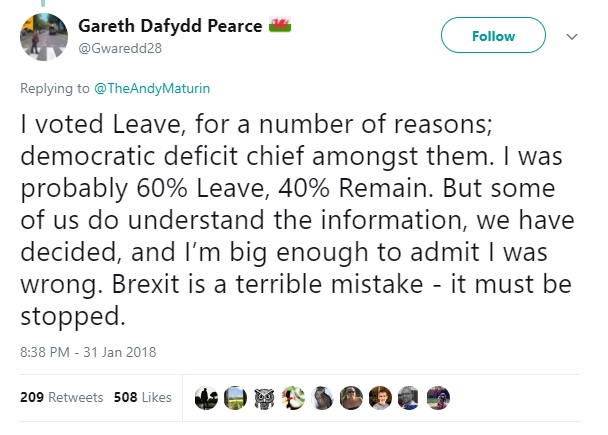
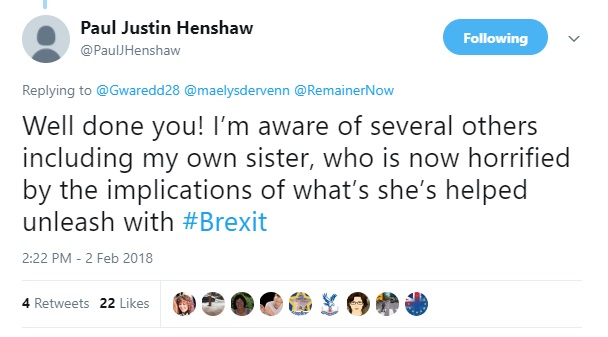
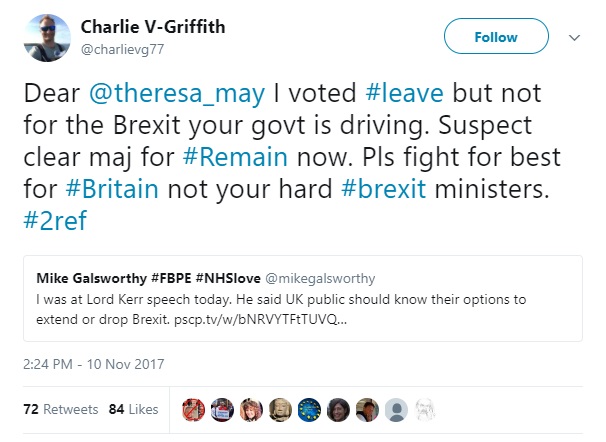
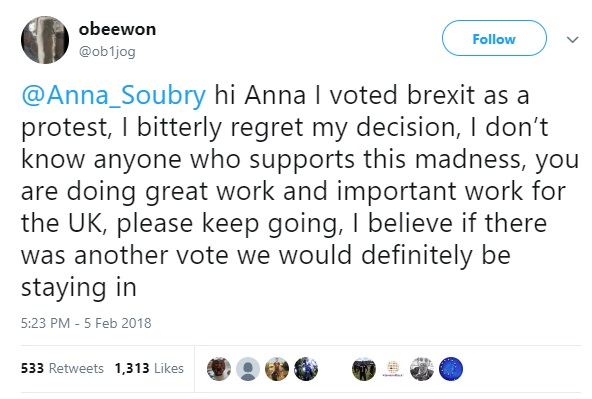
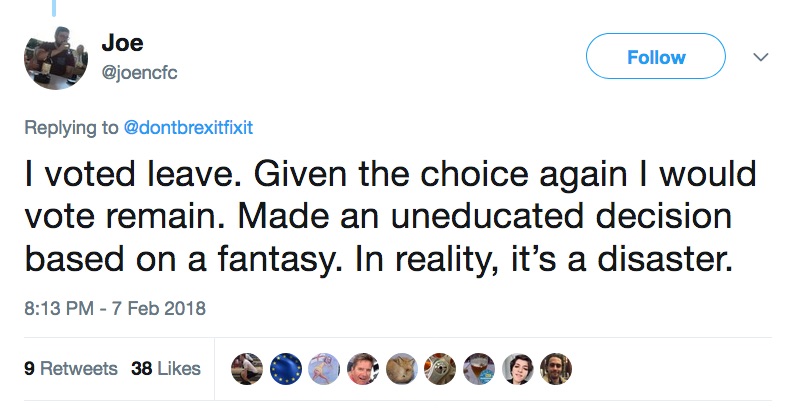
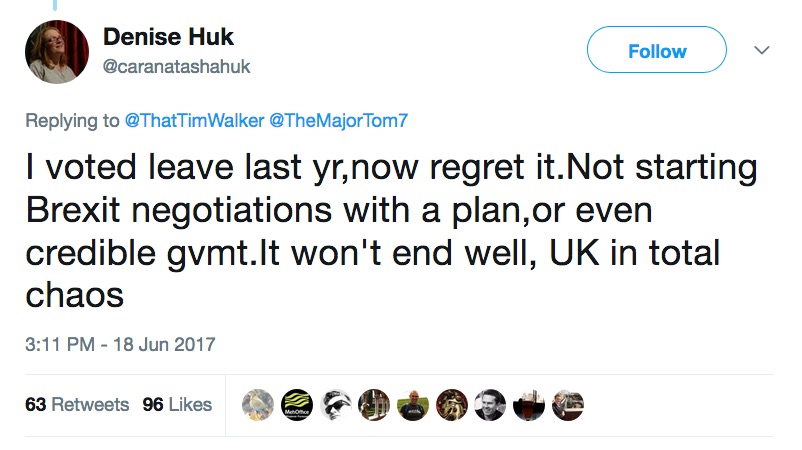
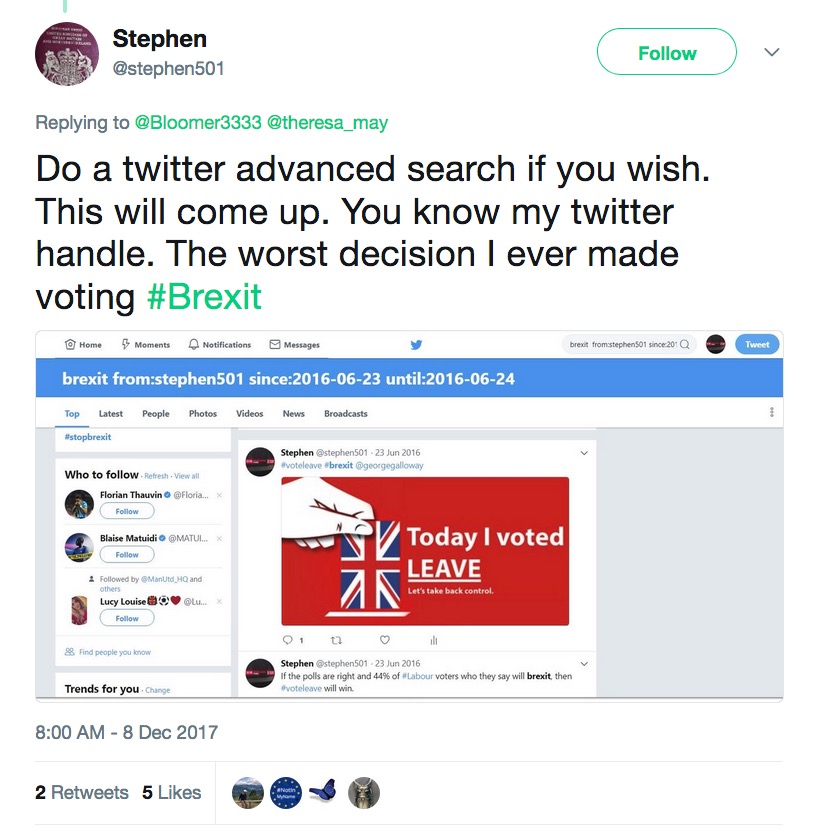
The Brexit headbangers would have us believe that support for Remain is waning. That really doesn’t seem to be the picture these tweets are painting.
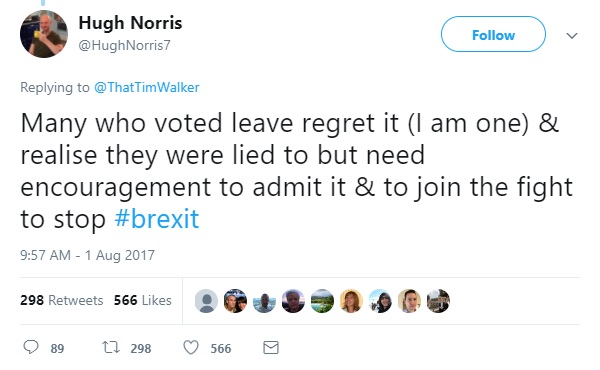
There’s no need to be afraid of mockery from Remain voters if you’re thinking of admitting your Leave vote might have been a mistake. We all voted on the basis of very poor-quality information.
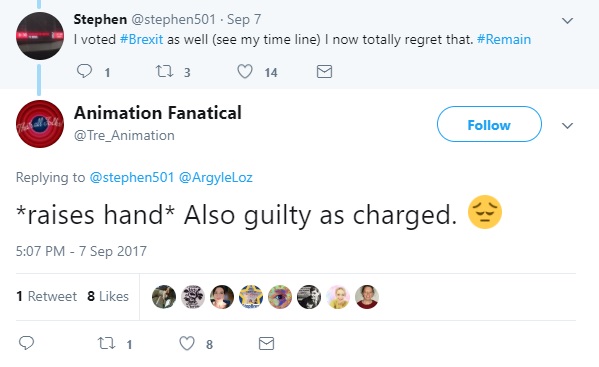
Don’t kick yourself too hard, Tre. There are plenty of billionaire disaster capitalists queueing up to do that for you.
I agree. I voted out, but have definitely changed my mind. The logistics are just too difficult. https://t.co/3106fEDTr7
Not exactly a full-throated recantation from Gordon, but it’s another vote in the bag. (Tweet has since vanished – I think Gordon runs one of those apps that automatically deletes all tweets more than a month old. The reply below, however, survives. Because of eventualities like this, I’m going through this post replacing all embedded tweets with screenshots.)
Aaand two more recruits, courtesy of Kristian.
It was almost certainly in your top three, Beth, but I won’t press the point.
This one came courtesy of @StuartBudd1 on Twitter.
According to this study, the number of people who regretted voting Leave was already greater than the margin of victory for Leave – and that was in October 2016. As the scale of the task facing the UK government and its rank unfitness to undertake it become ever clearer, that number can only have risen.
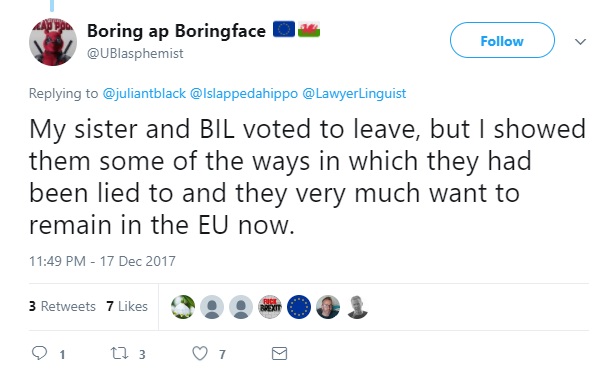
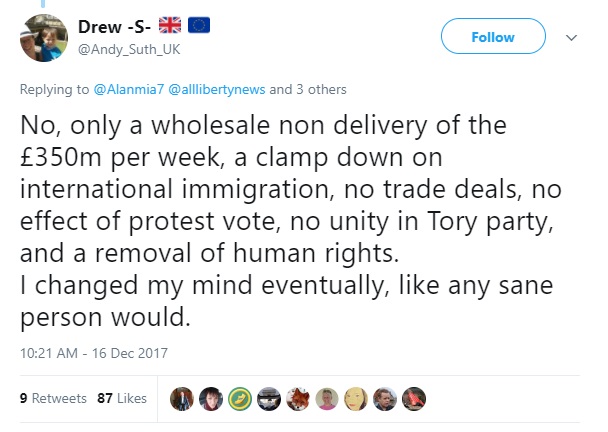
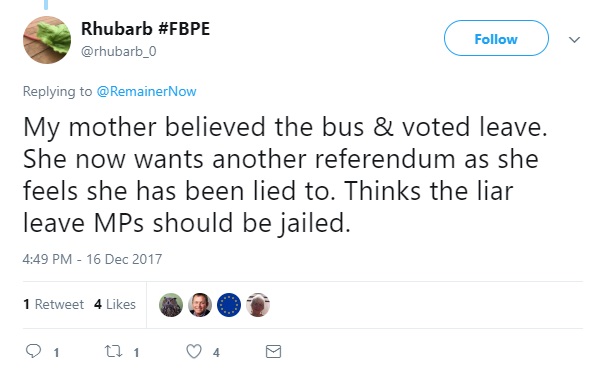
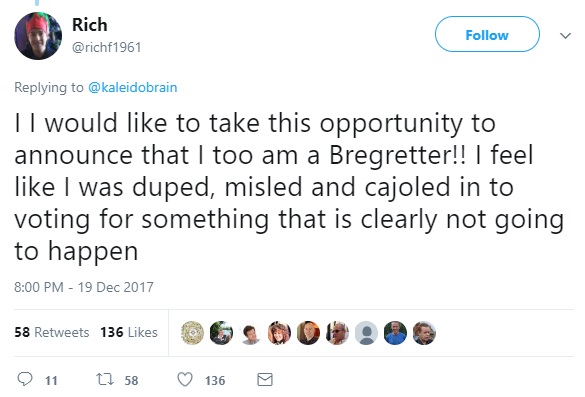
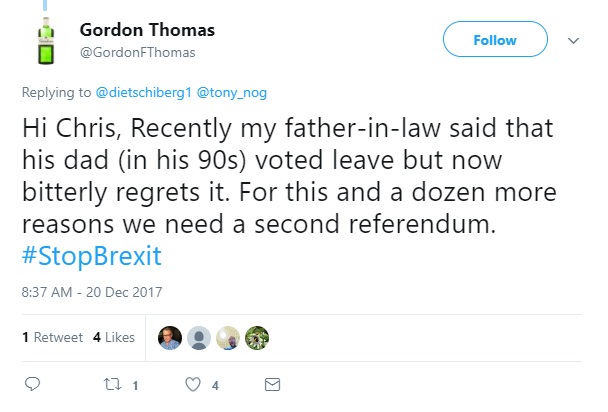
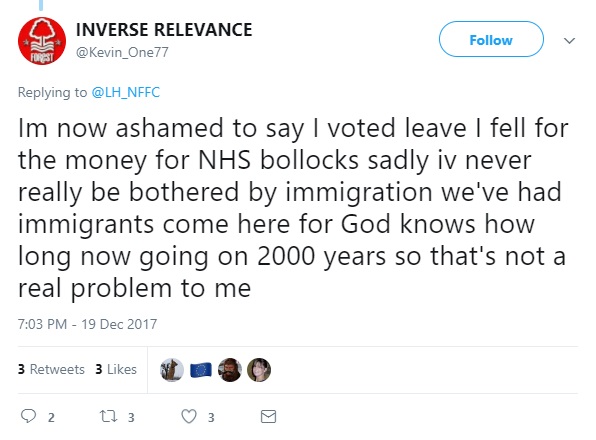
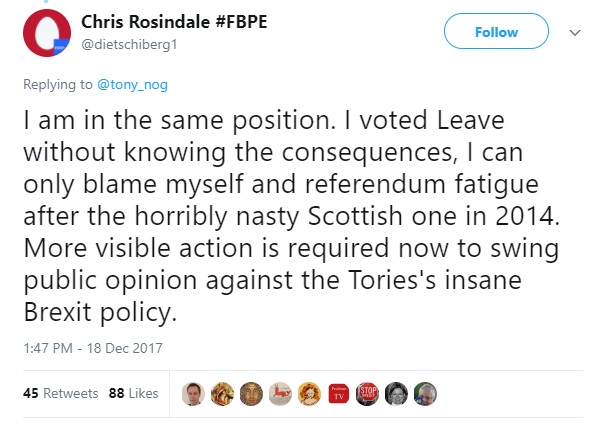
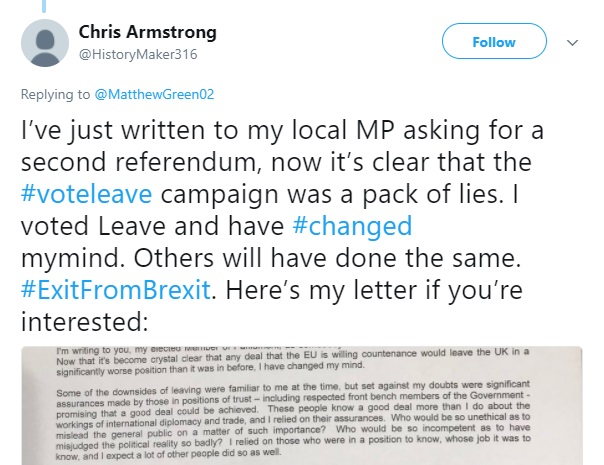
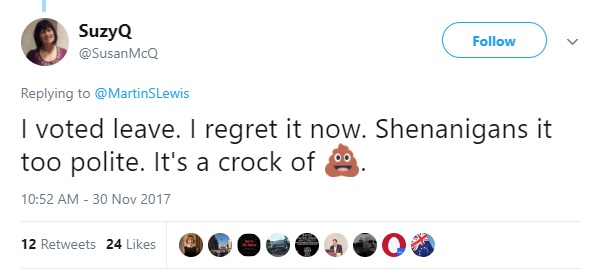
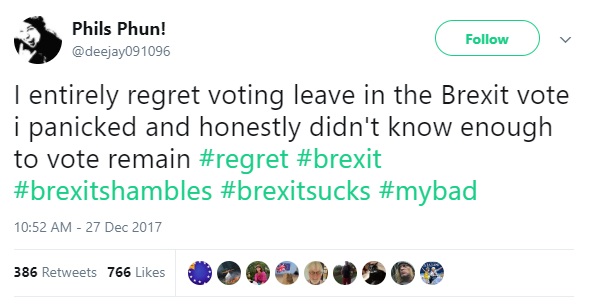
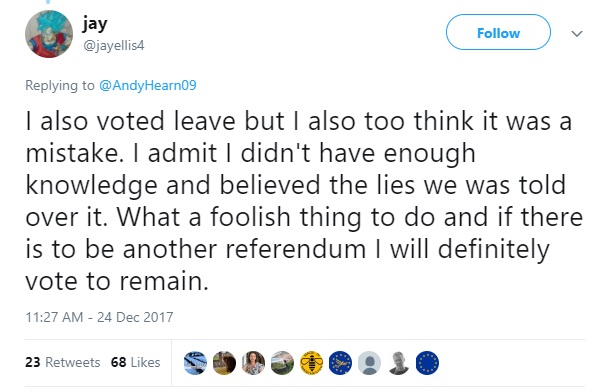
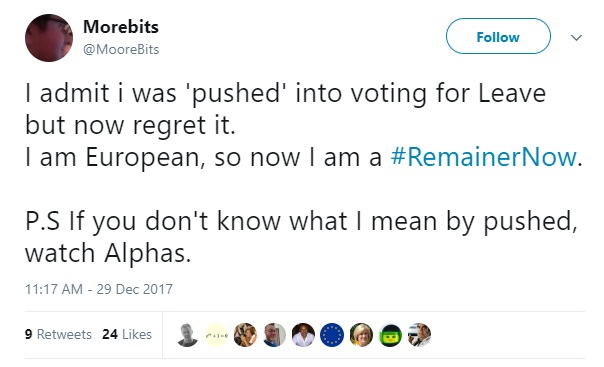
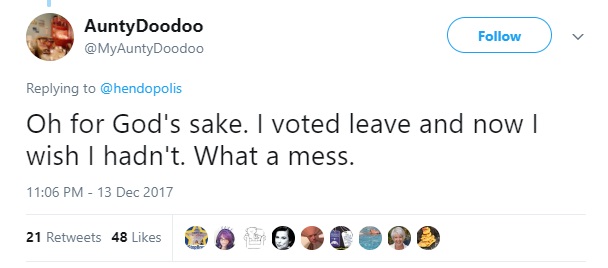
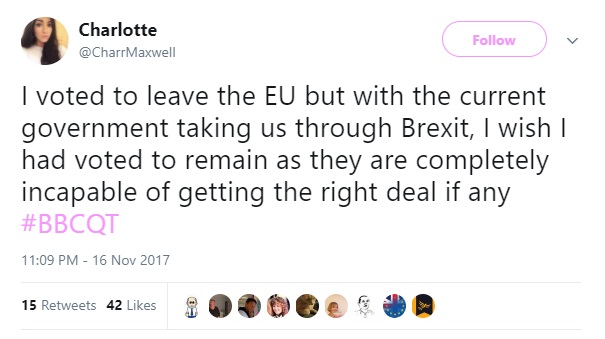
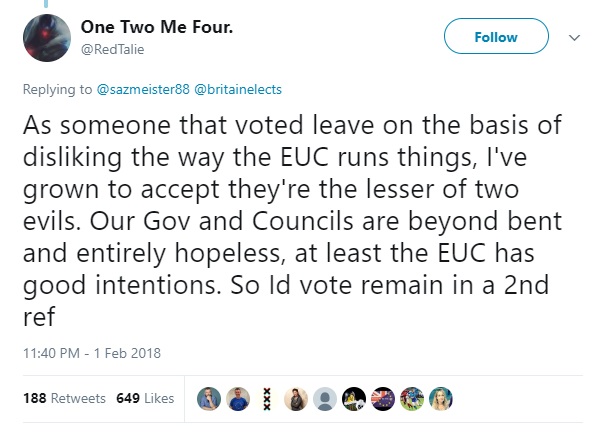
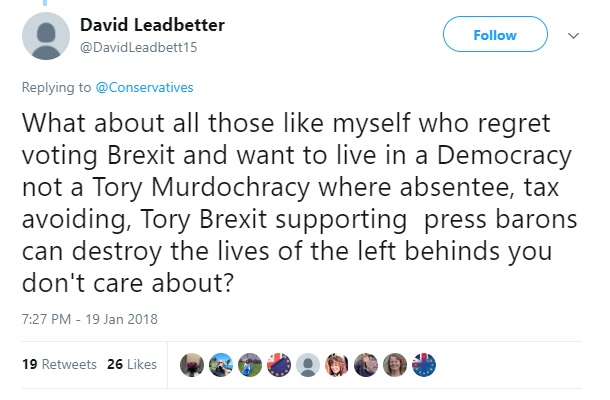
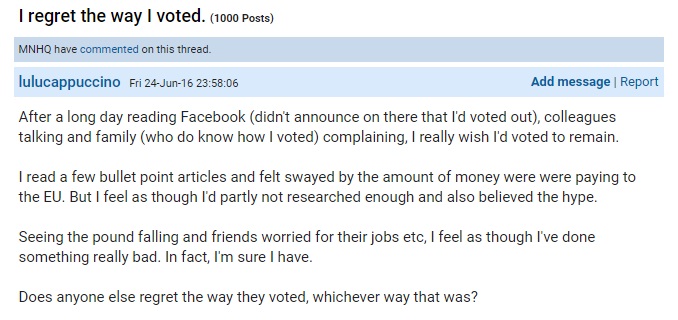
There are doubtless hundreds, possibly thousands more Bregretters – it only took me an hour to collect the examples above. Feel free to send me any more admissions of error you may find (after thanking them for their courage and honesty, natch). The case for a second referendum – or, preferably, a simple retraction of article 50 – grows stronger by the day.
Bregretters found since 20/9/17
I may have made a rod for my own back here. Mind you, I’ll take a rod up the tradesman’s if it stops Brexit.
(A revealing little exchange, that one. Despite the wailing of Liam Fox and various shady corporate-sponsored thinktanks, there has been much speculation that the BBC has given far too much prominence to advocates of Brexit – and especially of hard Brexit.)
(That last post was retweeted by the @BrexityRegrets account, which had, as of 18/12/2017, winkled out 95 more people who have had second thoughts since 23/6/16.)
Inspired by a broadside of hatred and scorn from hardened leavers (and doubtless a few Mercer trolls) on 18 December, I decided to broaden my search and started finding more Bregretters in unexpected places like Mumsnet:
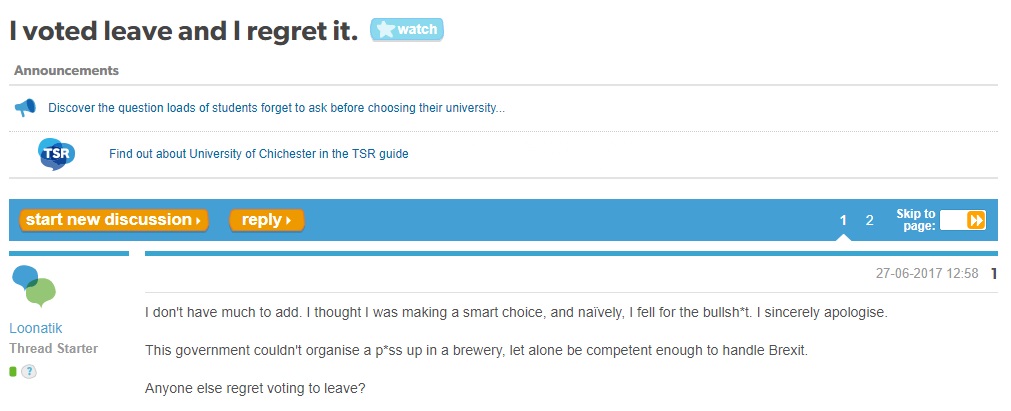
And here’s one from the Student Room:
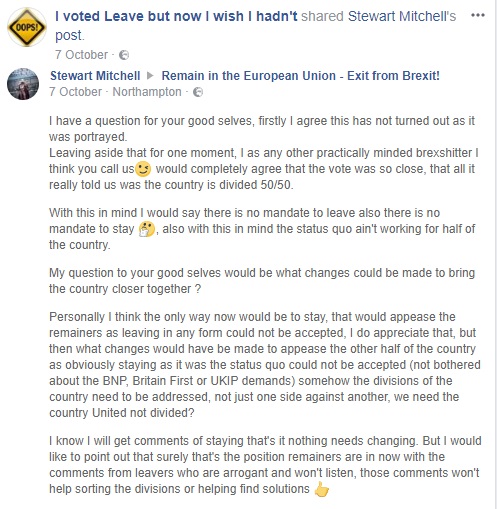
Ooh, just found a Facebook group that should turn up a few more. Here’s one:
I’m reserving a special mention for this guy, who I found only because of the dedication of frothing Brexadi @JohnWebbWindsor on Twitter. Thanks, John!
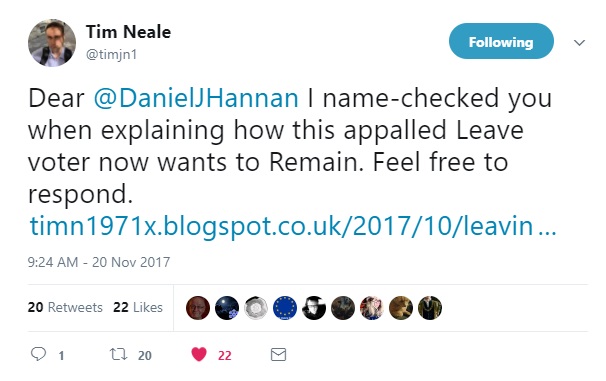
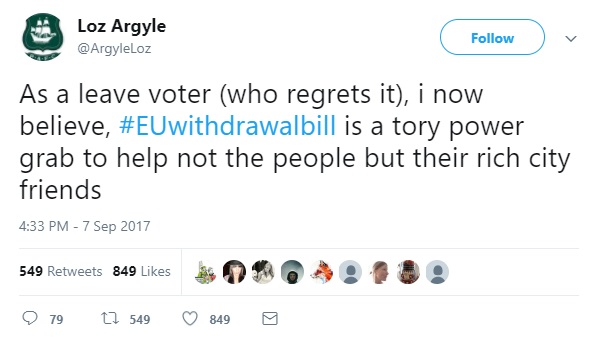
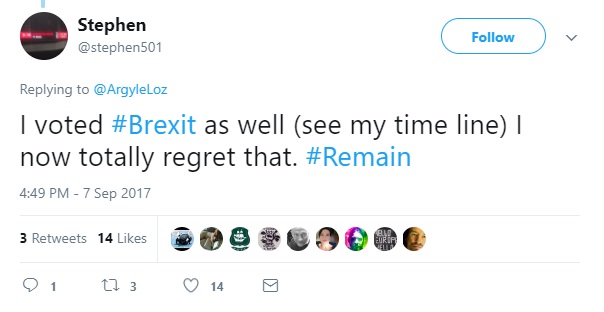
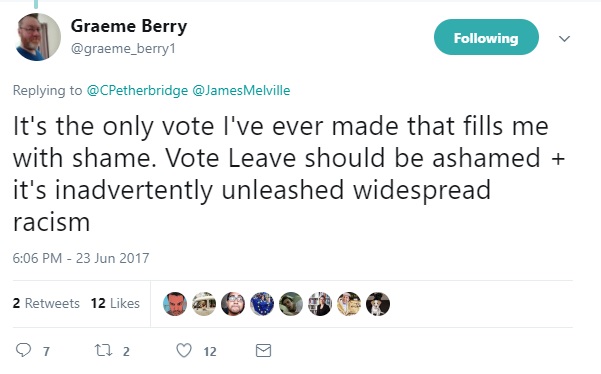
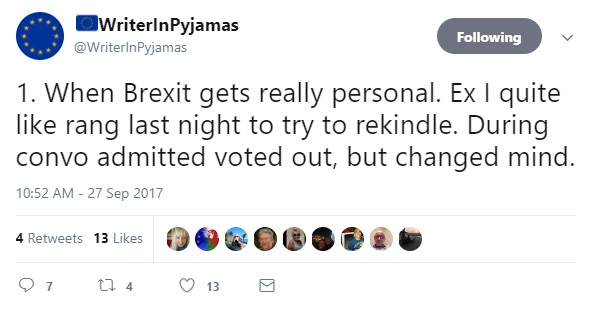
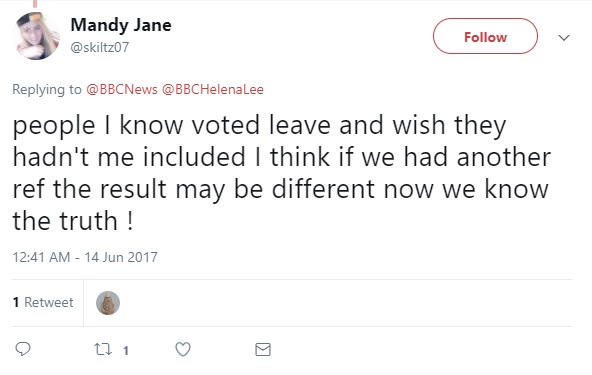
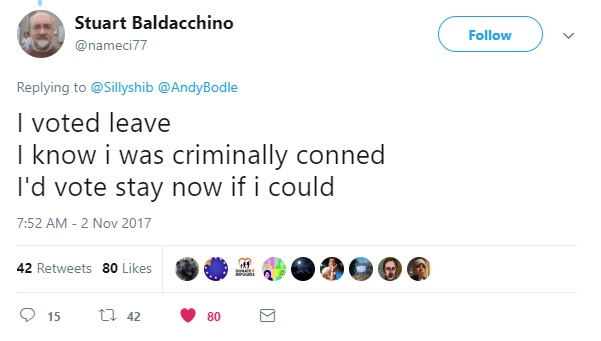
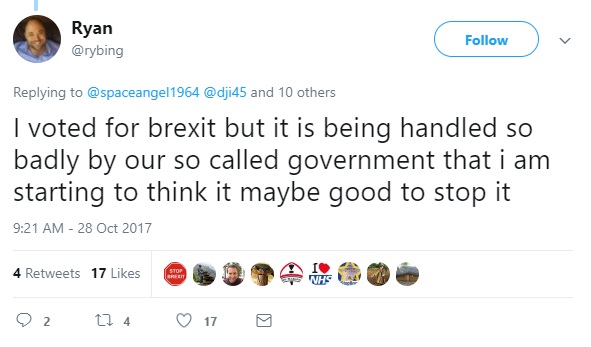
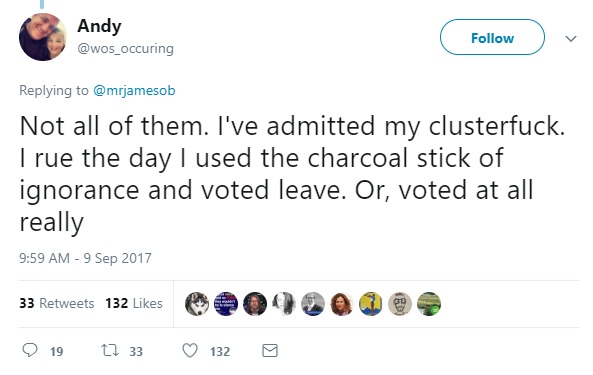
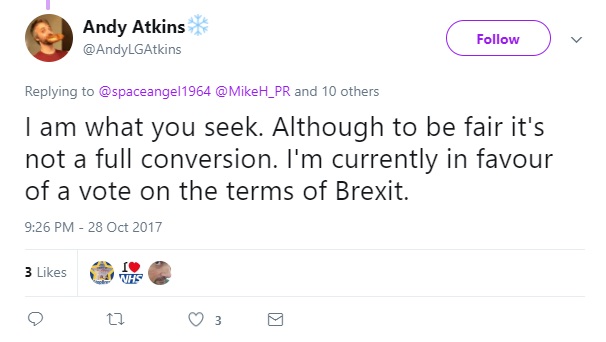
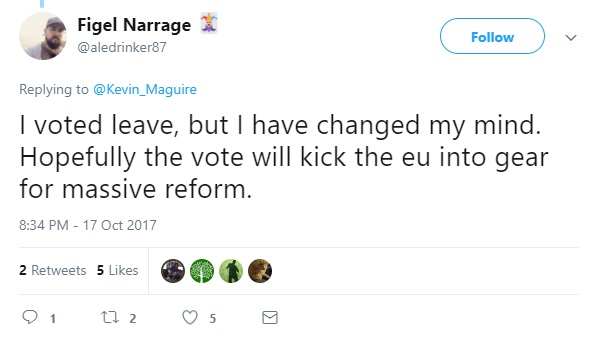
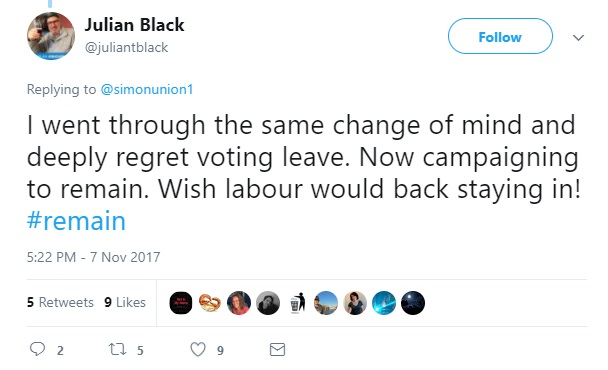
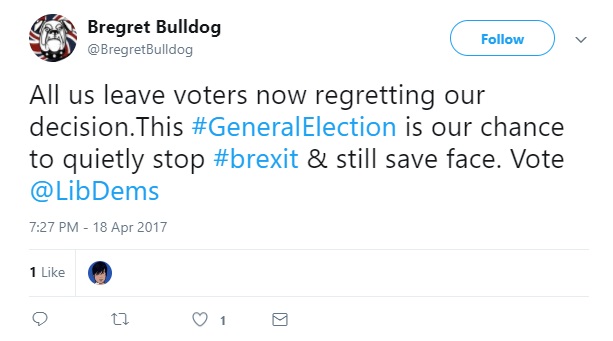
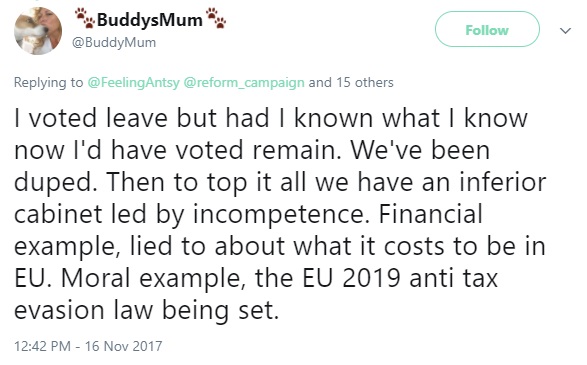
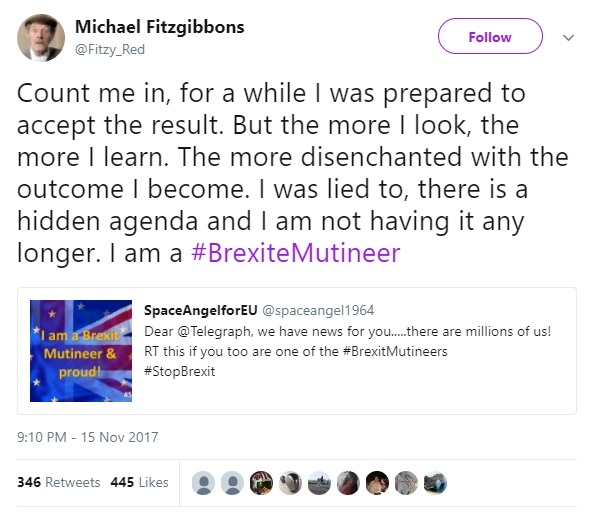
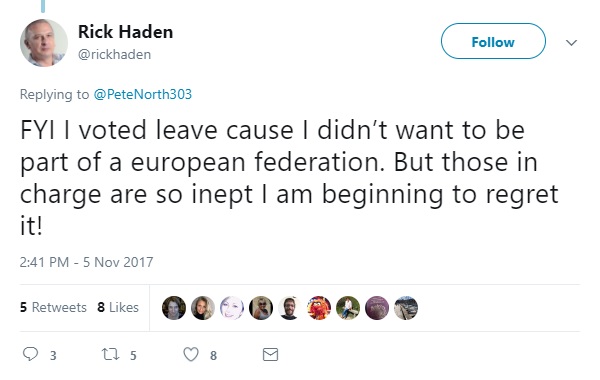
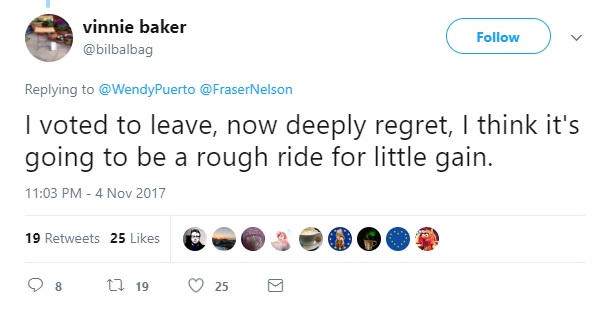
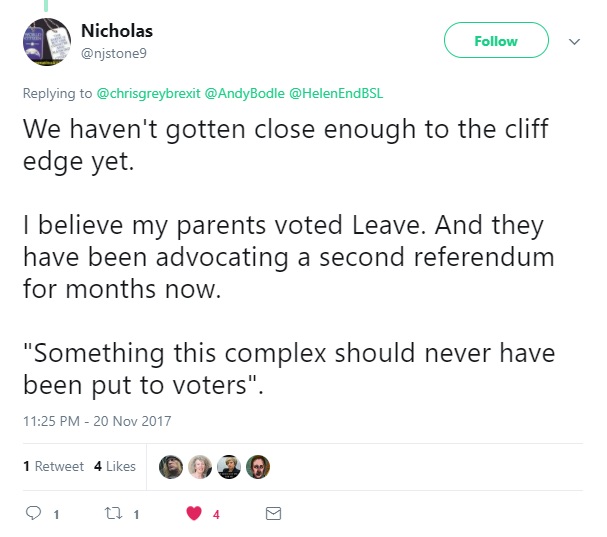
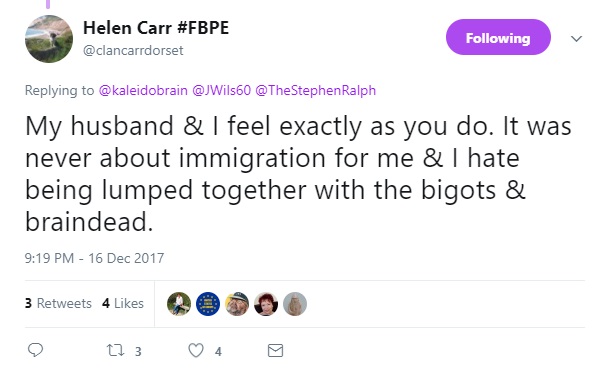
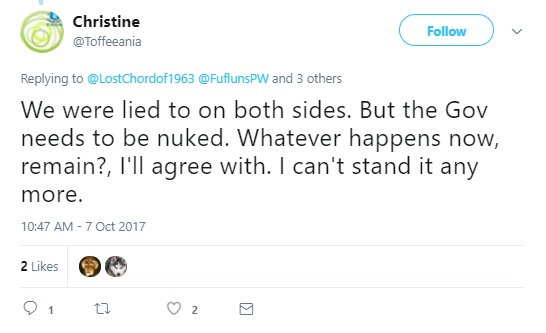
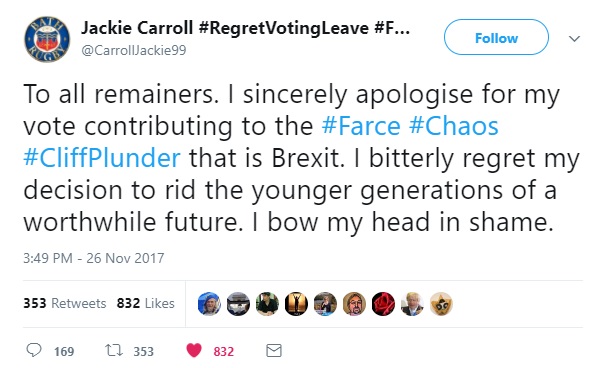
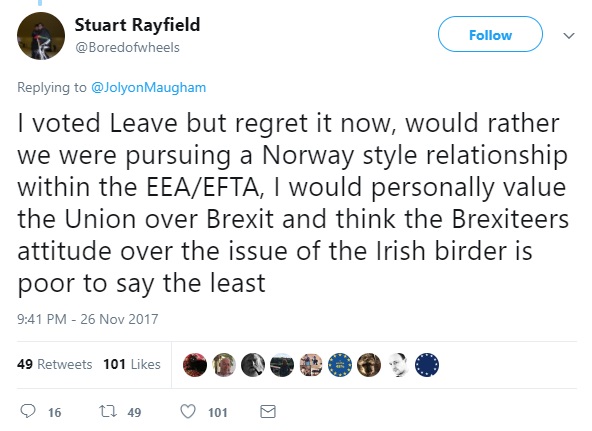
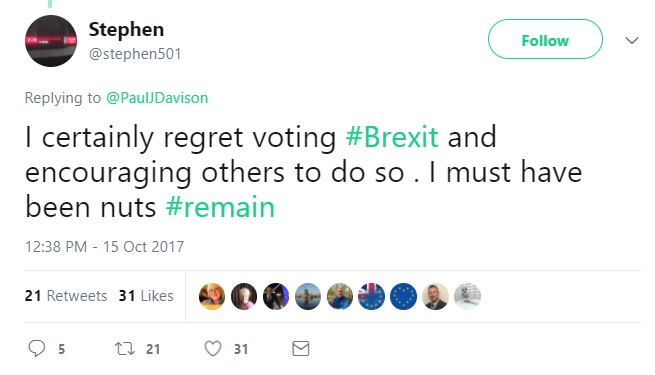
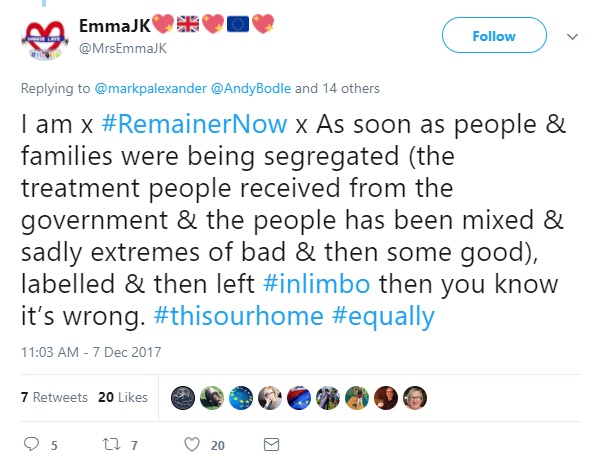
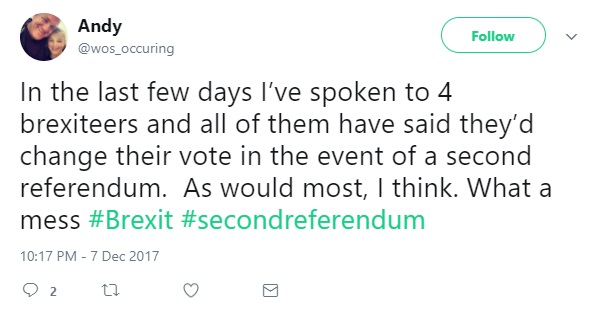
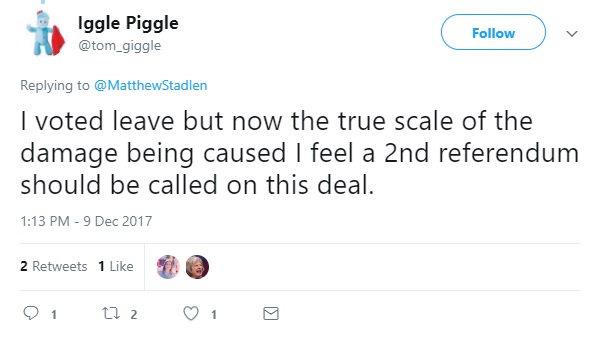
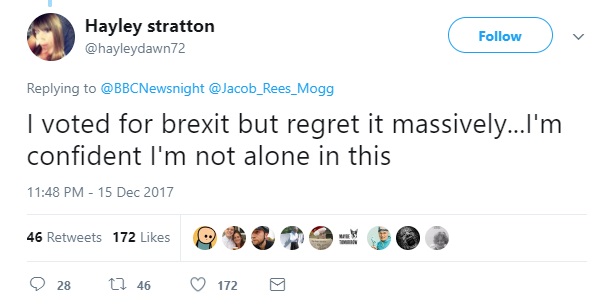
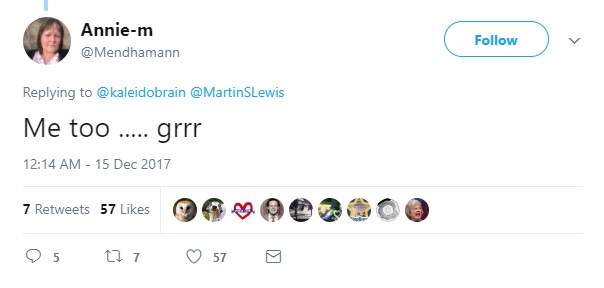
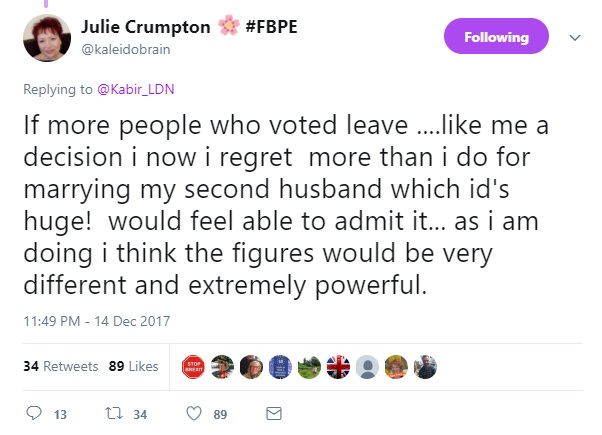
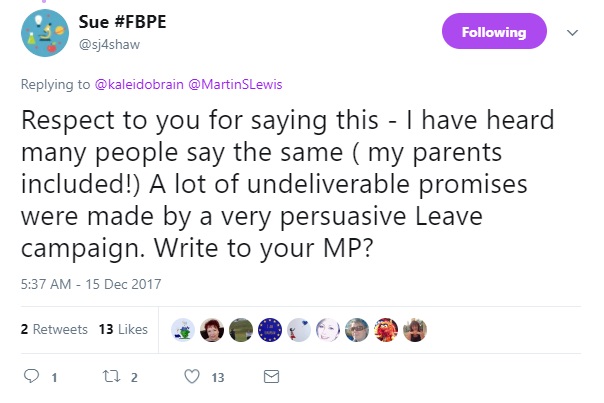
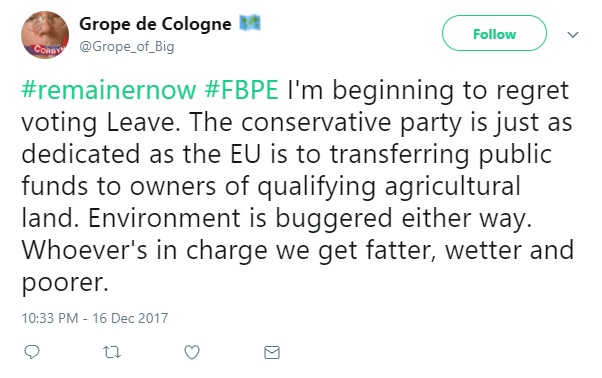
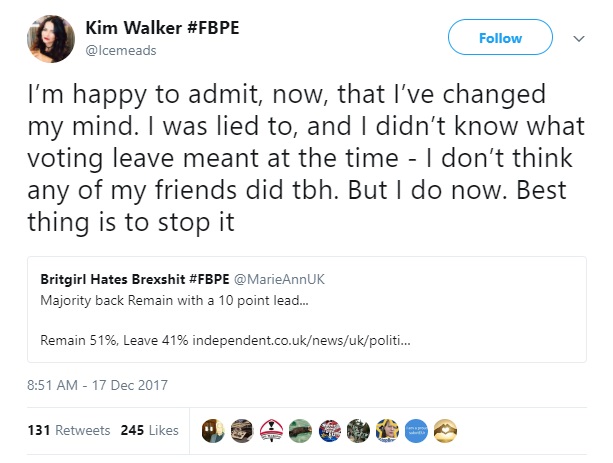
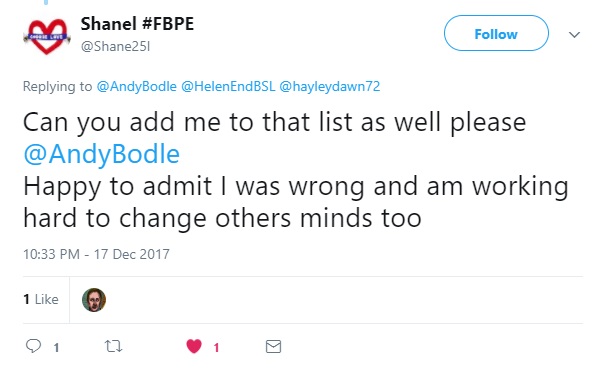
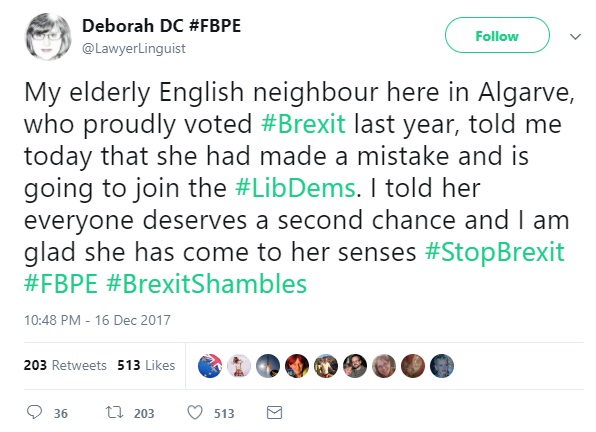
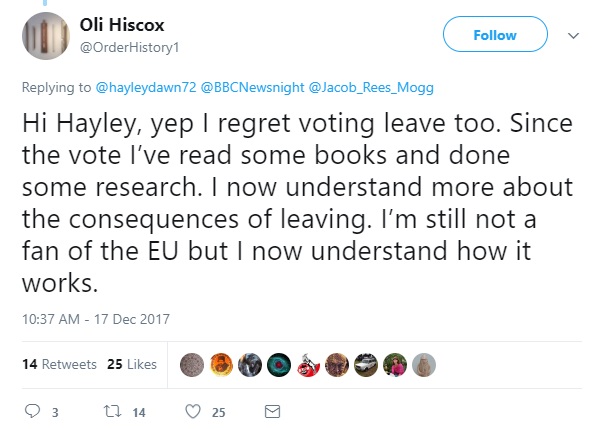
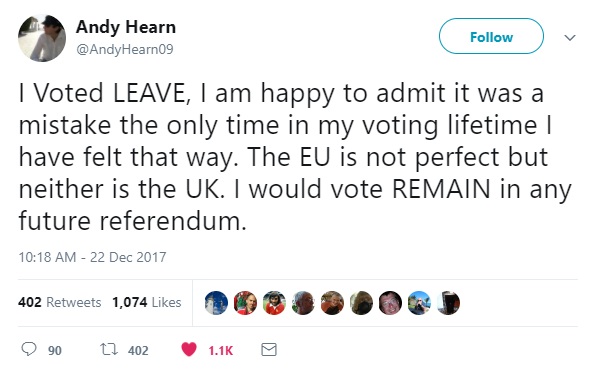
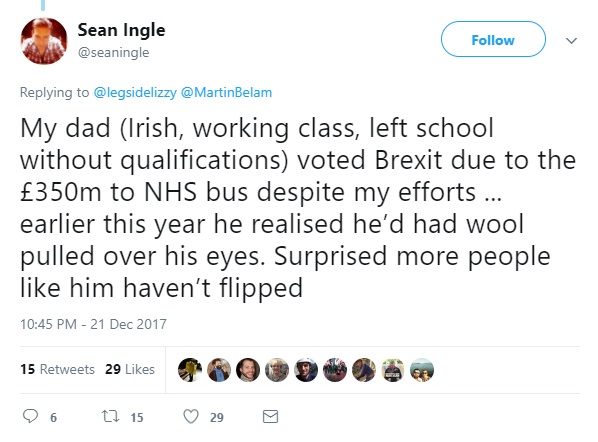
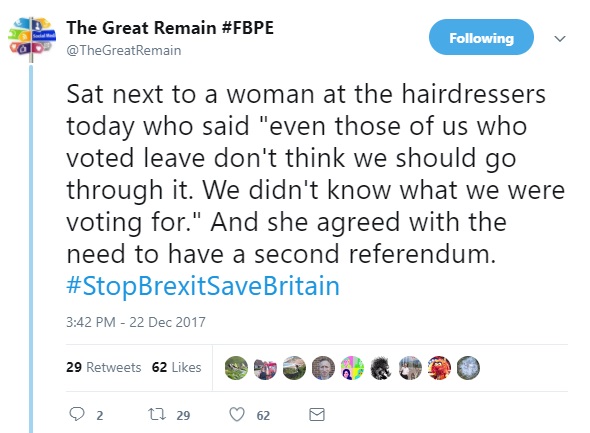
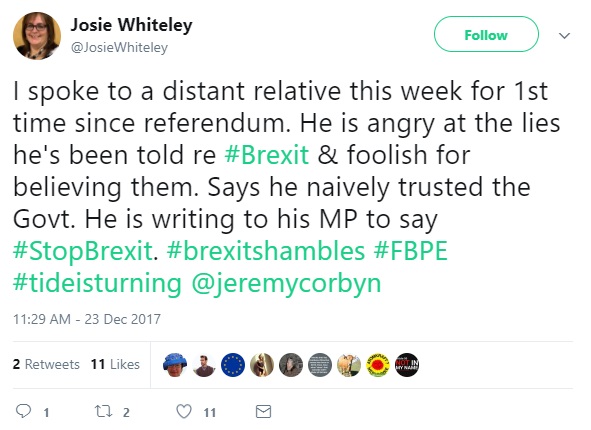
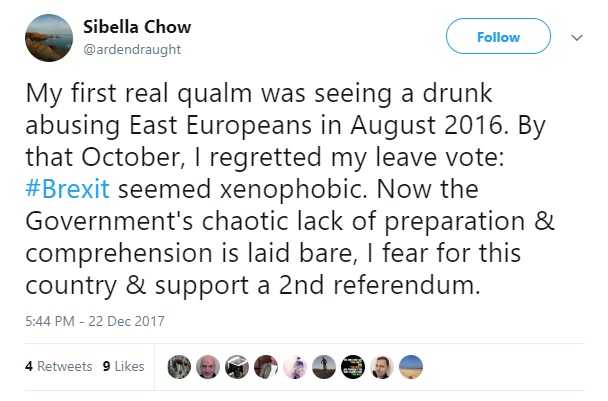
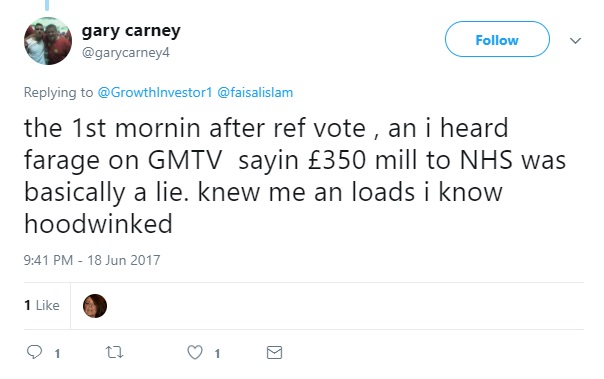
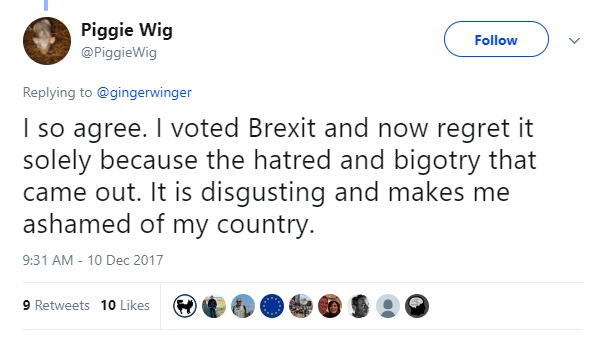
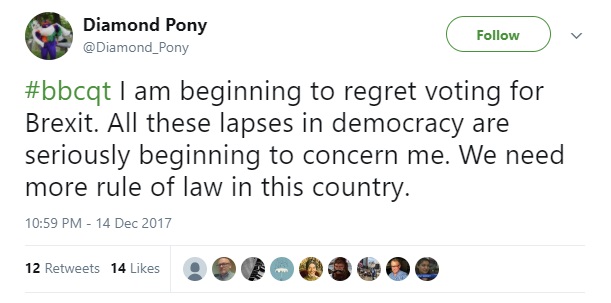
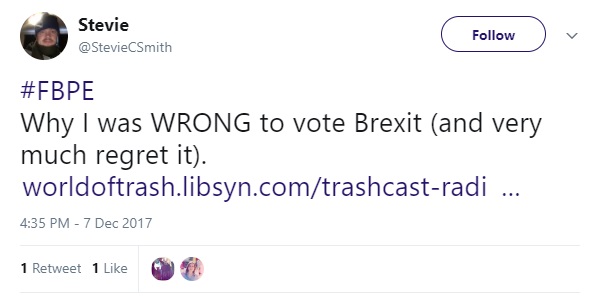
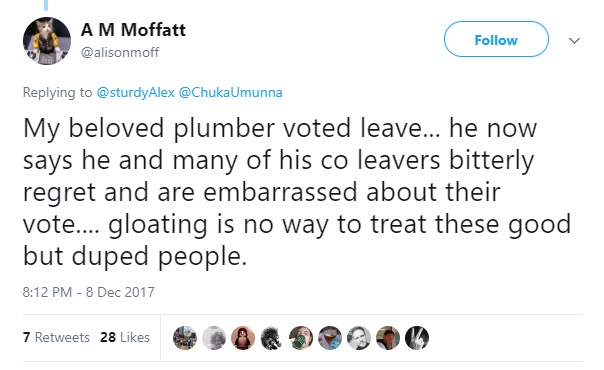
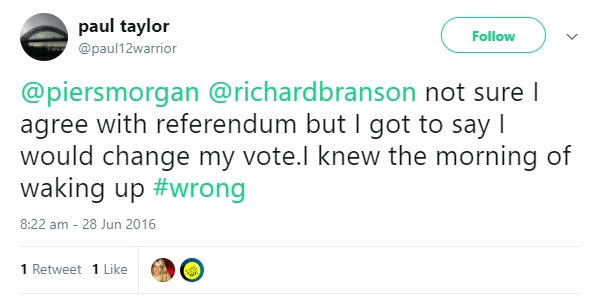
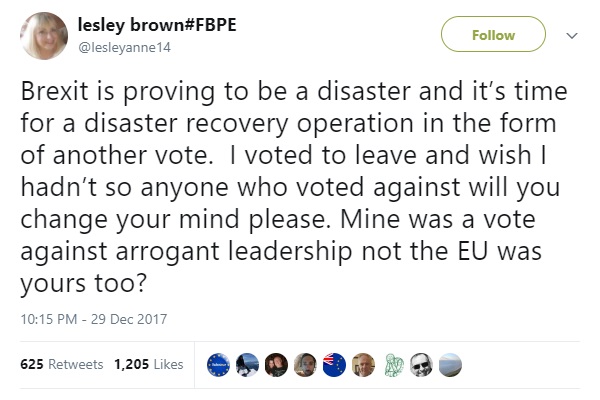
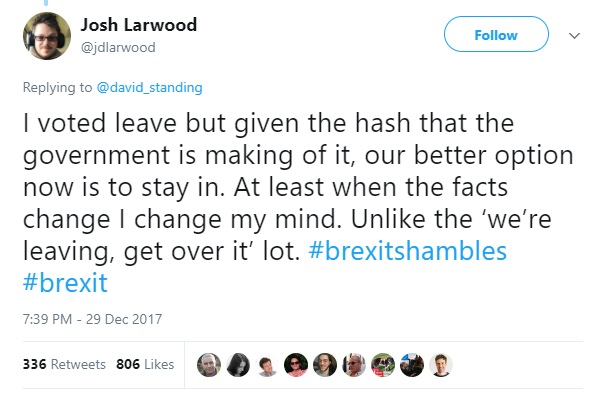
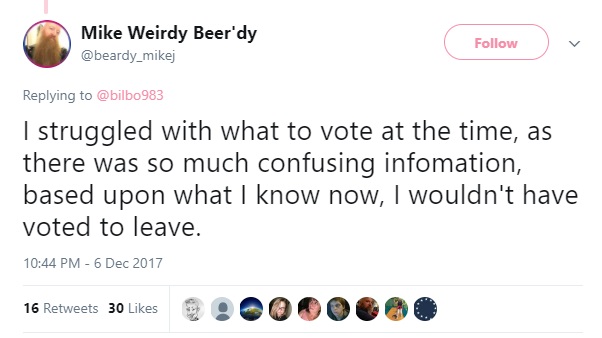
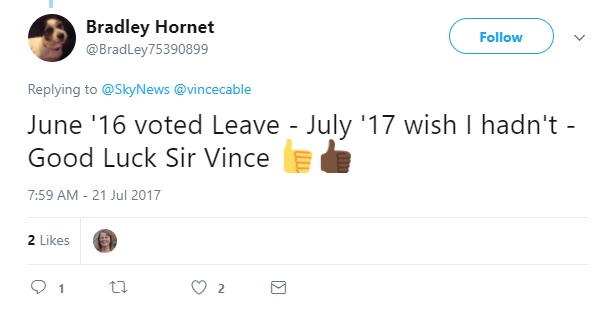
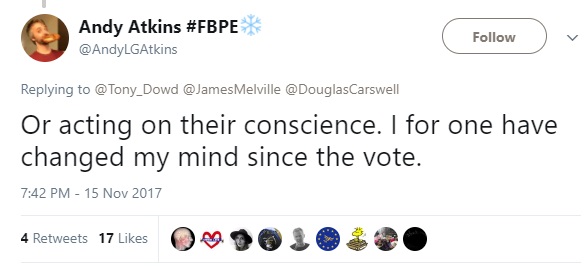
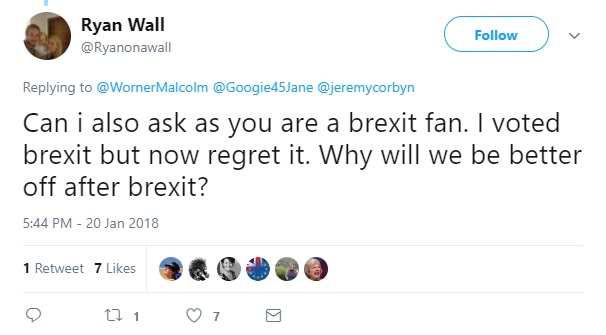
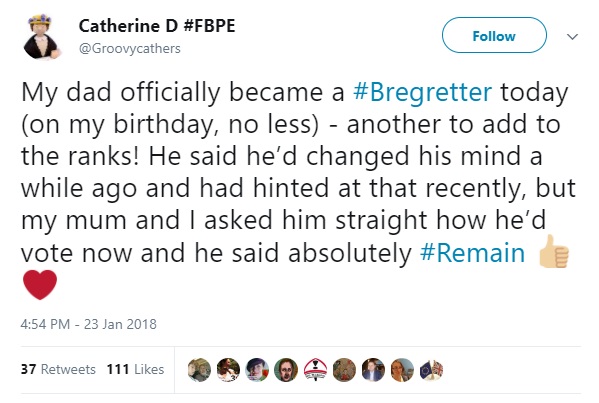
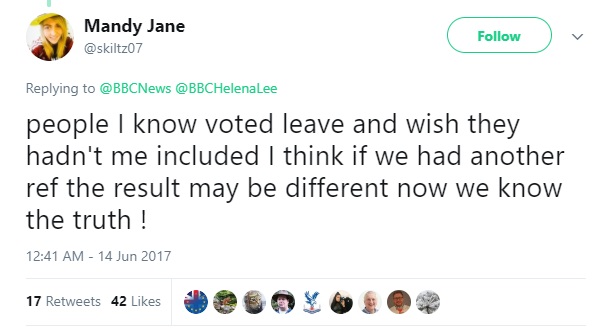
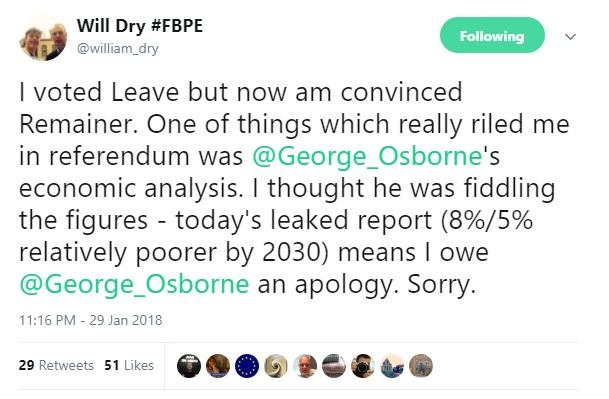
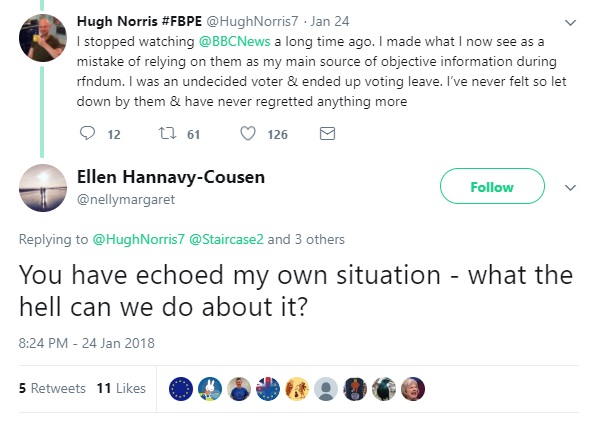
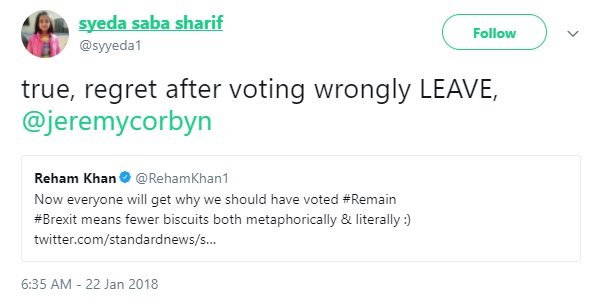
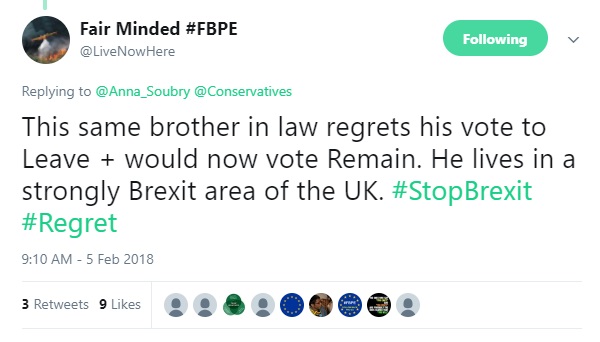
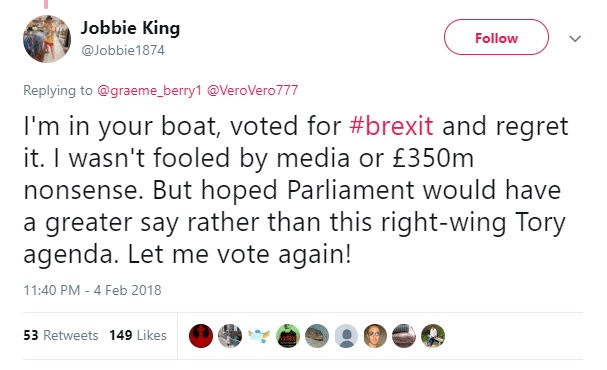
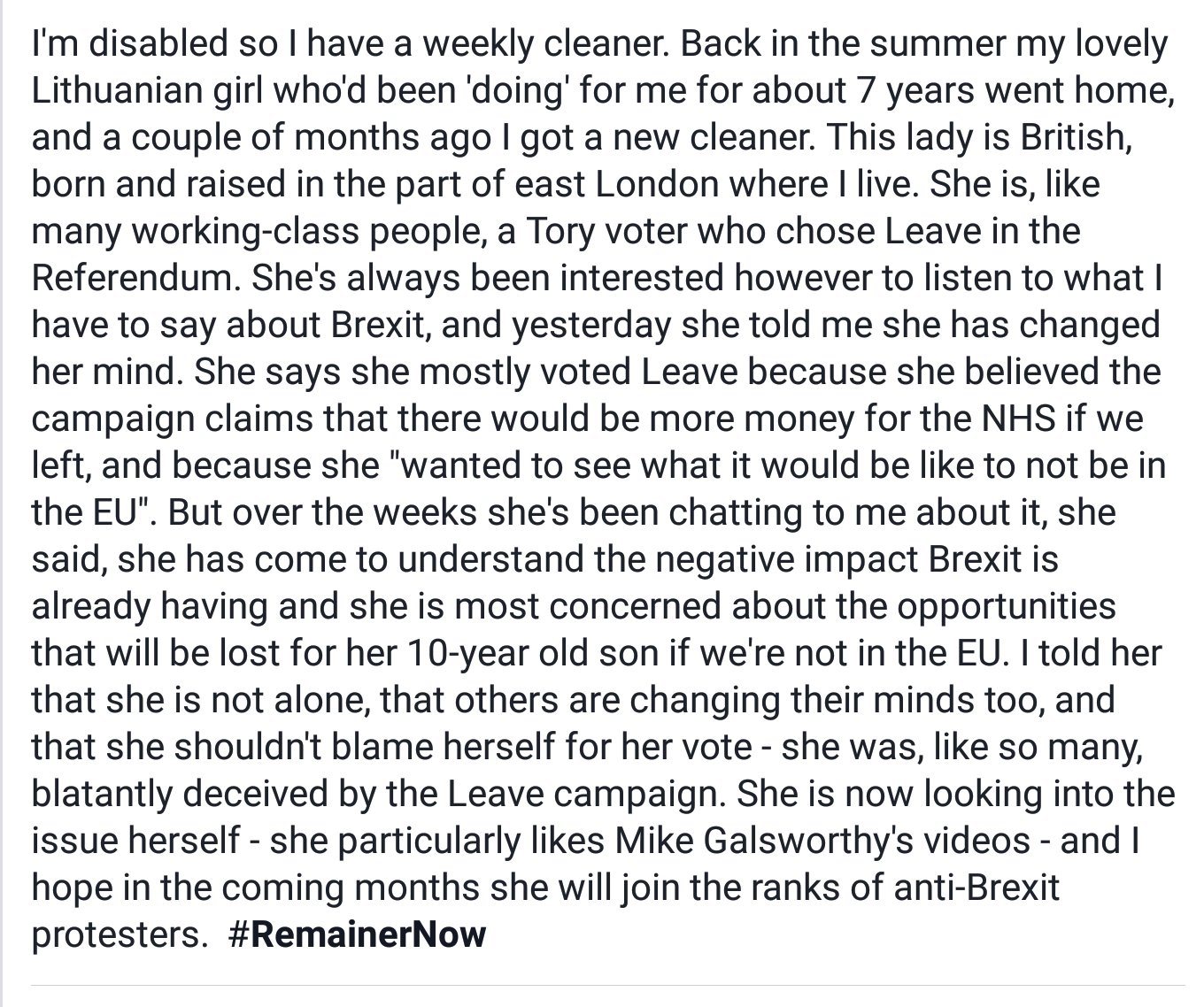
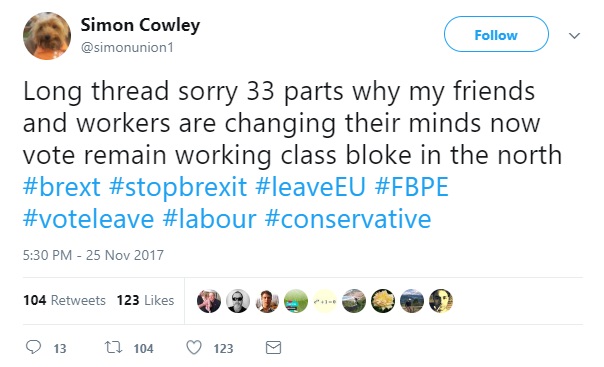
This is proving to be quite an inexact science – there are possibilities of duplications, of course, and there’s no telling whether all the people concerned are telling the truth (although it’s hard to see why someone would make something like this up). Take this tweet thread, for example:
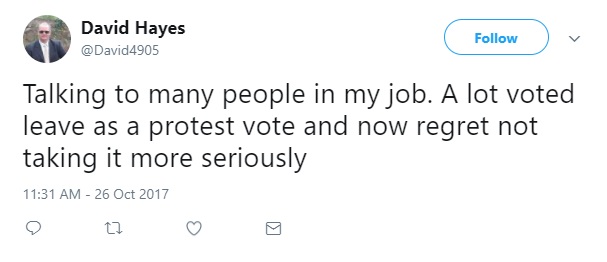
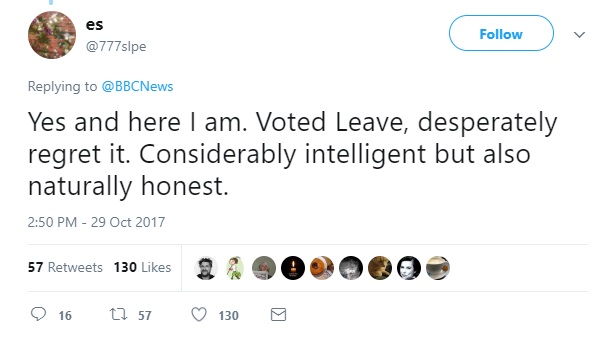
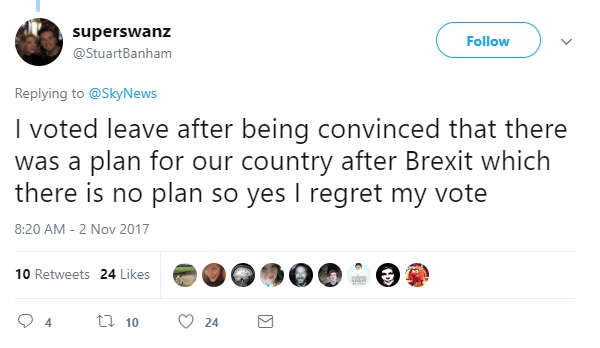
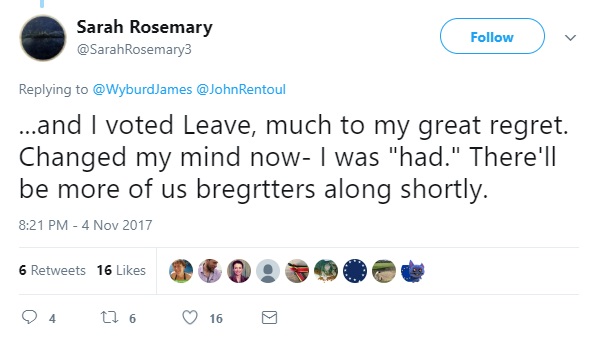
In the interests of fairness, I’ll only count this as one more Remainer. (PS: thanks for your bravery and honesty, Simon!) In any case, this is only supposed to give a general picture of the momentum building against a hasty and calamitous exit from the EU.
310 down. Only 598,690 to go.
Footnote, 12/02/18
Having hit the 300 mark, which I think is enough to make my point, and having realised that this page now takes a solid hour to scroll through, I’m going to be a little less rigorous with the updates, although I will continue to post links below every now and then.
A beginner’s guide to the UK’s newest language – a fascinating creole of English and bullshit
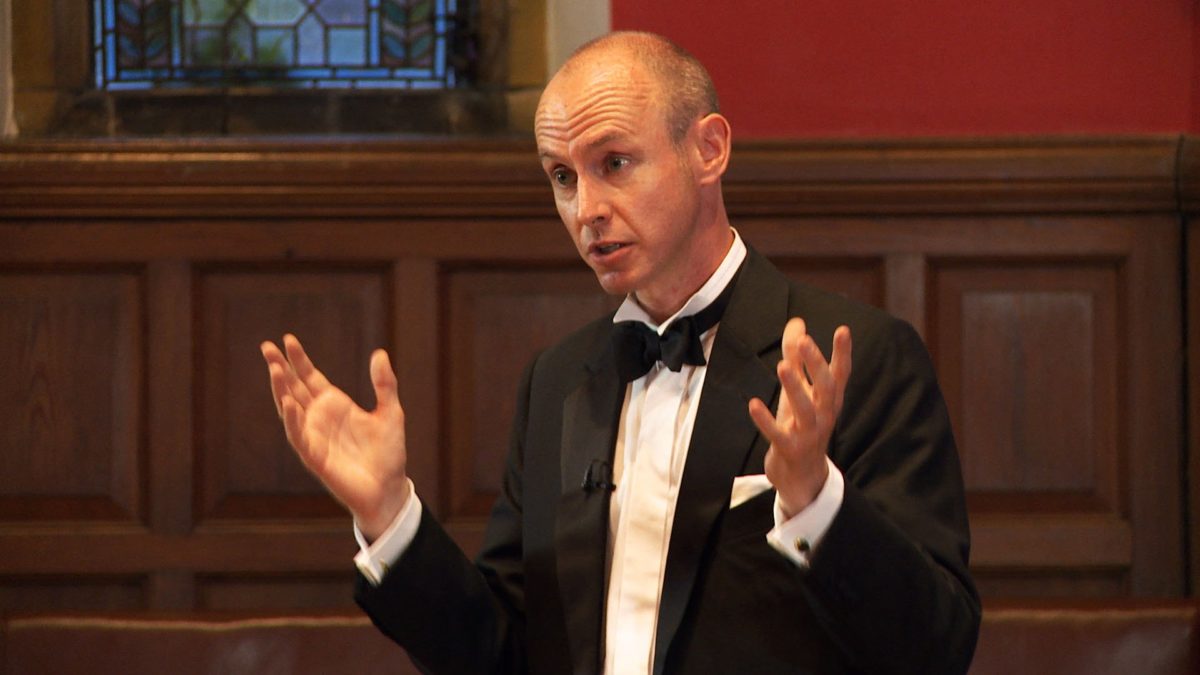
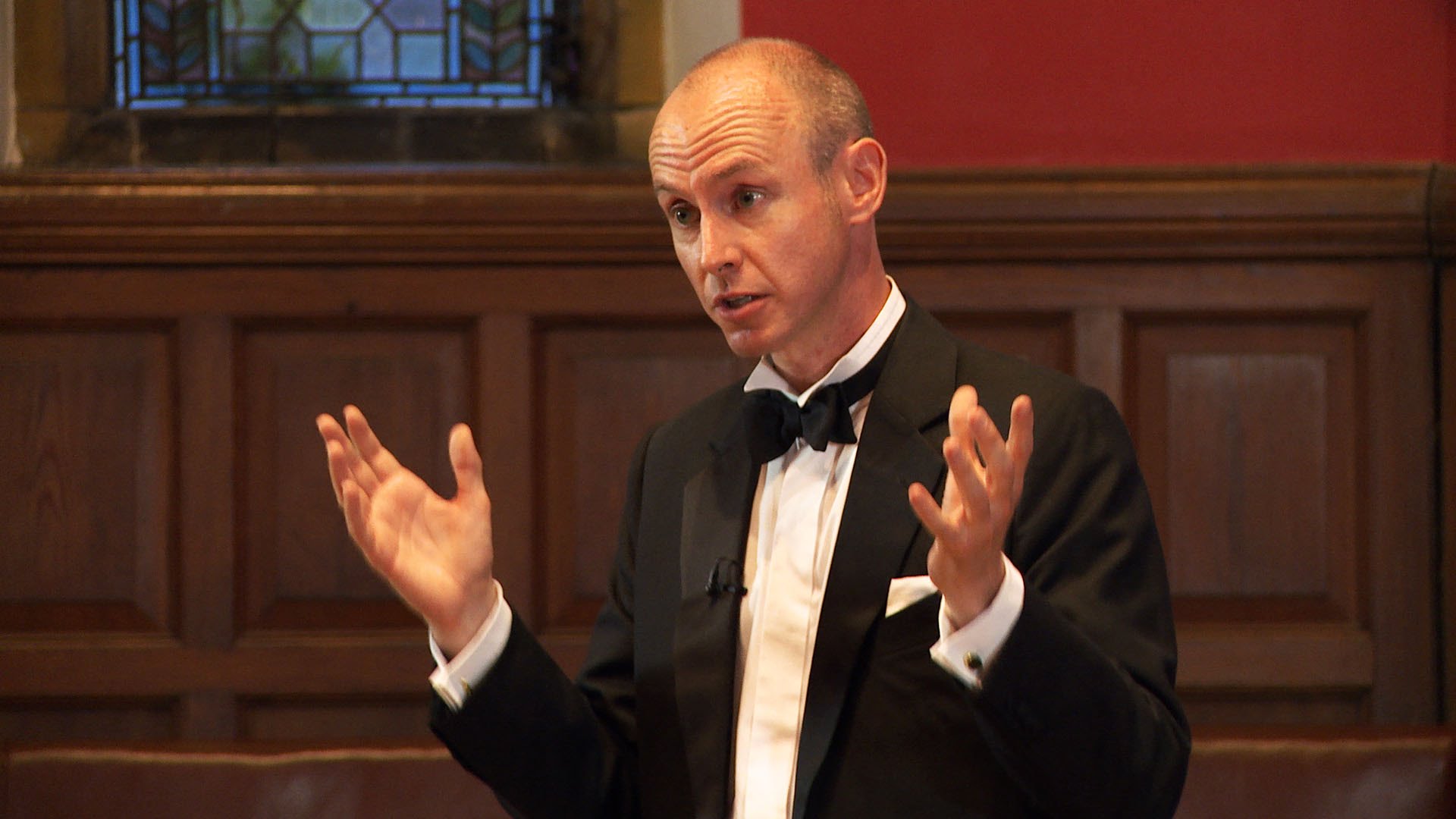
Daniel John Hannan, arguably the most fluent – nay, multiloquent – practitioner of Brexitese.
Until recently, there were 11 native languages in the United Kingdom: English, Welsh, Scots, Irish, Cornish, Angloromani, Scottish Gaelic, Shelta, British Sign Language, Irish Sign Language and Northern Ireland Sign Language. But some time in early 2016, a 12th tongue sprang forth.
Brexitese, at present attested for the most part only in written form, is superficially similar to standard English. Its grammar is identical (if simplified), and it draws on the same word pool. However, the Brexitese rules of punctuation are looser, and it has a far smaller vocabulary, to the extent that its users often have to support their text with cry emojis. Words of more than two syllables are generally shunned altogether.
The most striking feature, and the most problematic for learners of the fledgling tongue, is that the meanings of many Brexitese words differ slightly – sometimes markedly – from their standard English equivalents.
Here, then, for the benefit of those who wish to properly comprehend our isolationist brethren, I shall be compiling a brief guide to the most common of these linguistic “false friends”.
Democracy
English meaning: System of government under which a governing body, elected by the people as their representatives and advised and assisted by a civil service with the relevant expertise, takes decisions regarding the laws of the land. In a properly functioning democracy, these representatives are selected through free and fair elections, the citizens should participate actively in politics and civic life, the human rights of citizens should be protected, and the rule of law should apply equally to all citizens. Also known as parliamentary democracy.
Brexitese meaning: System of government, long since abandoned by most civilised societies, under which the people themselves take decisions on matters about which they do not have the first fucking clue. Votes need neither be free nor fair, and the human rights of millions of those affected by those votes can be trampled on whenever the winners see fit. Aka ochlocracy.
Examples: “You hate democracy”; “Stop trying to overturn democracy”.
Politically correct
English meaning: Taking care not to offend or further marginalise already marginalised groups, such as ethnic subgroups, disabled people, LGBT groups, women, and the adherents of certain religions; making an effort to accommodate the needs of minorities; showing consideration.
Brexitese meaning: Actively destroying the fabric of society.
Shackle
English meaning: A pair of fetters connected by a chain used to bind a captive’s legs together.
Brexitese meaning: Commitments voluntarily entered into by treaty; bonds of friendship.
Red tape
English meaning: Excessive bureaucracy or adherence to official rules and formalities.
Example: “Our businesses will only thrive when they are free of EU red tape!”
Dictatorship
English meaning: Form of government under which one person, or one small group of people, retains absolute power over a nation, with no or few constitutional limitations. Generally characterised by corruption, the extensive use of propaganda, the suppression of basic civil liberties, and the imprisonment, exile or violent removal of dissenters.
Brexitese meaning: Voluntary partnership with a prosperous trading bloc, which also happens to handle some of the smaller, administrative apparatuses of state. Constitutional limitations all over the shop, none of which can be altered without the consent of all member states. Characterised by tolerance, mutual understanding, compromise, and a commitment to upholding civil liberties.
Example: “We’ve had enough of this EU dictatorship!”
Expert
English meaning: A person who is highly knowledgeable about, or very skilful in, a particular area.
Brexitese meaning: A complete idiot who, despite having trained extensively in his or her chosen discipline, makes assessments and predictions that are wrong 100% of the time.
Example: “We’ve had enough of experts!”
Socialism
English meaning: Any of various economic and political theories advocating collective or governmental ownership and administration of the means of production and distribution of goods.
Brexitese meaning: Any system of government – but particularly violently oppressive ones – that happen to have used the word “socialism” in their name, however disingenuously.
Example: “The Nazis weren’t rightwing, they were socialists!”
Mandate
English meaning: The authority, granted by the electorate to a party or candidate that wins a vote, to carry out a policy explicitly spelled out before that vote.
Brexitese meaning: The authority to do anything the winners of an election want, regardless of what was voted on.
Example: “Should the United Kingdom remain a member of the European Union or leave the European Union?” 52%: “Leave the European Union.” Brexiters: “Great, this means we have a mandate to leave the EEA, EFTA, the single market, the customs union, Euratom, Horizon 2020, Erasmus, and the jurisdiction of the ECJ.”
Sovereignty
English meaning: The authority of a state to govern itself or another state; freedom from external influence.
Brexitese meaning: Precise definition unclear – no Brexit speaker has ever been able to give an example of how leaving the EU will increase Britain’s sovereignty – but saying it seems to make them feel a lot better. An interjection, perhaps?
Great
English meaning: 1. Of an extent, amount, or intensity considerably above average. 2. Impressive or grand.
Brexitese meaning: The way things used to be, or, at least, how I remember them being, when I was young and carefree and people still wanted to have sex with me.
Example: “Make Britain great again!”
Freedom of speech
English meaning: The legal right to broadcast one’s views or feelings freely. (Very few societies permit total freedom of speech – not even the US, which has restrictions on the expression of obscenity, child pornography, defamation, incitement to violence and true threats of violence.)
Brexitese meaning: My right to broadcast my feelings. Especially the offensive ones. You lost, so you have to shut up, for ever.
Will of the people
English meaning: The overwhelming consensus of opinion among the body of a population.
Brexitese meaning: The unspecified ramifications of one poorly informed decision, made one day more than 18 months ago, by 27% of the population, many of whom only did so as a protest vote. In English, we would render this “The whim of a quarter of the people.”
Enemy of the people
English meaning: One who acts against the interests of his nation and/or his countrymen, typically by violent means.
Brexitese meaning: Anyone who expresses even the tiniest doubt about the wisdom of dragging a country out of the world’s richest trading bloc for no good reason. Examples include judges, young people, liberals, scientists, economists, actors, philosophers, “metropolitan elites”, and 16.1 million Remain voters.
Traitor
English meaning: A person who betrays someone or something, such as a friend, cause, or principle.
Brexitese meaning: Anyone who has the temerity to use facts, reason and evidence in an argument, instead of blind emotion.
Unelected
English meaning: In office not as a result of a popular vote, but by another means, such as interview, test, examination, or competition.
Brexitese meaning: Wrong.
Lie
English meaning: A false statement made by someone who knows it to be false; a deliberate attempt to mislead.
Brexitese meaning: A prediction made in good faith in order to dissuade someone from pursuing a dangerous course of action.
Example: “But Remain lied too! Instant recession, austerity budget, world war three …”
Cockroach
English meaning: Any of about 4,600 species of primitive living winged insects, resembling broad, flattened beetles, generally nocturnal and considered domestic pests.
Brexitese meaning: A human being fleeing its home country because its life is in danger, because of war, famine or persecution.
Independent
English meaning: Not requiring or relying on others (for care or livelihood).
Brexitese meaning: Having no treaties or agreements with other nations; isolated and vulnerable.
Triggered
English meaning: Brought about, caused.
Brexitese meaning: Reduced to tears or powerless rage; extremely distressed. Used as a spurious claim of victory by teenagers and man-babies on the internet whenever an intentionally offensive message elicits any sort of response.
The referendum result drove me to go back and examine why Remain lost. In the process, I became a more committed Europhile than ever
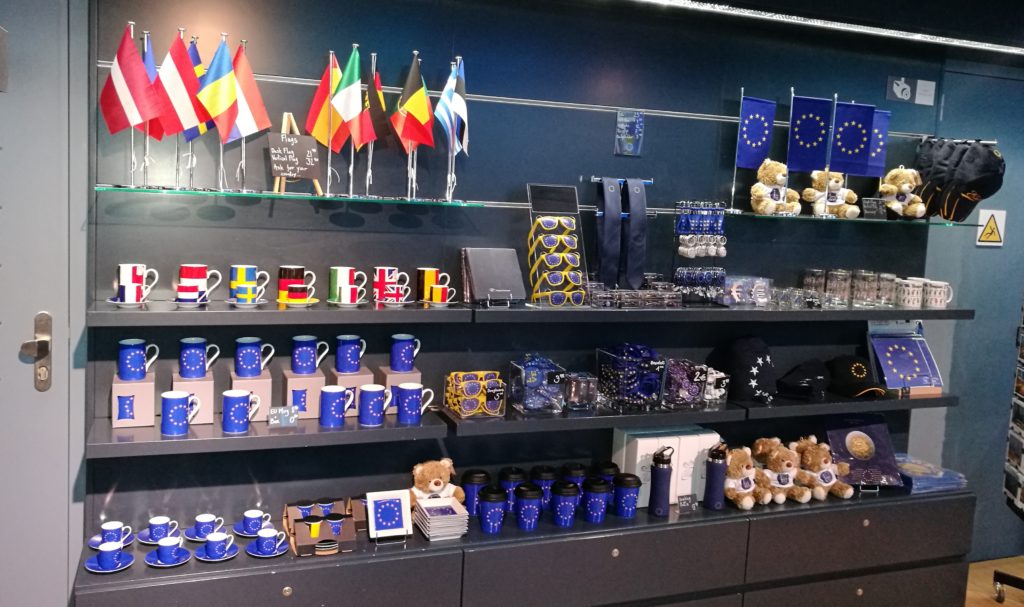
The EU parliament shop. Yes, I did buy something. See if you can guess what.
To add to their grubby little crib sheet of mindless, soulless slogans – “You lost, get over it,” “They need us more than we need them,” “You hate democracy”, “Stop talking our country down”, “Triggered!” – the Brexiters have a new refrain: “You love the EU.” Common variants include “EU-loving leftard”, “EU stooge”, “Why don’t you fuck off to Europe if you love it so much?” and “How much is Soros paying you?” (Answer: not enough to make up for the rise in the price of my weekly shop because of Brexit.)
This is clearly intended to be an insult, disturbingly close in spirit to the “n****r-lover” of old, insofar as it implies that any fondness for the target is self-evidently evil or stupid.
The grand irony here is that before the referendum, I didn’t have any special affection for the EU (just as, four years earlier, animosity towards it was vanishingly rare – pdf). I was aware of its existence, of course: I’d heard about all the red tape and a few allegations of corruption (mostly from Ukip MEPs), and about how the accounts were never signed off, but I also knew that a lot of people had benefited from freedom of movement and research collaboration and was dimly aware that free trade generally creates jobs and keeps prices low.
I did a bit more research in the weeks before the vote, enough to satisfy myself that my instincts were broadly correct, and noted that while some proponents of Remain (Cameron, May, Osborne) were hardly the most trustworthy individuals, the Leave campaigners were, to a man (and Kate Hoey), corrupt, self-serving slimeballs churning out nothing but fearmongering tripe. As a result, when June 23rd 2016 rolled around, I voted Remain.
Then Leave won, and it was only then that I, and millions of others, began to realise exactly how much we had lost.
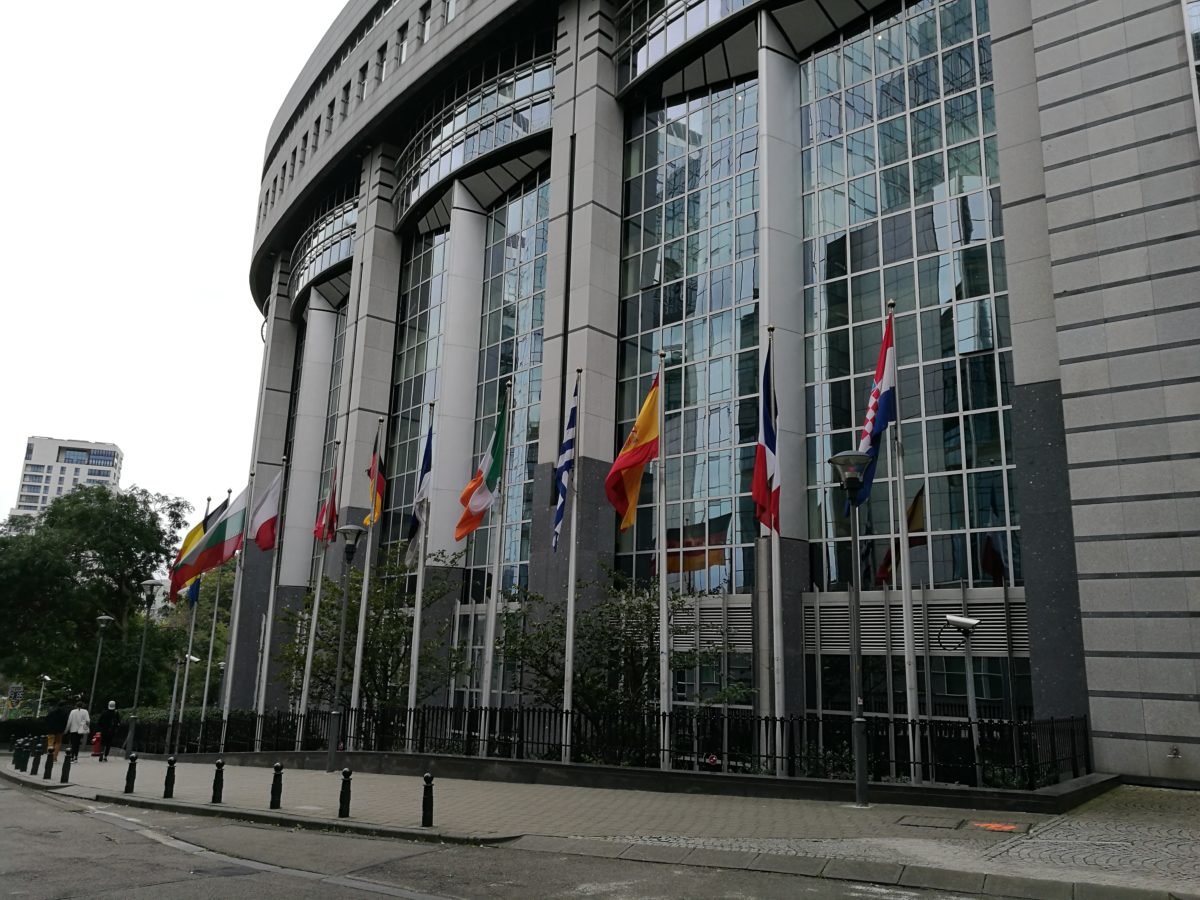
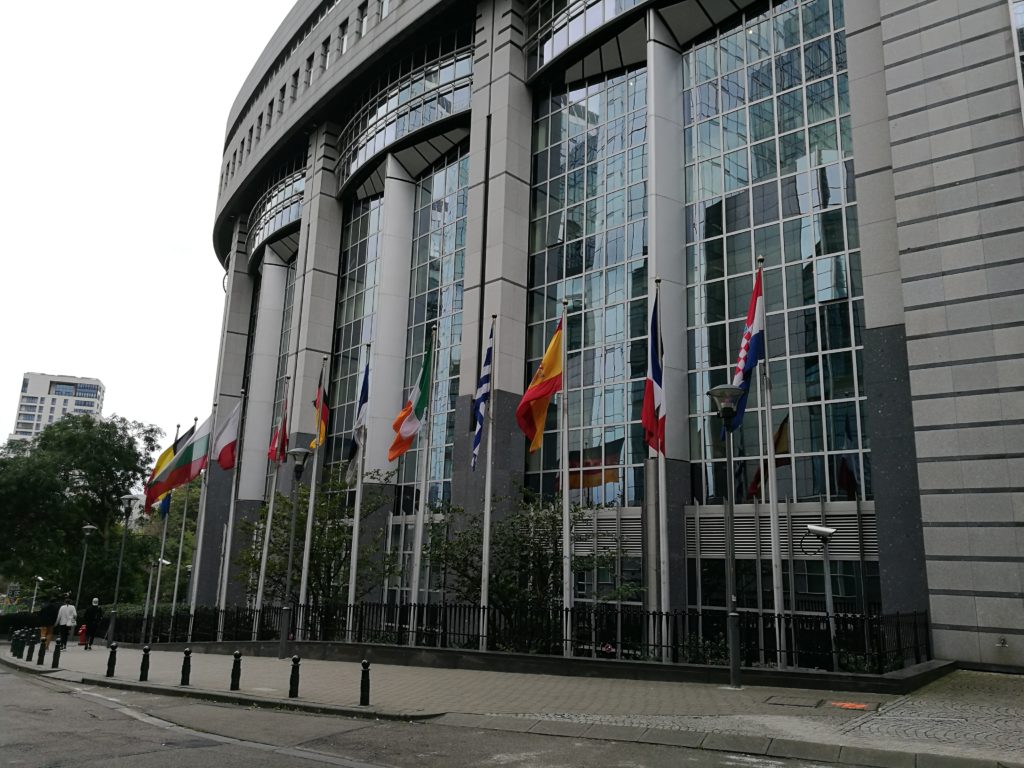
The EU Parliament building. You really should visit some time.
For the last two years, I’ve done little but debate with Leave voters online and devour articles and books on EU law and European history (I can particularly recommend Guilty Men: Brexit Edition by Cato the Younger). I interviewed EU citizens who were leaving the UK because of Brexit. I’ve now written 30 blog posts on the subject (one of which has racked up more than 600,000 hits and another of which was published in the New European, yay). I joined Best for Britain and began donating to all manner of Remain-related causes. I travelled to Brussels and visited the Parliamentarium and the Museum of European History.
And the more I found out, the deeper my attachment to the European project became. The Parliamentarium’s unpretentious explanation of the origins of the EU, as well as being fascinating, offered a sobering reminder of the dire circumstances that were the impetus for its foundation. The Museum of European History, with its tableaux representing decades of everyday life across 28 countries, lifted the soul.
I discovered that all those stories of red tape, corruption and unvetted accounts were a bunch of horseshit. At the same time, I found out that EU membership conferred vastly more benefits than I had imagined: consumer protections, basic labour rights, Horizon 2020, Erasmus, Erasmus +, free mobile roaming, Euratom, EMA, Galileo. And I watched with horror as the vote to leave not only unleashed a sickening wave of xenophobia in my once tolerant country, but led some of the vilest scumbags in existence to believe that they could get away with lies, abuse and psychological manipulation on an industrial scale.
So now I can say, proudly and with my hand on my heart: yes, I do love the European Union. And each one of your jibes and boasts and threats, Brexit fantasists, will redouble my determination to fight for the UK’s continued membership – or failing that, to retain the closest relationship possible.
It’s way past time we had a grown-up, informed conversation about freedom of movement
Warning: pot at gold at end of rainbow may turn out to be punch in face.
I’ve made the case for migration being an intrinsic part of what it is to be human. That does not, of course, necessarily make it a good thing. Human instinct is not the most reliable moral compass. And since purportedly liberal voices have recently joined the far-right tub-thumpers in talking about “tighter controls”, and even the Guardian has to use “actually” in the headline of a positive story about immigration, there are clearly issues yet to be settled here.
So here’s a cost-benefit analysis: a comparison of the (alleged) benefits and drawbacks of human resettlement.
The downsides
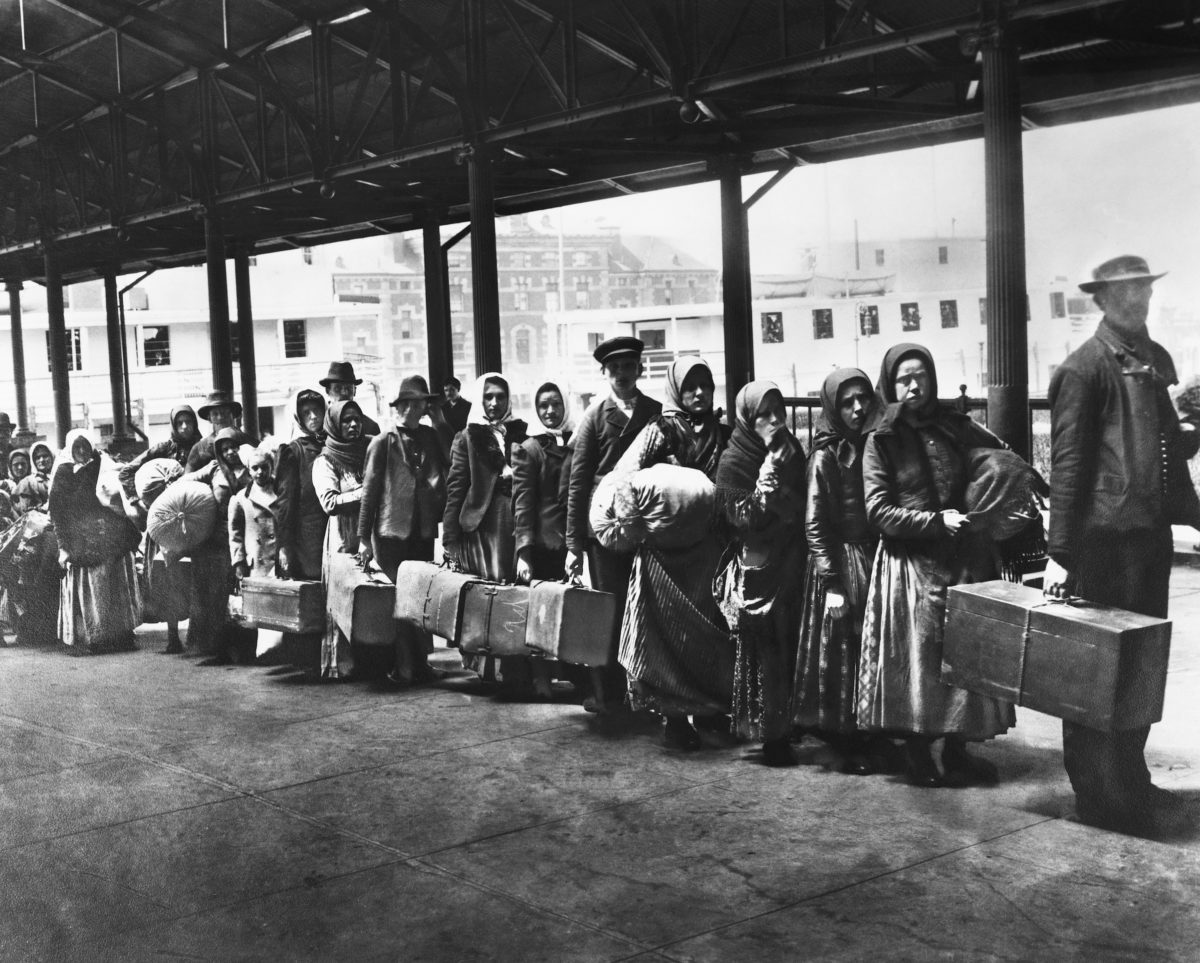
Prior to 1066, most arrivals in the British Isles were invaders or raiders rather than true migrants. The relative calm that followed the Norman Conquest paved the way for the first peaceful settlers – and the slurs the natives have lobbed at them have barely evolved in a millennium.
‘They’re stealing our jobs’
Twaddle on every level.
It was never “your” job to begin with. It was a job advertised in the country where you happened to be born. It was the employer’s job, to give to whomsoever she chose.
The migrant is in no sense “stealing” the job; she is merely competing fairly for it. If you’re finishing second best to someone whose first language isn’t English, you might want to think about a different line of work.
The majority of immigrants take jobs that Britons simply don’t want to do, such as cleaning, fruit picking and social care. Many more take roles that Britons cannot do: the UK has huge skills shortages in a number of sectors, notably engineering, IT and healthcare.
(Incidentally, the racists who trot out this line can rarely back it up with evidence. When they do, it’s anecdotal: “It happened to me” or “It happened to my mate”. Sorry to break it to you, Socrates, but the value of anecdotal evidence is precisely diddly-squat. All the large-scale data says otherwise.)
Besides, the number of jobs available is not fixed (this common misapprehension is known as the lump of labour fallacy). Immigrants earn and pay taxes, pay rent, buy food and clothes and phones and all the other things natives do. This indirectly creates more jobs. Furthermore, many of them start up their own businesses (indeed, immigrants are twice as likely as locals to do so), thus directly creating more jobs. If there were a fixed number of vacancies in an economy, then unemployment after years of mass immigration should be stratospheric. It’s not. The latest figure is 4.1%, or 1.38 million people – among the lowest of all time.
It’s true that living in an economic union of 550 million citizens means there’s 10 times as much competition as when the UK’s borders were closed. But it also means there are 10 times as many job opportunities. That’s the whole point of an expanded labour market: more choice for employers, more for employees.
‘They’re driving down wages’
Not according to 99% of all research into this issue, they’re not. Some studies have found marginal evidence of a slight depression in pay for the very lowest-paid, but the picture is far from clear-cut, not least because it’s impossible to know what would have happened to wages in the absence of freedom of movement.
At worst, according to the Migration Advisory Council’s calculations, a 10% increase in the number of non-natives entering the services industry may have resulted in a 1.9% decrease in wages for those employed in it – most of whom, traditionally, were migrants already.
Besides, any short-term losses are more than made up for in the long term by overall growth in the economy due to immigration, which benefits everyone.
‘They’re all scroungers’
This argument, in conjunction with the above, conjures the image of Schrödinger’s immigrant: a shadowy figure simultaneously stealing people’s jobs and lazing in front of Jeremy Kyle while wallowing in the opulence conferred by the UK welfare system.
It’s also bollocks. Government figures show that foreign nationals are far less likely to claim benefits than people born in the UK; while they make up 17.6% of the working population, they account for less than 7.4% of benefits awarded.
This is largely because the law grants foreign-born citizens less access to the welfare system in the first place. Under our arrangement with the EU, no EU citizen can claim benefits for the first three months of their stay, and they can be deported if they have not found work after three further months on benefits (or cannot otherwise support themselves).
Besides, it makes no sense. Who in their right mind would give up their friends, family and culture, uproot everything and go to all the trouble of building an entire new life in a country with unfamiliar food, customs and language, with the sole aim of pocketing the princely sum of £73 a week?
‘They’re all criminals’
Jewish usurers, Gypsy thieves, Italian mobsters, Irish thugs, Asian grooming gangs: virtually every wave of foreigners to set foot on these shores has endured systematic accusations of wrongdoing. While every cart has its bad apples, it simply isn’t true that immigrants are more likely to break the law than natives.
Unfortunately for your argument, Mr Racist, IRCs are … immigration removal centres, which hold people awaiting deportation, almost exclusively for immigration violations. They generally hold around 3,000 people. So the number of foreigners detained in English and Welsh prisons, for actual crimes, is only 8% of the total. Or below the national average.
In some cases, it appears that immigration actually lowers crime. One research paper, for example, found that the incarceration rate among foreign-born US citizens was a quarter of the rate for those born there.
Criminals, like benefit scroungers, are lazy. It’s their defining quality. The reason they commit crimes and sign on, rather than getting a job, is that they want maximum return for minimum effort. But (as any British plumber allegedly put out of work by a Polish counterpart will tell you) most migrants work hard.
It stands to reason. Is someone who has the get-up-and-go, organisational skills and commitment to do the necessary research, learn a new language, fill out all the paperwork, leave behind home, career and family, travel hundreds of miles, set up a bank account, etc, really going to turn into a slob on arrival? Is a rapist-in-waiting really going to go to all that trouble merely because he fancies raping British women?
Blackguards and wastrels are more likely to ply their “trades” nearer home, where they have established criminal networks and understand the local markets and loopholes, than to trudge halfway across the world to an alien land with a firmer rule of law.
It’s worth mentioning – because most Leave voters sure don’t seem to know – that under EU law, the UK already has the power to deport criminals of EU origin. It can also prevent known offenders from entering. In the year ending June 2017, 5,301 EU citizens were deported from the UK, and in the period 2010-2016, the Border Force refused entry to 6,000 EU nationals.
“But look,” say the racists, linking to a single story about an EU immigrant who committed a crime, or a handful of bad guys. Again, they’re generalising from isolated incidents to a broader pattern that the figures just don’t support.
“I don’t care if only 0.25% of foreigners commit crimes,” bleat other racists. “Ten thousand is too many! Get rid of them all!” That’s like banning all cars because 0.6% of them are involved in serious accidents every year, or banning all doctors because 0.4% of them have criminal convictions. Madness.
When racists attempt to support their claims with evidence, they invariably cite the Quilliam report, just about the only vaguely authoritative investigation into so-called grooming gangs conducted to date in the UK. Close analysis, however, reveals it to be no such thing; its assumptions, methodology and conclusions have all been rubbished by other commentators.
As a footnote, I would remind you that Britain’s departure from the EU threatens its participation in the European Arrest Warrant, under which almost 7,000 criminals were removed from 2009-2016.
‘They’re putting pressure on housing and social services’
There is some logic behind this one. Unlike the labour market, a country’s resources and services are, at any given point, finite. If more people arrive, there will be fewer houses, school places and GP appointments to go around.
However, governments always have the option to build more houses and schools, just as they have done to accommodate population growth throughout history. And as it turns out, immigrants disproportionately take jobs in education and healthcare, and, being younger and healthier, use these services less. As the UK is now discovering, if you create a hostile environment for foreigners, the teachers, lecturers, doctors, nurses and carers will be among the first to leave, and services will come under yet more strain.
“Why can’t we just train our own?” whine the racists. We can; but in the first place, it’s expensive – it costs £70,000 to train a nurse from scratch, £479,000 for a general practitioner, and £725,000 for a consultant. Second, it takes time: four years for a nurse, nine for a doctor. And third, you can’t expect exactly the right number of British students to step into a particular role simply because The Country Needs It. Supply does not always meet demand (which is another argument for a common market; it creates a larger playing field over which such imbalances can be corrected).
By the by, the notion that “Britain is full” is risible. The population density of the UK is 272/km2. By comparison, Monaco has 19,009 people per square kilometre, or 70 times the concentration. The UK population would have to reach 4.5 billion before it was as full as Monaco.
‘They’re destroying our culture’
A couple of hundred years ago, English culture was cockfighting, bear-baiting, maypoles and Morris dancing. Few got out their hankies when they faded away to be replaced with football, pubs and Celebrity fucking Big Brother.
In any case, the speed of change in the UK is constantly being exaggerated by the media. The endless stories in the Daily Mail and Express about people forced to say “Happy holiday” instead of “Christmas”, the word “Easter” being omitted from chocolate eggs and pork products being dropped from restaurant menus are usually anecdotal if true at all: scaremongering designed to sell more papers. Oh, and there are no sharia courts. There are a few dozen sharia councils that consult on matters of marriage and divorce.
To those racists who insist that the British way of life is under threat, I say this: Welsh, Scottish and Irish cultures are all still pretty damned vibrant. If they can survive centuries of English dominion, why can’t English culture survive the arrival of a few million guests?
Culture is fluid. Like language, it’s a living, breathing thing. Any culture that stops changing withers and dies. And how do cultures change? By evolution, certainly, but mostly, like language, by borrowing from others. To illustrate this point, I’ve compiled a short list of aspects of “British” culture that aren’t actually British at all:
Fish and chips (Portugal, Belgium), roast dinners (France), full English breakfast (Germans popularised sausages and bacon, while baked beans come from South America via the US and their sauce is made from Mediterranean tomatoes), barbecues (Caribbean), beer made from hops (Netherlands), golf (ancient Rome or China, via pre-Union Scotland), April Fool’s Day (France, or the Netherlands; certainly not England), Christmas and all things Christian (Middle East), Christmas trees (Germany), Easter eggs (Africa via Iraq), New Year’s celebrations (Iraq), pantomime (Italy), curry (India/Sri Lanka), pizza (Italy) and St George (Turkey).
‘They don’t integrate’
Admittedly, some do so more successfully than others. Just two points here: 1) integration is a two-way street. If you demonise and/or intimidate immigrants and refuse to employ them or socialise with them, you can hardly blame them for sticking with their own kind. 2) I can state categorically that every one of my friends from the EU – the ones who are still here, as well as the ones driven away by Brexit – speak and write English to a far higher standard than the average Brexiter on social media.
‘Allowing free movement within the EU discriminates against non-EU citizens’
This laughable bad-faith argument is about migration from specific countries rather than migration in general, but I’m mentioning it here because it seems to have gained a lot of traction of late.
You can see its appeal. It allows Brexit diehards to paint Remainers as the bad, racist guys and by extension themselves as the angels. But the notion that, because certain people enjoy certain advantages and others do not, you must create a level playing field by removing them from everyone – “’S not fair!” – is absurd.
By this reasoning, Fitness First is discriminating against non-members by only allowing in paying members. Alice is discriminating against Jenny (and everyone else on the planet) by dating Brian, so she must remain single for ever. And you are discriminating against all other fruits by eating an apple, and so must starve.
It’s impossible to strike deals with everyone at once. This is just a cynical contortion of language in an attempt to mislead, one that smells very strongly of 55 Tufton Street.
‘They’re all riddled with disease’
What utter bastards! When they’re not stealing your job or raping your children, they’re infecting you with typhus and AIDS!
Accusations of uncleanliness have dogged migrants for centuries – the Irish and the Gypsies came in for a particularly hard time – and while this line hasn’t seen so much play in the Brexit debate, the fake news merchants at Fox Newsand the like are frantically pursuing the health emergency angle in their rush to demonise the central American migrant caravan.
The more hysterical nationalists are convinced that if immigration persists at its present levels, white British people will soon be in a minority, or eliminated altogether.
This is the slippery slope fallacy in action: the assumption that a trend will continue unchanged. But trends never do. Rates of migration rise and fall. The UK has recently experienced a peak in new arrivals, as a result of the accession of the eastern European states. As those states’ prosperity approaches that of the UK, the number of people moving here will decline.
No one’s seriously going to dispute this, are they? I’ve already mentioned the high levels of foreign-born staff in the NHS and the education system, but they also make up a disproportionate chunk of the workforce in catering, construction, fruit-picking, food preparation and technology. Food is already rotting in fields and patients dying alone in hospitals since the number of immigrants began to fall after the Brexit vote.
They’re great for business
Immigrants bring energy, dynamism and ideas. Immigrants are responsible for one in every seven new startups in the UK, and their ventures create 14% of all British jobs. Here’s a far from complete list of great “British” brands that were in fact founded by immigrants or the children of immigrants: Dollond & Aitchison, M&S, Tesco, Rothschild & Co, ICI, General Electric, Burton, Selfridge’s, Barings Bank, Barnardo’s, Mme Tussauds, GlaxoSmithKline, British Petroleum, Reuters, Schroders Asset Management, Moss Bros, Triumph, Lion’s soaps, Shell, Easyjet, Cobra Beer, Acorn Computers (ARM), WPP, Cafe Nero, DueDil, RationalFX, Deliveroo, Transferwise, Kano, Carwow and Hassle.
They enhance our culture
New food, new music, new fashions, new words. You can draw up your own fucking list this time.
They boost the economy
If you can find me a single authoritative, peer-reviewed study that shows that immigrants to the UK have a net negative effect on the economy, I’ll shag Katie Hopkins.
But you don’t have to trawl through academic papers for proof that freedom of movement is an economic boon. You just have to draw up a list of the richest cities and countries in the world and then look at their respective levels of migration.
They compensate for falling birthrates
Indigenous Brits are not reproducing at a sufficiently high rate to replace the existing population. British-born women have an average of only 1.7 children each, and a further 200,000 Brits leave these shores every year. Without immigration to make up the shortfall, the British population would decline by 417,000 every year.
And a shrinking population, as China is discovering, is catastrophic for the economy, because there are fewer people to pay tax and thus fund healthcare and pensions for the older generation.
They enhance our personal lives
As well as giving us access to a wider employment market, migration – inward and outward – vastly increases the choice of friends, business partners and lovers available to us. As this is hard to quantify, there’s little in the way of hard research on the subject, but I know I am not alone in having made dozens of wonderful, life-changing connections that would never have come to pass without freedom of movement.
They make war less likely
Last and foremost, freedom of movement between the nations of Europe has – exactly as it was intended to – increased mutual reliance, cooperation and understanding between peoples, tempered nationalist tendencies, and led to the longest spell of uninterrupted peace in the continent’s history. I’m in no hurry to throw that away.
So that means …
“Tottenham has turned French” – Unnamed Londoner, early 16th C
“A certain preacher … abused the strangers in the town, and their manners and customs, alleging that they not only deprived the English of their industry, and of the profits arising therefrom, but dishonoured their dwellings by taking their wives and daughters” – Sebastian Giustinian, ambassador to Venice, 1517
“A congregation … of distressed exiles growne so great and yet daily multiplying, that the place in short time is likely to prove a hive too little to contain such a swarme” – W Somner, 1639
“The nation it is almost quit undone//By French men that doe it daily overrun” – Anonymous, 1691
“Why should we take the bread out of the mouths of our own children and give it to strangers?” – John Adams, US president, 1800
“The Jews of the lower orders … have not a principle of honesty in them; to grasp and be getting money for ever is their single and exclusive occupation” – Samuel Taylor Coleridge, 1830
“Refugees from Syria are now pouring into our great country. Who knows who they are – some could be ISIS. Is our president insane?” – Donald Trump, 2015
I feel ashamed to be a human being when I’m reminded of how little we have learned through the ages.
When debating Brexit with Leave voters on Twitter, I used to concede the point that “having concerns about mass immigration is not racist”. I take it all back. It’s racist as fuck.
The reason I’ve liberally peppered this post with the word “racist” is that, after looking at material from hundreds of sources and weighing the matter long and hard, I’ve concluded that there is no argument against immigration. The benefits are enormous, the costs negligible. The only possible reason left that anyone could have for objecting to immigration is xenophobia, English exceptionalism, Fear of the Other: in a word, racism.
Immigrants are people. Just like us. In fact, usually, better than us; more industrious, less likely to commit crimes, younger, healthier, brighter. If you deny or dismiss the fact that migration is a fundamental part of human nature; if you wave away the proven benefits; if you insist on stressing the downsides to the exclusion of all else, even though there is scant (if endlessly repeated) evidence to back up your point; then you, my foe, are a racist.
Historically, there have been some problems, but it’s invariably the migrants who bear the brunt. Locals might have been mildly inconvenienced by the unsanitary conditions in an Irish ghetto, or the din generated by Italian ragamuffins playing barrel organs on the streets of 19th-century London; meanwhile, the migrants themselves were starving, dying from cholera, being shunned and deported and lynched.
Robert Winder put it so eloquently in his book on migration, Bloody Foreigners, that I’m shamelessly going to quote him in full:
“Illegal immigration is a fine-toothed comb. The system catches the clumsy or the clueless; only the best, the bravest and the luckiest slip through. It should never surprise us when migrants prosper; nearly all of them have passed an exacting extrance exam.”
All this fearmongering about immigrants and minorities has no basis in reality; it is the tool of dangerous demagogues. It is they, and not the targets of their false fury, that we should be deporting.





 In the interests of fairness, I’ll only count this as one more Remainer. (PS: thanks for your bravery and honesty, Simon!) In any case, this is only supposed to give a general picture of the momentum building against a hasty and calamitous exit from the EU.