You've come to the wrong place for inspiration.

The curious case of Adam Baum
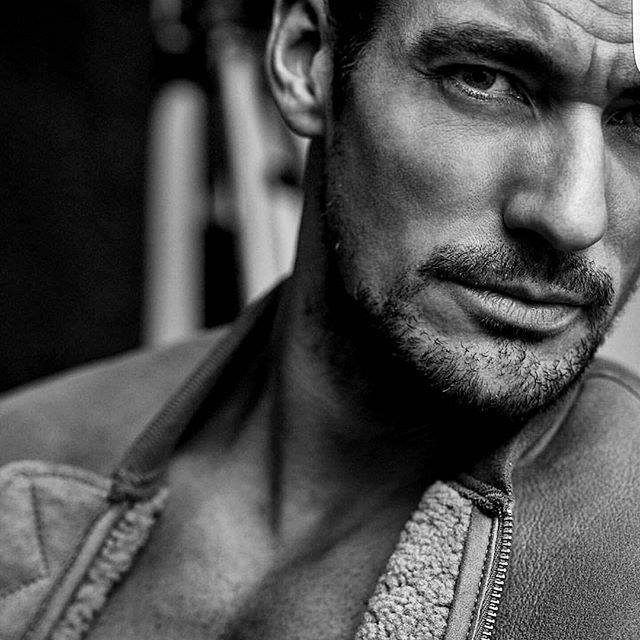
David Gandy, model

Patriotic American with a passion for Ukraine, or Putin-sponsored paedo troll? Tough call

David Gandy, model
Definitively not Adam Baum.

On 18 February 2014, anti-government protesters and police clashed violently in the Ukrainian capital, Kiev. The fighting left at least 80 people dead and 1,000 injured. The protesters were calling for the removal of the president, Viktor Yanukovych, who was seen as being too close to Russia and a threat to the country’s burgeoning relationship with the EU. They got their wish: Yanukovych fled on 22 February, and a government more sympathetic to the people, and the west, was put in place. It was a bitter blow to Vladimir Putin’s hopes for greater influence in his former vassal state.

On 23 February 2014, an individual going by the name of Adam Baum registered as a commenter on the Guardian website.

Guardian comment

Baum’s first comment, at 4.35pm GMT, is innocuous enough: an anodyne remark under a piece about the American healthcare system. Forty minutes later, though, he weighs in on a topic that will prove to be very dear to his heart.

Olympics comment

The article is an opinion piece by the Observer’s Nick Cohen about Ukraine and Russian money-laundering. The YouTube account hosting the video Baum links to has been deleted, but it’s a fair guess, judging by the rest of his posts, that it was some conspiracy theory about TV coverage of the Sochi Winter Olympics, which had recently finished.

Twenty-seven of his 67 comments over the next three years are devoted to the Ukraine crisis, all firmly on the side of Putin and Russia and against the west. Most of the rest are about – have you guessed already? – Brexit, and the last two, posted in January this year, are a defence of Trump and a dig at Hillary Clinton.

So what, you say? Perhaps Mr Baum is a Russian-speaking resident of eastern Ukraine. Perhaps he has every right to have an opinion on these issues. Well, this is where things get weird.

On his Guardian profile, Baum describes himself as a “political analyst and commentator” interested in “global issues”. But I could find no mention of a recognised political commentator of that name anywhere. In fact, I couldn’t find any third-party mentions of anyone called Adam Baum fitting this person’s description.

Nick Bateman
Also not Adam Baum.

So I downloaded his profile picture and carried out a Google image search. And wouldn’t you know, the photograph doesn’t seem to depict “Adam Baum” at all, but a certain Nick Bateman, a 30-year-old male model from Canada. Moreover, you’ll notice a little black, blue and red flag superimposed on the photo. Kudos to you if you get this one in the flags round of the pub quiz, because it turns out to be the emblem adopted by the People’s Republic of Donetsk, a self-proclaimed but largely unrecognised state in eastern Ukraine almost certainly supported by Putin.

That would at least tie in with the ethnic-Russian-in-Ukraine story. But why the fake pic? And if he is in Donetsk, why, in his third Guardian comment, does he tell us this?

Arizona comment

Note: “I’m an American.” This would all have remained a mildly baffling nothingburger, were it not for the fact that in Baum’s last comments, in January this year, he provides a link to a post … on the Facebook page of one Adam Baum.

I say Adam Baum’s Facebook page, but the chap depicted at the top (see main image) looks rather different from our Ukrainian Arizonan Canadian friend. This man, it transpires, is British model David Gandy, 37. (Hey, if you’re going to post a fake picture, you might as well set the bar high, eh?)

Now we begin to see a broader – but no less confusing – picture of Adam Baum. His bio says he is self-employed and “looking for a FaceBook Relationship with an intellectual & sexy Woman”. His friends aren’t public, but two people are listed as “family”: one an obvious fake sub-porno model account, inactive for three years, the other someone called John Ayaz, with no public details and a profile picture of the Indian actor John Abraham – another imposter.

The Facebook timeline featured more links, which in turn led to more, and more, and it soon emerged that “Adam Baum” (sometimes in his Gandy guise, sometimes as Bateman) has a presence on every social media platform you can think of. Tumblr, YouTube (35 subscribers), Twitter, Instagram, Minds.com (new “libertarian” site), Pinterest, LiveJournal, VK.com (the “Russian Facebook”), Patreon, and gab.ai, the new refuge of the alt-right since many of its chief agitators started being booted off major platforms. He runs a WordPress blog, and, until its recent suspension, had a Medium page too. He’s even, in a farcical show of completeness, got a MySpace page.
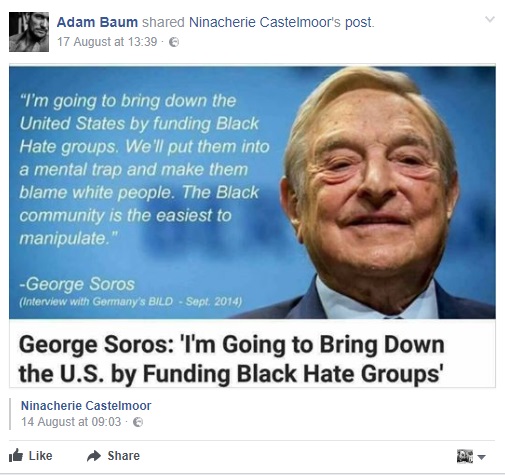
George Soros lie
He never said any such thing, of course. See http://www.snopes.com/george-soros-bring-down-us/

None of these accounts are quite what you’d expect, either from a middle-aged Arizonan or a Russian spy. They’re a mix of putative personal photos (mostly stock shots stolen from Greek and Turkish websites), memes, crackpot conspiracy theories, shit jokes, anti-globalist propaganda, and, disturbingly, dozens of pictures of scantily clad or naked women. In some cases very young women.

A few are outright pornographic, and one shot on his Twitter feed looked very much like a photograph of Britney Spears spattered with semen, but most are just glamour shots of borderline anorexic teenage models like the ones below. Among his “liked” pages are those of Liberty Grant, a 14-year-old singer, and Laneya Grace, a model aged 13. He’s a member of five public Facebook groups: something about Syria/Ukraine, a Putin fan page, a porn group and two pages devoted to teenage girl celebrities.

Underage girls
*All models considerably younger than 18.

The deeper you dig, the more slippery the identity of this person or persons becomes. Baum’s English, good on the whole, is marred by the occasional serious lapse, and not of the type that a native speaker would make: “The #US Coup Junta has given the peaceful #Maidan protesters a bloodstained Fascist reputation to live down” (why hashtags on a comment? Suggestion of automation here?); “We were put here with all that we needed to be fruitful and share in with thanks for it going to are all common creator”; “From my dead cold hands”.

Halfway through his Guardian history, there’s a particularly startling moment: beneath a story about diplomatic calls leaked on YouTube, he has posted a comment entirely in Russian. Was this a drunken mistake? (Once you’ve posted a comment on the Guardian website, you can’t delete it.)

Comment in Russian
Шутки в сторону?

Here’s a rough translation: “I’m all for the California idea … the main problem here will be that it seems the Chinese beat you to it. Before the overthrow of the regime there, America should look closely at Cuba. Florida may be up for a referendum on secession. [laughs])” Why would Baum be interested in California? Simple: the Californian independence movement is one of a number of causes believed to be supported by Vladimir Putin in his campaign to destabilise America and Europe.

But according to Russian friends of mine, this is clumsy, unidiomatic – the sort of result Google Translate might produce. English may not be Baum’s first language, but it doesn’t seem as though Russian is either.

Of all the “personal” pictures I checked out, I could find only one that wasn’t obviously lifted from somewhere else, and that shows the One World Trade Center in New York. Not terribly helpful. He’s no tech wiz, because in three years of posting comments on the Guardian, he never figured out how to use the “link” tool.

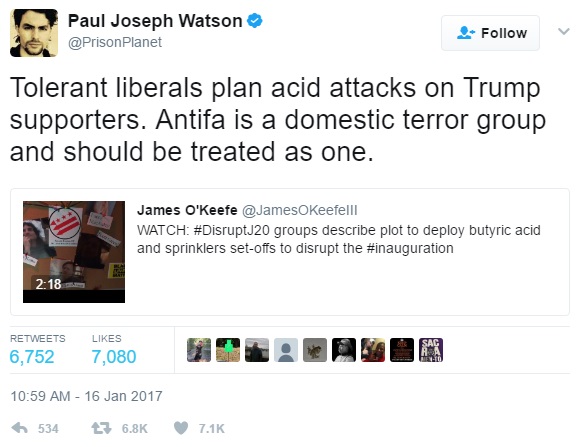
He follows only 49 people on Twitter: radical political commentators of left and right, “alternative media” (bullshit artists), cosplayers, porn, Trump, alt-right propagandist Paul Joseph Watson, and Julian Assange. His bio links to a video on the sharing service RUTube, the Russian YouTube, showing someone apparently being shot in Ukraine in 2014. His 57,000 tweets, made at the rate of about 25 a day, are as eclectic as the rest of his output, and rarely provoke a response from any of his 2,000 followers. The most informative resource is his profile on VK.com, which describes him as a 42-year old resident of Los Angeles. Which sort of fits with some of what we’ve seen. But that just raises the question of why an LA resident has a profile on Russian Facebook in the first place.

As for life history, all we have is that bizarre reference to Arizona jail time. It seems an odd thing to make up, and since he never refers to it again (but does leave a couple of comments on stories about US jails), it seems unlikely that it’s part of some elaborate cover story. I think the individual behind Adam Baum really did serve time in prison. The event he describes took place in 1998, which would put him in his late 30s or early 40s – consistent with the VK.com bio, and in the same ballpark as Gandy.

Most perplexing of all, across all these accounts, Baum never really seems to have any meaningful interactions with anyone. His Facebook posts get no likes or responses, ditto for his tweets, and there are no comments under any of his ripped-off blogs. If he is a paid Russian shill, Putin ain’t getting much bang for his rouble. (It’s worth noting, though, that his mere six pages of comments on the Guardian site generated more than 100 pages of responses.)

I messaged the Twitter account asking him to explain who he was and why he was so interested in Ukraine, and he immediately blocked me. I sent him a message over Facebook asking the same thing; no reply came.

I have three vaguely plausible theories as to what we’re dealing with here. One, a Ukrainian national in his early 40s, now living in the States, who has maintained an interest in the motherland and swallowed a load of conspiracy tosh. Two, a seedy failed glamour photographer supplementing his income by spreading dezinformatsiya for Vlad or Robert Mercer. Or three, a full-time employee of Putin’s who inexplicably thought the best choice for his fake persona would be a kiddie fiddler.

I might be able to narrow it down if I did some more combing through his online corpus, but frankly, I don’t have unlimited time to devote to one small cog in what I now firmly believe to be a colossal propaganda machine.

Because it’s an established fact that trolls and bots are being deployed on social media sites and in the comments sections of news sites in a bid to sway public opinion.

Human operatives, directing automated and semi-automated accounts, are poisoning the waters of discourse with lies and propaganda, most of it directed against Muslims, liberals, and the EU. The extent of these operations is not yet clear, nor exactly who is behind them, although suspicion has alighted on Vladimir Putin, big tobacco, big sugar, and billionaire investor Robert Mercer, among others.

It’s even harder to tell just how effective the campaigns have been, but the fact that both Brexit and Trump won in defiance of virtually every prediction – Trump in exactly the electoral colleges he needed to – strongly suggests something fishy was going on.

Thing is, we all believe that we’re independent thinkers. We think we’re savvy enough to look at the available facts and form sensible opinions therefrom. But the painful fact is, not many of us are right. Many people – especially those who haven’t got the time or the inclination to look into matters for themselves – tend to go along with the majority view (or at least the consensus among their identity group – their class, their neighbours, their political party).

In 1951, psychologist Solomon Asch performed an experiment in Swarthmore College in Pennsylvania. Groups of people were given a test with one very obviously right answer and two very obviously wrong ones.

The catch was that only one person was actually being tested. The rest were plants. The surprising conclusion of the research was that if the plants all insisted on giving the wrong answer, 32% of the test subjects, instead of defending the correct solution, caved in and went with the flow. (In the control group, where there was no pressure to conform, subjects gave the wrong answer only 1% of the time.) Subsequent tests with different subjects and criteria reported the effect to be smaller, but it is undoubtedly there.

We’re all familiar with the phenomena of mass hysteria and mob mentality. When all your friends feel a certain way, there’s huge pressure, internal and external, for you to go along with it, because you don’t wish to rock the boat, or be considered the odd one out. It’s how most cults and religions work.

I am no longer in any doubt that this is a human weakness that Vladimir Putin, or Robert Mercer, or whoever, is pulling out all the stops to exploit. If you can change the minds of 33%, or 15% – sometimes even only 2% – you can start rigging results to go your way. Remember, the Solomon Asch experiment was a relatively clear-cut issue. How much stronger could the conformity effect be if the matter at hand were something more complex and less obvious, like the relative costs and benefits of leaving the EU?

In online and telephone polls before the referendum, Remain was winning comfortably until about two weeks before the vote. The proportion of “don’t knows” held steady at about 20% for most of the campaign, narrowing to 10% immediately before the vote. The margin of victory on the day was less than 4%. What changed these waverers’ minds?

Analysis of social media activity has shown that in the final days of campaigning before the referendum, messages promoting Leave outnumbered those promoting Remain by anything from 3 to 1 to 7 to 1, depending on the platform – even though we know that younger people are far more active on social media and that young people were far more likely to vote Remain. A similar phenomenon was observed immediately prior to the US presidential elections. How many of these messages were from people like Adam Baum, and how many floating voters did they hook?

One thing’s for sure: you need to be very, very concerned about Baum and his friends. Yes, even you, Brexiters. Because the point of this barrage of misinformation was not just to help win Brexit and elect Trump. Vlad (or Bob) is not done yet. He wants our countries divided, conflicted, broken. And his efforts to turn Brit against Brit and American against American are having a side-effect: they’re destroying our reputation in the eyes of the rest of the world.

You may not be a racist Leaver, and this may not at heart be a racist nation, but because these troll armies are shouting their xenophobic tripe so loudly, other countries are starting to believe we are. EU citizens and UK nationals are leaving in droves and investment levels are through the floor. The decline in tourism to America since Trump took power is projected to cost the US around $7.5bn this year (and that estimate was made before Charlottesville). Regardless of whether Putin and Mercer achieve their long-term goals, the short-term damage could still be immense.

I was inspired to carry out this work partly by the recent sterling efforts of Mike Hind and Conspirador Noreño in outing an industrious Russian troll on Twitter, @DavidJo52951945. “David Jones”, who has over 102,000 followers including a number of Ukip MEPs and has been tweeting anti-EU, anti-immigrant propaganda for years, was finally, conclusively proven to be a Russian plant this week. (Do check out Conspirador’s highly informative and entertaining thread on it.) I would like to think that, if a few more people can start hunting down and exposing these trolls, then we can start fighting back against the tide of disinformation that’s threatening to swamp our democracies.

I don’t expect everyone to put as much time as I have into these activities. But I would ask you, when you next come across a suspicious account, not to ignore it and hope it goes away. These people aren’t going anywhere any time soon. Challenge them. Report them. Inform the photographers whose copyright they have violated. If you’re on Twitter, tweet about them, and maybe someone else will be able to take up the cudgels. Our society, our very way of life are under attack, and since our governments don’t seem willing or able to do anything about it, the job of protecting them falls to us.

UPDATE, 30/8/17: I feel vindicated. (Screenshot from the “Make Adverbs Great Again” tool, which I’ve only just discovered, that grades Twitter accounts on their likelihood of being trolls.)
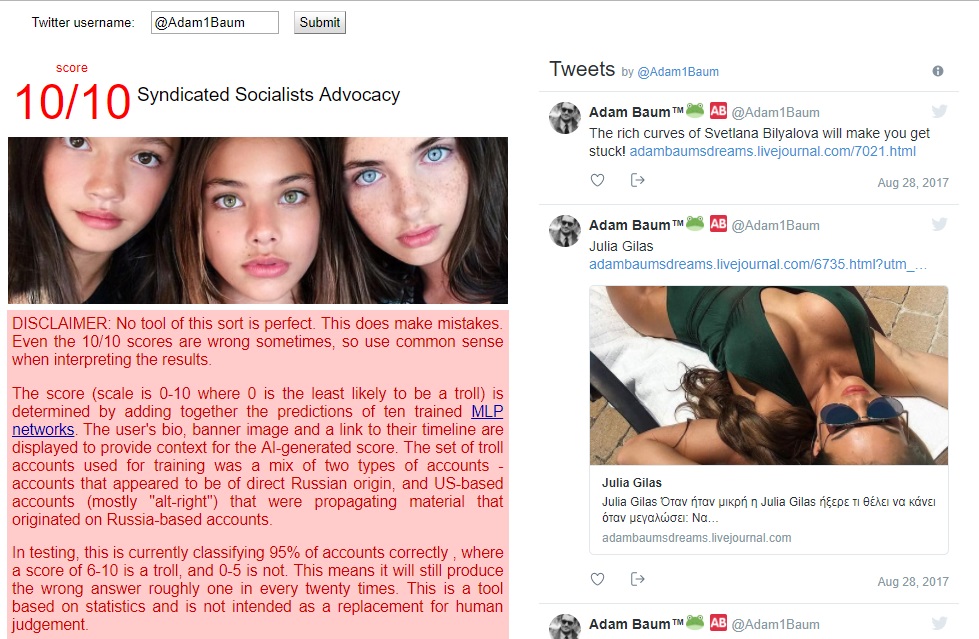
Account scores 10/10
Fuck you, Dmitry.

Exit, pursued by a bulldog

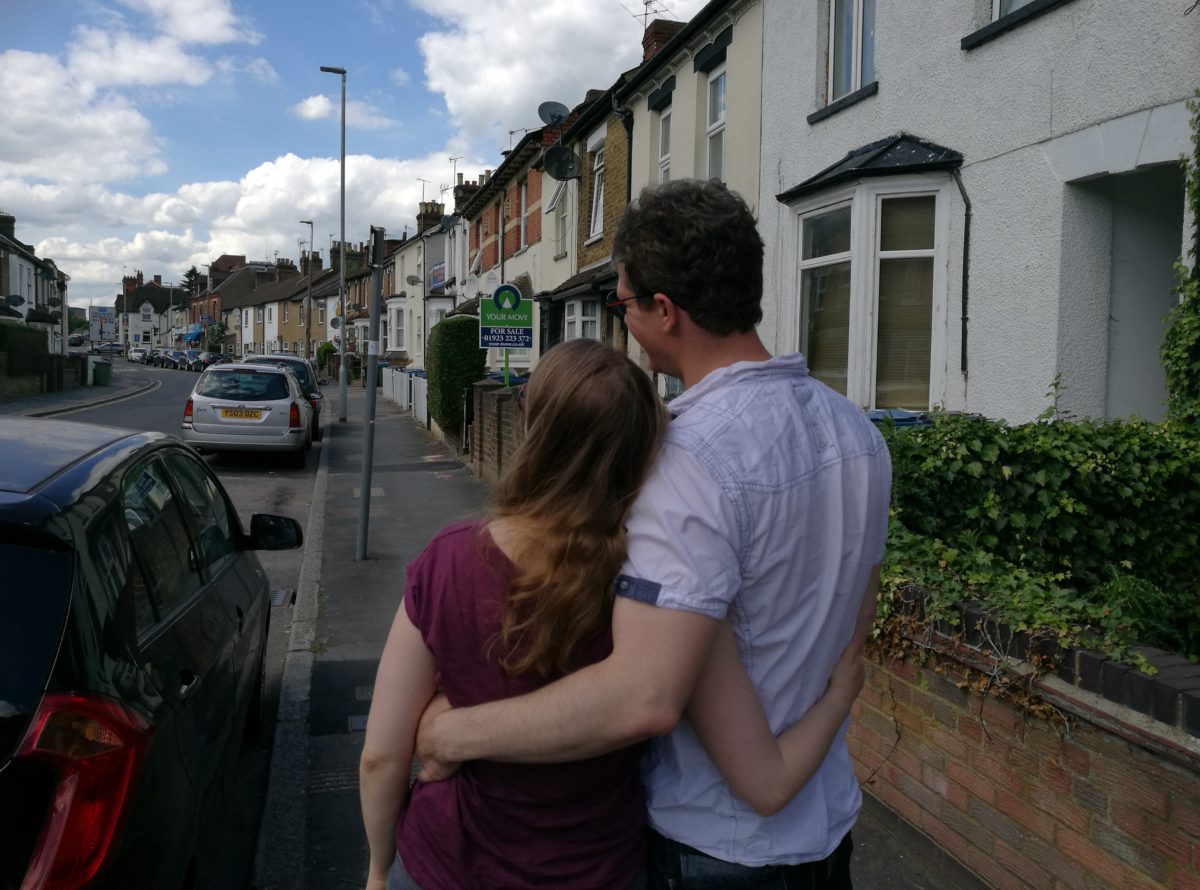
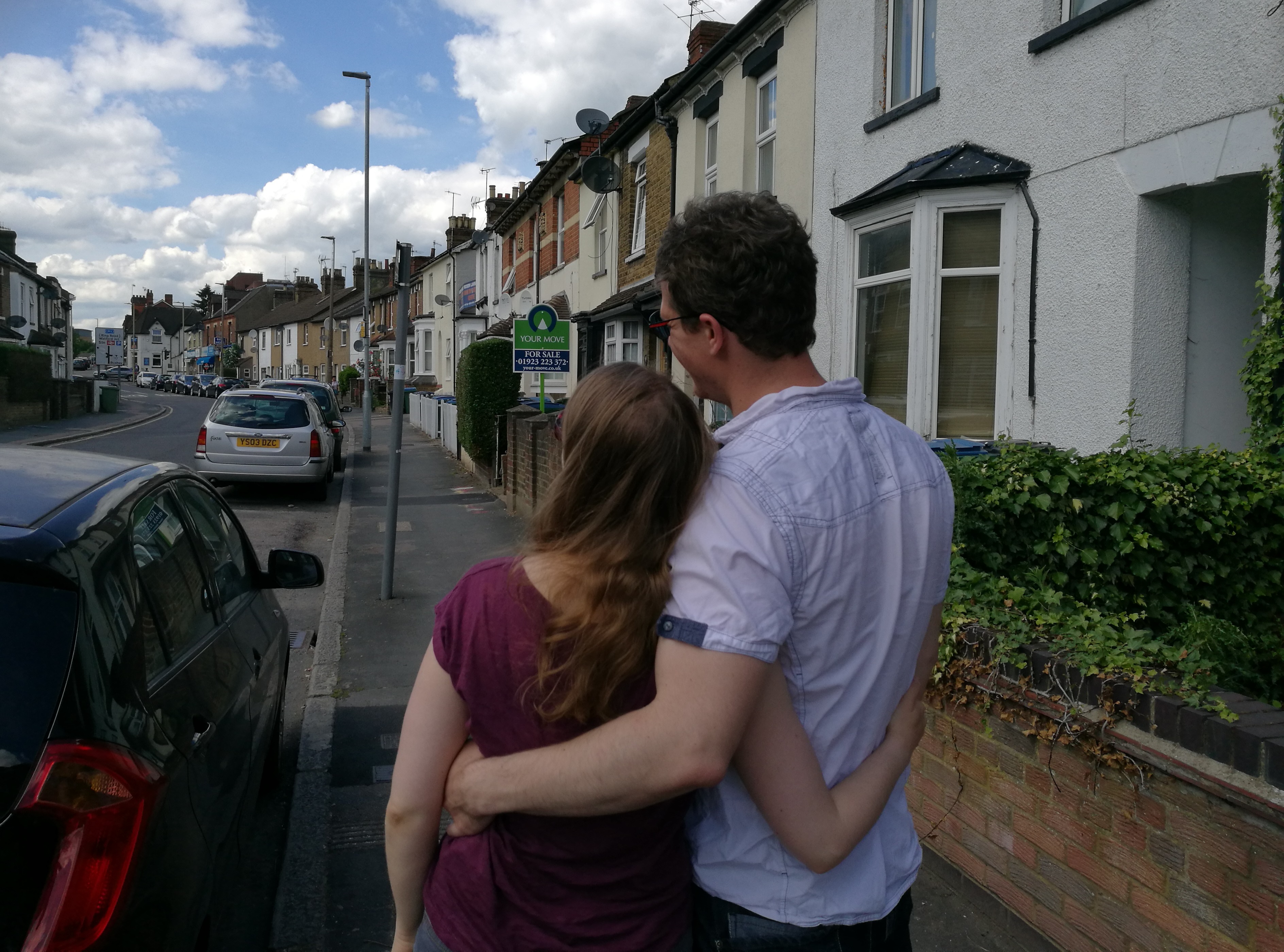
Couple looking at For Sale sign

Theresa May says the “best and brightest” EU migrants will always be welcome in the UK. The fact is, thanks to her and the Mail’s rhetoric, they’re already leaving

Couple looking sadly at house
“Our heart is not in Britain any more.”

The first thing I hear when Mathieu and Pauline welcome me into their home is an insistent buzzing-and-slushing noise. Mathieu apologises profusely and hurries to turn off the offending washing machine. Pauline shows me through to the immaculate kitchen and offers me tea: “Would you like an Englishy one? Earl Grey?”

Both French and either side of 30, Mathieu and Pauline are two of the 3 million-plus EU citizens who chose to build a life for themselves in the UK. But that life is over. In light of the Brexit vote and the events that have followed, they’ve decided, with heavy hearts, to move on.

They’re not the only ones. Net migration to the UK fell by 84,000 in the year to May 2017, according to the Home Office’s latest figures, thanks in part to the departure of large numbers of eastern Europeans. Over 300 nurses left the NMC’s register in December 2016, almost twice the number who did so in June 2016, which, combined with an unprecedented 90% drop in the number of EU nurses registering to work here, threatens an imminent staffing crisis. Universities, too, are reporting an alarming fall in applications from EU students, which will put a huge dent in their finances. Coffee chains and farmers are already complaining of problems recruiting workers. A Facebook group called Plan B, set up by a German national in February specifically for EU citizens thinking of decamping, now has more than 1,200 members.

According to immigration law experts Migrate UK, the exodus is because of the political uncertainty surrounding EU citizens’ status, and further labour shortages should be expected. Managing director Jonathan Beech says: “Until the government ends uncertainty among EU citizens by guaranteeing rights to remain in the UK after Brexit, we are likely to see a continuation of these trends, and potentially the start of a Brexit ‘brain drain’ from the UK.”

Of the people I spoke to, none could remotely be described “spongers” or “low-value” workers. These are young, healthy, skilled, taxpaying contributors to society, who speak impeccable English and are well integrated into their local communities.

Mathieu and Pauline moved here in 2012, just in time for the Olympics, not so much drawn to the UK as repelled by the culture in France. “The system is so inflexible there. There’s a lot of nepotism, racism, a pervasive culture of sexism, and there are too many strikes,” says Pauline. “In the UK, no one gives a shit that Theresa May is a woman, or that David Lammy is an MP,” adds Mathieu. “You don’t get that in France.”

“So you came here because it was more tolerant and open?” Hollow laughter ensues.

Pauline works as a contractor for the NHS, Mathieu as a software engineer, which gives them a combined salary of £75,000; that’s £11,000 tax and £7,000 national insurance that the government won’t be collecting next year. And since Pauline has undergone one minor operation and Mathieu has visited his GP twice, you could hardly call them a burden on the state.

So where have they chosen for their new start? “Canada. It’s not just Trudeau – even if it had been Stephen Harper, we’d have thought about moving there,” says Pauline. “They love immigrants in Canada,” says Mathieu. “And as English-speaking French people, we are their dream immigrants,” Pauline concludes, her eyes twinkling briefly.

Only Mathieu currently has a job lined up in Quebec, but it turns out they’ll earn more from one income there than they do from two here – their money will go further, too. “House prices! Oh my God! Our friend just bought a five-bed house there for £220K!” “The water’s free, the electricity’s very cheap, food is super-cheap, electronics … Jackpot! We might just end up thanking Brexit.”

Which brings us to the $64m question. When did they decide to up sticks, and why? “It wasn’t actually Brexit,” says Mathieu. “I was expecting it, to be honest. People are pissed off, the system is broken, inequality is growing, people don’t want to be under rightwing Angela Merkel, the problems in Greece. It’s what the government did after Brexit.”

The tone until now has been overwhelmingly of sadness, disbelief. But suddenly a tinge of anger enters Pauline’s voice. “I’m disgusted by the attitude of the Tory government. They’re using us as leverage. It’s been 11 fucking months. All that time they could have said, ‘You’re welcome to stay,’ but they didn’t. They could have condemned hate crimes, but they didn’t. They could have told Amber Rudd to shut up. They could have told the Daily Mail to shut up.”

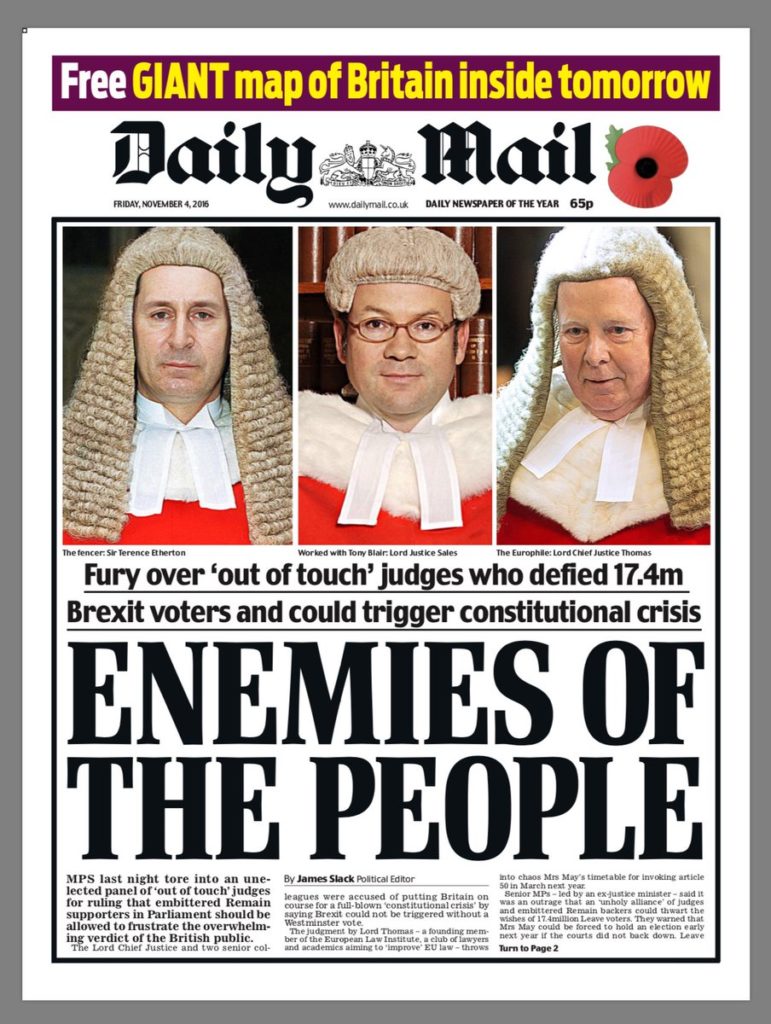
“The Daily Mail is hate speech,” Mathieu interjects. “‘Enemies of the people’? That’s Hitler, that’s literally Hitler! In France you would get prosecuted for that bullshit.”

It was the rapid poisoning of the atmosphere, they say, that made up their minds. “People tend to look on us with scorn and suspicion now,” says Pauline, “and I don’t think that’s acceptable, when you have given so much and made so much effort to integrate.

“My boss invited me into a meeting, and he said to me, ‘Brexit is good news. It’s not personal – it’s not against you – we’ve just to get rid of those Polish scroungers.”

Mathieu reserves special venom for Boris Johnson and Nigel Farage: “‘We’re going to give money to the NHS. Oh no, you know what? We lied. We’re going to stay in the EEA. No, that was all lies, too.’ And the British people don’t care. I expected people to throw eggs at Number 10, to be honest. But nothing.”

Now it seems that lying is a habit the Tories can’t shake. “‘The NHS is not failing because of cuts, it’s because the immigrants came,’ they say. ‘The housing shortage is not because we’re not building enough, it’s because the immigrants came.’”

“We’re really concerned about the British people – it breaks my heart to see so many people going to food banks, to see disabled people getting their benefits cut to nothing,” says Pauline, unprompted.

The mood has turned sombre again. “We were invited here, they needed us,” says Mathieu, “and now suddenly they are telling us that everything is our fault.”

***

Daily Cunt "Enemies of the People" headline
… along with immigrants, liberals, the disabled, “luvvies”, academics, lawyers, gays, lesbians …

The decision to leave was rather more momentous for Melissa. For one thing, she’s been here longer, having arrived from Germany in 2009. For another, she’s older – in her late 30s. Last but not least, her partner is British.

Melissa came to the UK because she loved to travel, wanted to experience a different culture, and spoke excellent English. She first set up home in Norfolk, but a year later met Sean, an automotive engineer a couple of years her senior, and when a job opportunity arose for him in the Midlands, they moved there together. She works from home as a freelance translator, earning £30,000-£40,000 a year, most of it from German clients.

The main factor in their decision to go, she says, was the work situation; carmaking is one of the areas most likely to be adversely affected by Brexit. “If the economy goes too far south, Sean might lose his job. We feel like rats leaving a sinking ship.”

But money wasn’t the only consideration. “The language being used reminds me very much of what I learned in my history lessons in Germany,” says Melissa. “‘Traitor’, ‘enemy of the state’ – it’s very worrying.

“Because I work from home, I’m not exposed to much xenophobia, but I did get a few people giving me the Hitler salute.” It’s Sean who bears the brunt of the abuse, mostly from his staunch Brexiteer colleagues. “One of them once turned round to him and said: ‘You’re sleeping with one of them, so you’re just as bad.’”

The couple’s plans to move to Germany are now at an advanced stage. While Sean speaks no German, his skills mean he will have little trouble finding a decent job.

“The referendum result has been a massive, massive blow. Both Sean and I are heartbroken. We’ve lost some very good friends over this. It was not an easy choice, but we don’t see a future in the UK any more – the country he was born and I chose to make my home and was very happy in.”

Since Melissa does most of her work for German clients, the UK won’t particularly miss her talents, although Sean will be harder to replace. Mathieu and Pauline, too, foresee big problems for their employers. There are only two or three people in the country with Pauline’s particular expertise, and it would take 18 months to train a replacement. When Mathieu’s boss was headhunted by Apple over a year ago, he had to deputise – and he’s still deputising, because they haven’t been able to replace him. And that’s with easy access to all 28 EU nations. The prospects for the company are not bright; only a handful of the staff in his team are British – there’s little appetite for computer science degrees in this country – and several other EU nationals are considering a fresh start.

***

Lara is another one whose skills will be sorely missed; she’s a GP. According to an estimate made last summer, EU immigrants make up 10% of registered doctors and 4% of registered nurses, making the UK health service one of the world’s most dependent on foreign labour. And with the GP system already being described as “on the verge of collapse”, that’s a talent pool the UK can ill afford to lose access to.

Lara, in her early forties and of mixed French and Mediterranean heritage, will also be taking a British partner with her when she goes, and two children. Again, she says, it wasn’t the Brexit vote per se that forced their hand. “Initially, after the vote, I thought, ‘It’ll be all right, they’ll guarantee our rights,’ but they never did.”

She too lays much of the blame at the door of the immigrant-bashing tabloid press. “Basically, all these endless stories about EU citizens stealing jobs and being scroungers made me feel not at home. I was in shock. Surely this is not the country I’d spent the last 22 years in? It suddenly felt foreign to me.”

While she hasn’t personally received any abuse – her English is flawless, her dress and appearance unexotic – she has witnessed some unpleasantness. “One of our patients – ex-army, I think – started shouting at some of the other patients, Polish and Asians, in the waiting room. ‘Britain’s for white people, get out of my country …’ I don’t think anyone would have said any of these things before the referendum.”

So next year, instead of taking home £48,000 as a doctor in the UK, she’ll be earning a little less to treat French patients instead. It’s her friends and colleagues, she says, that she’ll miss most. “I have amazing work colleagues. Even though some of them voted leave because they felt the EU had an unfair advantage over Commonwealth people.”

***

Linda, too, will be taking a native Brit with her when she leaves. Aged 37 and originally from Turku in Finland, she arrived here in 2003. “I had basically loved Britain since I first came here aged 16 and spent a month in Devon on a language course. I travelled all around Europe Interrailing, but nowhere else felt so ‘homey’.”

She runs a small market research company with a British business partner, for which she claims a salary of £70,000. “We started the company five years ago, and have grown to a team of 10, mostly Brits.”

As with everyone I interviewed, Linda considered applying for permanent residency, but found the process too daunting. “I reluctantly considered applying for PR about four months after the referendum. Having looked at my 14 years in the UK, no five-year period was simple or straightforward enough to not worry that it wouldn’t pass the hostile approach of the Home Office. For example, I’ve studied twice while I’ve been here, although working part-time both times, and I’ve been ‘unemployed’ (while building the company and living off my savings).”

Crunch time for Linda and Ian was the Conservative party conference in October 2016, when Theresa May first signalled her willingness to lead the UK to a hard Brexit. “We’d toyed with the idea of leaving from the morning of the referendum, but I’ve spent almost my entire adult life here, and leaving at 37 didn’t really appeal. But it became apparent to us that under Theresa May, the environment would become hostile for EU citizens, and we realised there was really no future here for us if Britain left the single market.” Ian works in the tech industry, which, they fear, will fade to nothing in a UK cast adrift from the bloc.

The lack of support from the government, and the failure of the Lords’ amendment to article 50 on EU citizens’ rights, came as a further blow. “The uncertainty was taking an enormous emotional toll on me, especially as I was recovering from the burnout I got from the early years of building the business. The anxiety was pushing me back to depression and Ian felt it was important to get me out of the UK for my emotional well-being.”

Linda is in no doubt that Britain has become a less tolerant and hospitable place since the vote. “I would go as far as to say it’s hostile,” she says. “I came to the UK partly because I felt it was more open-minded and tolerant than the country I grew up in – needless to say, that illusion has now been totally shattered.”

Are there any circumstances under which they would cancel their plans, or consider coming back? A soft Brexit, maybe? “Nothing. I can never feel at home in England or Wales again. But if Scotland becomes independent, we will strongly consider moving there, as that was our original plan.”

So as soon as they can make the arrangements, they’re relocating to the Netherlands. They’re sad to be leaving their friends, but she also has more mundane concerns: “I will miss having Amazon Prime, and going to Boots!”

One of Pauline’s greatest fears is losing access to Marmite – “God, I love Marmite!” – but mostly, she says, they’ll miss the Brits. Well, some of them.

“In the UK you find the very worst of people,” chips in an impassioned Mathieu. “Uneducated, almost as bad as Americans. But you also have the best people – oh, my God, wonderful people – who are so logical, considerate, articulate … They know how to talk. They are perfect.”

The trouble, apparently, is that there just aren’t enough of them. “I still have emotional attachment to the people – but people are not a place,” says Pauline with a sigh. “Home is literally where the heart is, and our heart is not in Britain any more.”

The Tories, Labour and the Liberal Democrats have all promised, as part of their manifestos, to make the rights of EU citizens in the UK one of their top priorities after the election. Alas, it looks increasingly as though that might be a case of shutting the strong stable door after the horse has bolted.

• Names have been changed.

Tool Britannia

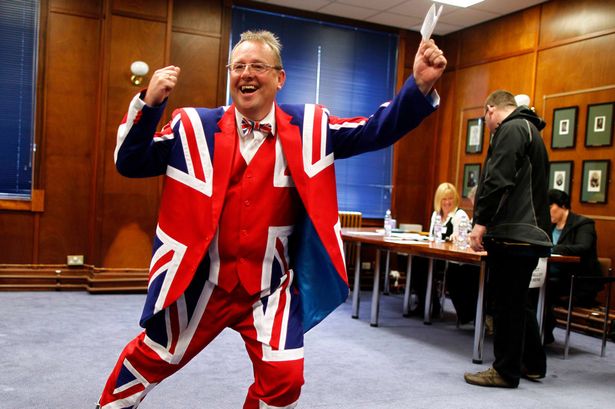
A tool in a union jack suit

I believe the UK is great. If only it could stay that way

A tool in a union jack suitI’m getting a teensy bit ticked off with being told that I hate my country. “You think we can’t survive on our own,” Leave voters inform me whenever I dare to point out any potential pitfalls of the UK’s departure from the EU. “Stop talking the nation down, traitor!”

Because I don’t hate Britain in the slightest. I have lived and worked in the UK all my life and am proud of it all ends up. So to set the record straight, I’m going to roll out the union jack bunting and sing hallelujah for the nine industries in which my country leads the world.

Aerospace technology

The UK is the second biggest player in the world in aerospace engineering, excelling particularly in wing technology, one of the most specialised and lucrative areas. Last year, the UK aerospace sector grew by 6.5% to £31bn, 87% of which was exported. The industry employs 230,000 people in all, and unlike, say, banking, the whole country benefits, with large operations in Belfast, Broughton in Wales, Birmingham, Derby, and a huge cluster of activity in the south-west.

Financial services

Say what you like about bankers – I’ve had plenty to say about them in the past – but they do contribute a fair chunk to the economy. In 2016, financial and insurance services was worth £124.2bn in gross value added (GVA) to the UK, 7.2% of the total. The industry employs over a million people nationwide – 3.1% of all jobs in the UK – and the banking sector paid £24.4bn in tax to the exchequer in 2016. What’s more, the banking, insurance and pensions sectors are one of the few areas in which Britain is a huge net exporter. Exports of these services netted us over £60bn in 2016, vastly outweighing the £12bn imported.

Higher education

No fewer than 12 of the UK’s universities feature in the top 100 universities worldwide, from Oxford, widely admired for its excellence in the arts but also making huge strides in science, to Durham, with its world-renowned physics department and the pioneering Centre for the Advanced Study of the Arab World. There were 2.3 million students at the UK’s higher education institutions in 2015-16, providing 400,000 jobs and directly generating around £2bn for the economy each year – on top of the incalculable value of giving an outstanding education to a third of the populace.

Artificial intelligence

The UK owes its growing stature in AI largely to the existence of Google DeepMind, a company founded in London in 2010 and bought by Google in 2014. But a veritable explosion of innovative AI startups over the last few years, including language processing specialists VocalIQ, machine-learning keyboard SwiftKey, digital marketer Phrasee and neural network developers Magic Pony, has put the UK at the very vanguard of the field. Many recent developments – voice recognition software, predictive text and autonomous vehicles – have been driven by UK-based tech firms, leaving the UK uniquely poised to be a serious player in this young but booming sector. According to Accenture, artificial intelligence could add £654bn to the UK economy by 2035.

Electronics

Expertise at small-scale production and innovation are the two key drivers of the UK’s electronics success. While it can’t compete on an industrial scale with the likes of Japan and Korea, it can produce little marvels like the Raspberry Pi, which has now sold more than 12.5 million units. The UK electronics sector, the fifth largest in the world, has an annual turnover of £80bn a year and employs 800,000 people.

Life sciences

The life sciences – pharmaceuticals, biotech and medical research – are another area where the UK has taken giant strides in recent years, thanks again in large part to its thriving higher education system. We have a particular talent, it seems, for small molecules, therapeutic proteins and vaccines, and are among the chief voices on the Human Genome Project. By most metrics, the United States is the only country with a more cutting edge in matters medical; we’re ahead of the pack in neuroscience, parasitology and material science, and are the second most prolific producers of medical research papers – a jolly good show for the country with the 21st biggest population.

Life science projects in the UK contribute £56bn a year to the economy, support 482,000 jobs – which again are well distributed across the country – and attract more direct foreign investment than in any other European state.

Music

We may suck royally at Eurovision, but in the broader scheme of things, Britannia rules the airwaves. Domestic success often translates into success abroad, and we export £1.4bn worth of songs every year. Since the Beatles, we’ve seen acts from Pink Floyd to Adele, and Elton John to One Direction go global.

In 2015, British artists accounted for more than a quarter of all the albums purchased across Europe.

TV and film

Despite the best efforts of Channel 5 and the BBC’s comedy department, the UK still enjoys a reputation for top-notch television, and as a result, sales of UK-made programmes hit £1.3bn in 2015/16. TV, film, radio and photography (which the ONS unaccountably lumps together) provided 260,000 jobs in 2013 and produced a GVA of £10.8bn.

Sport

While UK Sport’s trophy cabinet may not exactly be heaving at the moment, for a nation of 64 million souls, we punch well above our weight. As well as the impressive medal hauls at the London 2012 and Rio 2016 Olympics, we’re always there or thereabouts in world tournaments of football, rugby and cricket, and are disproportionately represented in tennis, snooker, boxing, cycling, hockey, canoeing, rowing, fencing, darts, squash, polo, sailing and golf. Even in off years, sport generates around £20bn for the economy.

(Australia, for what it’s worth, aren’t even the reigning champions of Australian rules football. Papua New Guinea are.)

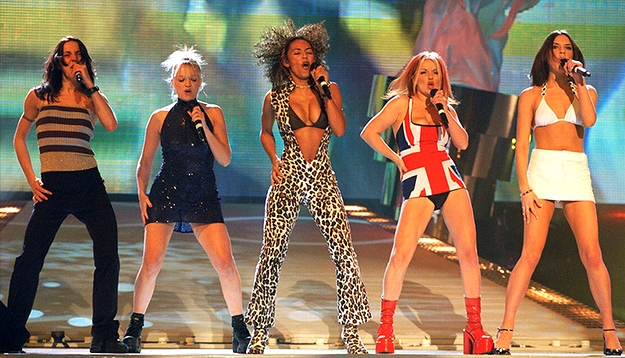
Spice Girls
Zig-a-zig, oops.
The future (aka, the punchline)

So there you have it! Britain really is great! We may no longer be a fearsome military power or an industrial powerhouse, but we’ve carved out a new niche for ourselves, at the heart of a global economy! So much for Talky McDownerson!

Hang on a sec. Who’s this? Oh, hi, TM. I see you’ve compiled a summary of reports from the respective fields on the predicted effects of a hard Brexit.

(These are not the opinions of cloistered academics, faceless journalists, or “out of touch” economists. These are detailed, fully researched assessments by people either within, or intimately involved with, the trades concerned. These people have no intrinsic bias towards Europe, only first-hand experience of how their businesses interact with the European Union and to what extent they depend on it.)

The list of worries expressed by leading figures in the aerospace industry is as long as the non-EU passports queue at Gatwick. Long border delays for parts in the event of departure from the customs union. Concerns about access to the best talent from the EU. Rising costs if the UK is forced out of the European Aviation Safety Agency.

Other EU countries – Germany and Spain in particular – are already vying for contracts after Brexit in the hope that trading conditions no longer favour the UK.

  • “I’m scared witlessStephen Cheetham, chief executive, PK Engineering
  • “We are very worried about the impact of Brexit on the whole Airbus discussion” aerospace supplier interviewed in Financial Times
  • “In terms of attractiveness … in terms of political stability, the UK goes down” – Andrew Mair, chief executive, Midlands Aerospace Alliance

I won’t spend too long on the impact of hard Brexit on financial services, as it’s one of the few areas the media have widely reported on. Suffice to say that the uncertainty caused by the vote alone has already wrought significant damage, with investments withheld and jobs and offices relocated to the mainland. The loss of passporting rights in the City of London is certain to prompt a mass exodus; rival financial centres from Dublin to Frankfurt to New York are salivating at the prospect of pillaging our capital of its coveted, lucrative institutions.

If David Davis walks away from the talks with the EU in September, as he seems intent on doing, he will be wiping out tens of thousands of jobs and setting a match to tens of billions in tax revenue.

In 2014-15, 20% of all students in UK higher education (437,000) were from abroad. While EU students are only liable for the same rates as UK citizens, those from outside the EU are charged more, so foreign students collectively pay £5bn a year in tuition fees –14% of universities’ total income. In addition, non-British students add around £26bn a year to the economy through their spending on and off campus, and indirectly support around 200,000 jobs.

But funnily enough, it seems not all foreigners are keen on being used as bargaining chips in negotiations or being attacked for speaking their own language in the street. Cambridge University has already seen a precipitous drop of 17% in applications from EU students, and Manchester University recently announced plans to axe 171 staff jobs, at least partly, according to the University and College Union, because of Brexit.

A falling pound, rising xenophobia, uncertainty over their futures and the faltering British economy are also driving away the best foreign tutors and lecturers.

The UK needs foreign nationals for its burgeoning AI industry more than most, suffering as it does from a critical shortage of digital skills. Far too few people are studying AI and other computer sciences to fill the positions locally, and almost 13 million British adults lack even the most basic IT skills. As a consequence, the IT sector recruits almost a third of its workers from elsewhere in the EU. For reasons discussed above, a hard Brexit is likely to drastically reduce the UK’s access to this talent pool. Reports of skills shortages are already emerging.

Since AI companies can set up almost anywhere, it’s primarily talent that attracts them, and if the UK loses its grip on the cream of Europe’s geeks, the business will go elsewhere.

As a footnote, a parliamentary report in October 2016 concluded that Brexit had thrown a crucial legal framework for AI and robotics, the General Data Protection Regulation, into doubt. It’s also jeopardised the free flow of data between the UK and the continent, crucial to the UK’s competitiveness.

Google DeepMind was founded by a British man born to Greek Cypriot and Singaporean parents, a Kiwi, and a Muslim Brit. Under the monocultural, send-’em-all-home regime proposed by nationalist Brexiters, it would never have seen the light of day.

A survey of the tech sector in early 2016 found that 84% felt it would be in the sector’s best interest if the UK stayed in the EU. Six per cent were undecided.

  • “A lot of organisations are now looking elsewhere to base their Innovation Labs for artificial intelligence” – Chris Rosebert, head of data science & AI, Networkers technology recruitment
  • “The funding that the research community has taken advantage of to hold its position internationally [in artificial intelligence and education research] has all come from the European Union” – Prof Rose Luckin, UCL Institute of Education

Insiders in the electronics industry have expressed fears about CE certification (European conformity). Tests to ensure that products meet agreed safety and quality standards are expensive, and if the UK adopts a different set of standards – in order, for example, to harmonise with America’s FCC – smaller British companies are unlikely to be able to afford to market their wares in Europe.

A more pressing problem is trade: if the UK crashes out of the EU without a deal, it will have to renegotiate free trade deals with other countries from scratch, a process that can take a decade or longer. In the interim, all British products would be subject to stiff tariffs (we’re not even guaranteed WTO status) and thus far more expensive than their competitors.

Fujitsu, Samsung and Hitachi (the second biggest private investor in the north-east after Nissan) are among the many electronics firms who have cautioned against a hard Brexit, warning that changes to the free movement of labour, customs operations and data passporting would mean job losses, a reduction in investment, and headquarters being relocated.

A report by thinktank Public Policy Projects, led by former health secretary Stephen Dorrell, warned that leaving the EU could have a damaging effect on the UK’s pharmaceutical and biotech industries. (It might also, by the by, adversely affect Britons’ access to the best drugs.)

Concerns include extra administrative burdens on clinical trials, additional checks and possible blocks on imports, patent protection, increased difficulty securing marketing authorisations, and a reduction in pharmacovigilance (oversight of safety standards, monitoring, risk management, transparency). The loss of the European Medicines Agency, and the 900 jobs and influence that go with it, will be a bitter blow regardless.

  • “The effects on the Life Sciences sector are likely to be substantial. This is because the UK would no longer keep access to many of the benefits of the EU system, such as the centralised procedure for marketing authorisations, the EU portal for clinical trials and the Pharmacovigilance database” – Toby Sears and Sally Shorthose, Bird & Bird Commercial Law

Visas for touring bands. Customs restrictions on merchandising. Increased production costs for vinyl. Copyright issues. Licensing. Higher tour expenses. Exclusion from the Digital Single Market. Cultural quotas. Dearer iTunes downloads. A hard Brexit would throw a sackful of spanners into the UK’s well-oiled music machine.

As a result, trade bodies AIM, the British Academy of Songwriters, Composers and Authors (BASCA), Featured Artists Coalition (FAC), Music Managers Forum (MMF) and Musicians Union all threw their weight behind Remain. In fact, one survey found that 91% of the music industry was in favour of the UK holding on to its membership.

  • “Those copyright rules have a huge impact on our business, and there is a very strong feeling among our members that the UK needs to be at the table to make sure that those rules are working in the interests of UK companies” – Geoff Taylor, chief executive, BPI
  • “Adopting an isolationist position is a huge mistake” – Colin Lester, CEO, JEM Artists management company
  • “The biggest impact would be not being able to influence EU regulation, particularly around intellectual property and the Digital Single Market” – Carolyn Fairbairn, director-general, CBI
  • “A victory for Brexit would be economically, politically, socially and culturally disastrous – for all of us” – Martin Mills, founder, Beggars Group, and David Joseph, CEO, Universal Music UK

A 2016 survey found that 63% of television executives believed the UK’s creative industries would fare better within the EU, outnumbering those who favoured Brexit by three to one. Another survey without a “don’t know” option came in 85/15. Their main worries were barriers to trade, economic damage limiting people’s purchasing power, and the loss of EU funding.

The film industry will also lose out on EU monies – British animation in particular looks likely to take a kicking – and will suffer further blows as more barriers are raised to British/European co-productions, and British-made content ceases to be classified as “European”, making it less appealing to countries that impose cultural quotas. Independent cinemas also look set to take a hit.

The picture is replicated across all the creative industries, from our hit plays, to our world-renowned dance troupes, to our novelists, our artists, our fashion designers. Many of these sectors, after a catastrophic drop in EU funding on top of the cuts imposed by recent Tory governments, face decline and possible collapse.

In addition to the measurable, practical difficulties above, there’s the less quantifiable but nonetheless important role of the UK’s “soft power”. Now that the UK is leaving the EU, English may soon cease to be an official language of the bloc – only Ireland and Malta speak it, and it’s not the only language in either nation – and now that it’s harder and less attractive for Europeans to come and work and study here, fewer people will bother learning English. Why would they, when there are easier options in France, Germany, Spain, Sweden, Poland? As fewer people understand English songs and TV shows, so fewer people will buy them.

  • “This decision has blown up our foundation. As of today, we no longer know how our relationships with co-producers, financiers and distributors will work, whether new taxes will be dropped on our activities in the rest of Europe, or how production financing is going to be raised” – Michael Ryan, chairman, Independent Film and Television Alliance
  • “Leaving the EU would be an utter disaster for the creative industries” – Ed Vaizey, culture minister

Brexit ‘likely to be devastating’ for UK film and TV industry

The main short-term effect of a hard Brexit on sport will be the changes to freedom of movement. Football players, for example, from South America as well as Europe, will find it much harder to gain a UK work permit if freedom of movement is lost. Cristiano Ronaldo, Thierry Henry and David Ginola might never have played in the Premiership if the UK had not been in the EU.

Similarly, the Kolpak agreement, under which sportsmen from Africa, Caribbean and Pacific Group of States (ACP) enjoy the same rights as EU players, will become void, meaning that the UK’s cricket, rugby and polo teams, among others, will be denied access to a valuable pool of players.

Olympic and Paralympic sports have already seen Brexit-related cuts to funding, and have been warned of more to come.

The international series of NFL games played every year in London may well cease, according to Maria Patsalos, a sports immigration lawyer at Mishcon de Reya LLP.

All 20 Premier League clubs were in favour of Remain.

  • “It is important that if we want the best league in the world, then we remain in the EU” – Jonathan Barnett, football agent
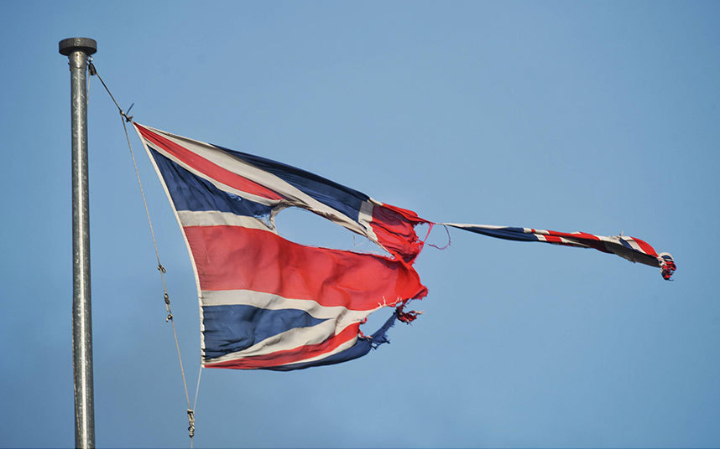
Torn union flag
“You finally really did it. You maniacs. God damn you all to hell.”
So where does this leave us?

Oo, looky there. That’s right. Literally every single one of the things that make modern Britain great depend partly – in some cases entirely – on our membership of the European Union; on close cooperation with partners, on minimal barriers to movement and trade, on the free and frictionless exchange of ideas, on attracting the cream of talent from 27 like-minded nations, on a reputation for tolerance, openness and fairness.

Sure, if Theresa May and co can somehow wangle us a good deal – keep the UK in the European Economic Area, giving us a status similar to that of Switzerland or Norway – then these jewels in the UK’s crown may survive largely unscathed. But no one bar a handful of spittle-flecked zealots believes we will get a good deal, because the EU will never retract its insistence on free movement as a condition of free trade. And since the Tory government has made it abundantly clear that they will take no deal over a bad deal, that means, in all likelihood, no deal. Adamantium Brexit. Armageddon for all the above.

I wouldn’t be so worried if Brexiters had offered a single suggestion as to what we can replace them with. We’ll never be competitive in steelmaking or textiles again – unless you’re willing to toil for 100 hours a week for less money than a sweatshop worker in Hyderabad. We don’t have much in the way of natural resources, our military strength is ranked below Italy’s, we’ve slipped to 20th place in the world education tables and are plummeting in the press freedom rankings. Cool Britannia is now a distant memory; since the referendum, the world now thinks we’re a bunch of arrogant, ignorant xenophobes. What will be the foundation of the New British Empire? Poverty tourism? Virtual-reality fox hunting? Jam?

You can’t turn back time

What the most ardent Brexiters fail to realise is that times have changed. Yeah, sure, Britain was once great, ruling the waves, duffing up Frogs and Krauts and all that. But then the empire collapsed, and other world economies, following our example and borrowing our technologies, started catching up. By the early 1970s, we were starting to struggle.

“Things were so much better before we joined the EU,” the Brexwits baa, apparently forgetting (cheers, nostalgia fallacy) that in 1973, many still lived 10 to a house and shared an outside toilet with next door. No one had a home computer, no one had a mobile phone, most people were lucky even to own one black and white television and a gramophone. Few could afford to go on holiday or eat out, child mortality was at 2%, and people were still dying of smallpox. Sure, so there was more of a sense of community and some people were still leaving their front doors open, but things were, on the whole, shit.

(It’s worth a reminder at this point that, even when Britain was truly great, things were by no means great for all Britons. The quality of life for all but the landed classes was miserable. Most people lived in abject poverty, public health was appalling, public sewerage was primitive where it existed at all, citizens were still subject to conscription, most people couldn’t vote, and the average person was doing well to live past 50. Success was only success for the few. Furthermore, most of the UK’s wealth was accrued at the expense of its colonies; it plundered their resources and enslaved or otherwise exploited their peoples. And those options, as far as I am aware, are no longer on the table in the 21st century.)

When it became clear that we were starting to lag behind our neighbours, we realised that a new strategy was required; so we swallowed our pride and joined the European Economic Community. And within that community, we adapted. We learned a new way of operating. And we did so so effectively that over the next four decades, our growth within the EU outstripped that of all other members.

The UK’s per-capita GDP increased by 2.1% in every year of our membership of the EU (compared with only 0.9% during the empire “boom” of 1872-1914). The key to our success was twofold: a language, culture and history shared with America and other English-speaking nations on the one hand, and geographical proximity to and membership of the European trade bloc on the other, made us the perfect bridge between the two. We might have ceded our pre-eminence in manufacturing, cotton mills and subjugating brown people, but in their place, after a period of painful adjustment, we built new temples. We ceased to be a powerhouse, and became instead a hub: a beacon of collaboration and commerce, a focal point for like-minded, progressive, creative thinkers.

I like to think of it this way. Prior to joining the EU, the UK was an independent organism: a lion, if you like, but one with mangy fur and rotting teeth. It made alliances where necessary, but it was basically self-sufficient, though its hunting prowess was fading fast.

When the UK joined the EU, it was forced to make compromises. It was no longer completely free, but this had its advantages; since it no longer had to take care of all functions, it could specialise in a few. Over the course of its 40 years of membership, the UK evolved from a discrete animal into something more like a vital organ within the larger beast that was the EU; a heart, say, or a lung.

Now, all of a sudden, ardent Leavers expect that lung to leap outside the host body and thrive by itself. (Like any animal deprived of a lung, the EU will suffer, but it will survive.) Some of them don’t even think we need a transition phase.

With their tireless, vainglorious, ill-informed insistence that the UK can succeed alone, a bunch of people who know as much about the way the modern world works as Kylie Jenner knows about thermodynamics have mortally endangered every single industry the UK worked so hard to lead the world in.

Congratulations, Brexitards. You killed your country.

2 thoughts on “Tool Britannia”

  1. Great piece. One thing you left out is food. The EU as a whole is self sufficient for almost all moajor food groups, apart from bananas, I think. The UK on the other hand is less than 70% sufficient (and yes we have no bananas either). We seem to be heading towards a more unstable world, big refugee movents, globl warming etc. Over the next 20 years food may well become an issue and we have just decided to pay more for it or bring it from further away in a world where carbon footprint will increasingly matter.
    The big problem, it seems to me is that there are no rational arguments for leaving the EU, everything I have heard from the leavers is either based on untruths or on some kind of visceral hatred fro stuff they don’t understand. Only when we have wrecked the country are they likely to learn anything, and even then they will probably want to blame the EU rather than the clutch of millionaire running our media and the eurosceptics in the Tory party.

  2. This is a very good analysis. What a pity some of these home truths have still not penetrated the minds of many of my fellow citizens. “I want my Country back” was a mantra of Farage. Back to what? As the article points out things weren’t that good before we joined the EU. The fact is the Brexiters are nostalgic for something that did not exist and what we have now done is to destroy all the goodwill we gained via our sacrifices of World War 2. Indeed we have destroyed the very thing most important in any business – The Brand.

Comments are closed.

I’ll never be a ‘re-leaver’

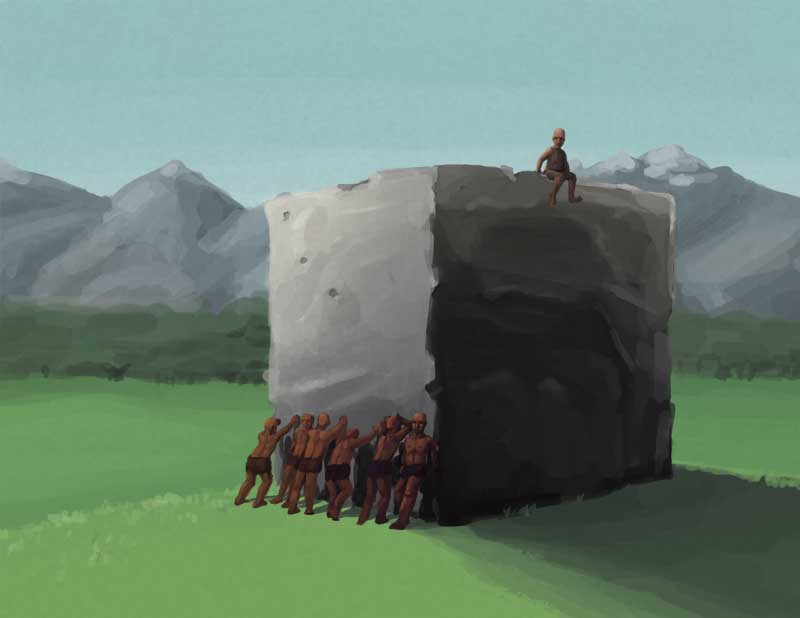
Men vainly pushing huge stone

There has never in my lifetime been a more clear-cut case of light versus dark

Men vainly pushing huge stone
You’re going to need to push a lot harder than that.

Just a little post on why I am such a passionate Remainer.

I wasn’t actually all that pro-EU when all this referendum business started. I mean, I knew it was expensive, and could be more efficient, and sometimes seemed a little in thrall to the neoliberal economic model. But I also knew that it conferred huge benefits, in freedom of movement and trade and cooperation with our European neighbours. That was, frankly, enough to decide the matter for me.

But what made me so rabidly pro-Remain, so determined to stop this, was the breathtaking, unabashed wrongness of the Leave campaign. The sneering. The abuse. The lies. The threats. The casual, carefree use of logical fallacy. The racism. The ignorance. The creeping suspicion of foreign interference. 

And as if that weren’t enough, look at the Leavers themselves. Gove. Johnson. Hannan. Farage. Banks. Duncan Smith. Rees-Mogg. Hoey. Even May, when she switched sides, went from steely, sensible woman to bitch from hell. Can you think of one person associated with the Leave campaign with a scintilla of compassion or wisdom?

For me, this is no longer about clinging on to the status quo, or protecting against personal loss (although Brexit has already been costly to me not just financially, but in terms of opportunities lost and friends forced to leave).

No, now this is just about making sure the bad guys don’t win. There has never been, in my lifetime, a more clear-cut case of light versus dark. And I’m not about to step into the darkness, or even the penumbra, in the interests of an easy life.

Fuck you, Farage, and Banks, and Cummings, and Putin. For as long as there is breath in my body, I shall fight your perfidious Brexit.

***

Footnote: the Tories, the Daily Mail and their cabal of piss-breathing liars would have us believe that half of all Remainers have suddenly changed their minds and thrown their weight behind Brexit. This just three weeks after another poll by the same firm showed that people who thought Brexit was a bad idea outnumbered those who supported it for the first time.

Of course, this claim, like pretty much everything else that comes from a far-right source these days, is bollocks. I was going to devote a post to explaining why, but handily, @HelenDeCruz, bless her cotton socks, has saved me the trouble. (TL:DR; the questions were poorly phrased and the headlines were misleading.)

We’re not going away any time soon.

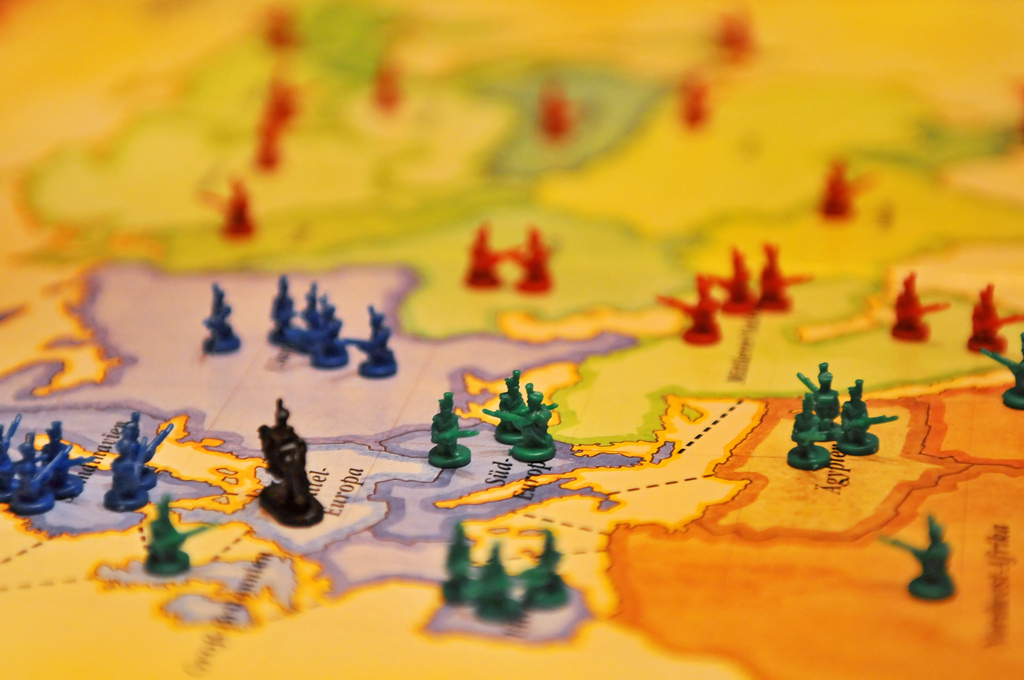
It’s a game to them. And you’re just a piece

Risk board

How does it feel to be written off by a vampire onion with a fake CV?

Risk board
“Double six. Two of yours. Two actual living, breathing human beings.”

Something pinged when I watched this interview. A connection was made where before there had only been a fuzzy proximity. And in that moment, one of the fundamental and perennial problems of politics crystallised.

“Low-value people”? Who defines people in terms of their value? As if it were some predetermined, unchangeable quantity? People who don’t see people as people, that’s who; people who see people as pieces in a game. Their game.

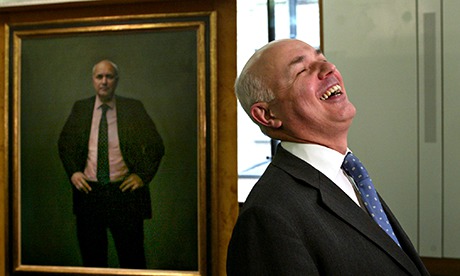
Look at yourself through Iain Duncan Smith’s eyes for a second. What are you? A pawn? A bishop? A king? Are you worth sacrificing for guaranteed mate in four?

Perhaps Risk is a better analogy. Up to six can play, diplomacy and chance have a greater role, and troops can be replenished. (There’s probably an even better one in the world of video games, but since I’ve been out of that world for a good 15 years now, I’ll leave that to the fancy of the digitally minded.)

The metaphorical link between politics and games has always been strong. Games started out, after all, as simplified simulations of life. Military commanders have long used counters on boards to represent troops. Game theory, under the right conditions and parameters, has been revealed as one of the better approximators of human behaviour. And increasing computer processing power means that the gap between simulations and reality is fast dwindling to nothing. It should come as no surprise that the opposite transformation sometimes occurs.

Iain Duncan Cunt
“And then I ate him. Artists are a bit … stringy”

But when it comes to real policies, which affect real people – people you know, people you love – is it really acceptable to think, and legislate, in terms of pebbles or pieces of plastic? How does it feel when a vampire onion with a fake CV writes you off on the basis of a report drawn up by a prematurely balding double-barrelled nanny’s boy straight out of Oxford via Harrow? Who made this fucking loser God?

I can’t shake the image of Duncan Smith, and sundry shadowy halitotic sepulchraves like Dominic Cummings, releasing silent farts in their Soho club, cradling a brandy and sniggering as they dispatch five infantry and two cavalry from Japan into Kamchatka. And then your disability benefits are stopped. Kaboom.

I like to think, if more people kept this image in their skulls as they walked into the polling booth, that our governments would look very different from the way they do today.

From Russia with hate

Pointing finger

An epidemic of abuse is threatening to tear western civilisation apart. Who stands to benefit?

Pointing finger
“But what about that time you …”

In my last post I wrote the epidemic of abuse sweeping the western world – against individuals, but also against entire groups, including immigrants, liberals, “experts”, academics, Muslims and the mainstream media. I mostly talked about the how. Now I’d like to focus on the why.

When public debate consists almost entirely of ad hominem attacks, it does far more than create an unpleasant atmosphere. Let’s follow ad hominem reasoning to its logical conclusion. (It may be that only 10% of the population are thick enough to swallow this logic, but as Brexit and Trump have shown, 10% is enough.)

Tony Blair, because he took the country to war against Iraq, cannot be trusted on anything ever again. Hillary Clinton, because she conducted some government business on a private email server and happened to be secretary of state when terrorists attacked the US embassy in Benghazi, can never run for public office. Tim Farron, because he avoided, as a Christian, saying that gay sex was not a sin, is the embodiment of evil. Jeremy Corbyn, because he once spoke to members of the IRA and Hamas, is a “mutton-headed mugwump” whose every word must henceforth be disregarded.

Furthermore, according to the guilt by association fallacy: because a handful of immigrants claim benefits, they’re all at it. Because the EU once passed a slightly fussy law about bananas, the entire institution is corrupt, from root to branch. Because the Guardian once published a column in favour of feminism, the entire media is irrevocably biased. Because you haven’t personally taken in a displaced Syrian family, you’re not allowed to advocate for the humane treatment of any refugees.

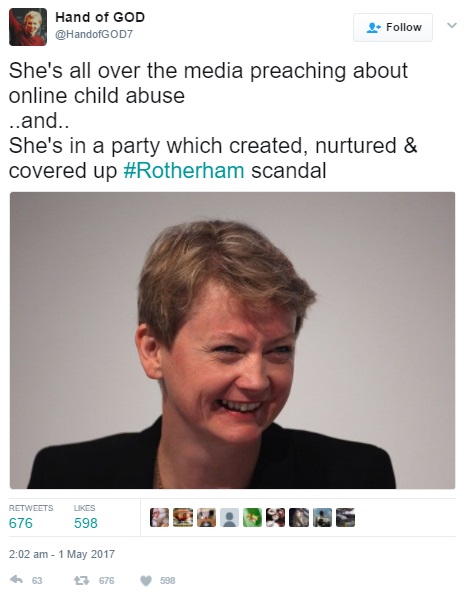
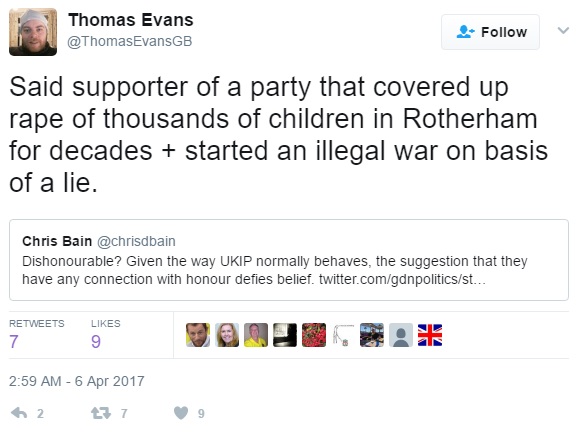
And at least 598 people seem to agree with the sentiment that because Yvette Cooper is a member of the Labour party, which happened to be in power for part of the period during which a group of men of Asian origin were found to be running a child abuse ring in Rotherham, she has no right to talk about the dangers of internet grooming.

Yvette Cooper tweet

(Donald Trump, on the other hand, can misspell basic words, mishandle legislation disastrously, go bankrupt four times, lie through his teeth, mock a disabled reporter, make openly racist comments and boast about sexually assaulting women, and still be allowed to run the most powerful nation on the planet.)

Quite apart from being the logical equivalent of – well, bollocks, frankly – this speaks to a fantastically grim view of human nature. A single misdemeanour, or error of judgment, renders your entire existence invalid. Make one mistake – or even have a fleeting association with someone who once made a mistake – and you forfeit all right to express an opinion again. (Except if you’re Donald Trump. He can screw up as badly and as many times as he likes.)

We all make mistakes. Human beings are flawed creatures. And as I argued last time, we’re all, inevitably, hypocrites. But by the reasoning of the far right, this means that no one in the entire world should ever be listened to again.

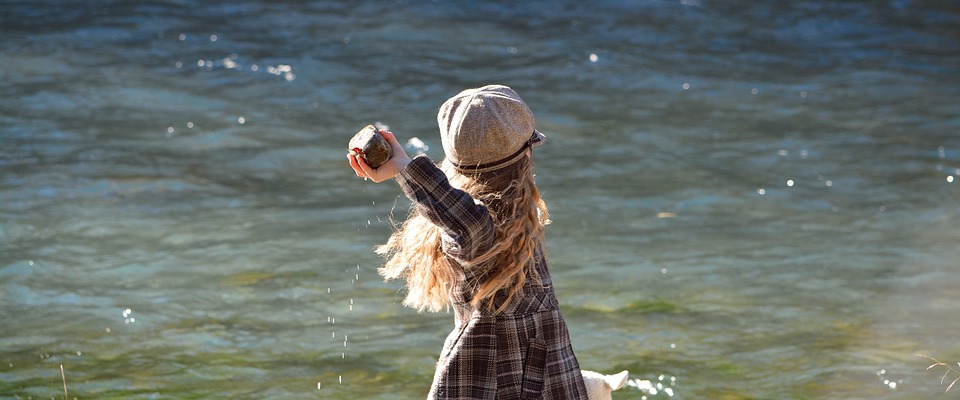
Thus, there can never be any laws. No decision can ever be taken by any authority, because no one on this earth is perfect enough to have authority. “Let him who is without sin cast the first stone,” a chap called Jesus once said, knowing full well that no man born is without sin.

There’s more. By ad hominem logic, no one is ever allowed to change her mind. People do not learn from their mistakes. No one can grow or become a better person. No more Martin McGuinnesses; once a terrorist, always a terrorist. (Everyone you ever had a drink with is a terrorist too.) Every feud is eternal, every war unending. In this universe, apologies are pointless, redemption impossible. Thou must not forgive. Rehabilitation? Ha.

I’ve straw-manned a little here, but I hope it’s clear that this way of thinking is more than just deluded; it’s destructive. The tribalism produced by the guilt by association fallacy, by demonising entire classes of people at a stroke, entrenches opinions, feeds resentments, and creates deep and damaging divisions. This assumption that the acts of a few in a group reflect the disposition of all of them breeds distrust, intolerance, hate. Ad hominem reasoning, combined with the guilt by association fallacy, undermines trust in the system in a way that threatens the very stability of society.

And yet the far right (and, to a comparable extent, the far left) seem to be pushing this exact agenda. Who on earth stands to benefit from this?

‘And you are hanging blacks’

There’s been quite a lot of speculation as to whether the Russian government has meddled in the US presidential election, in the French presidential race, and in Brexit. There are stories of armies of Russia-sponsored Macedonians and bots generating and disseminating fake news and “astroturfing” – creating the impression of grassroots support for far-right ideas, when in fact the number of people subscribing to those ideas is far lower. There are allegations of shady political deals between Donald Trump’s team and Russian operatives, mysterious donations to anti-EU groups, and connections between Russian entities and and Leave campaigners. There’s also, as a footnote, a growing trail of bodies of Russian diplomats.

It all sounds a bit tinfoil-hat, until you remember that it is Vladimir Putin’s plainly stated aim to disrupt and undermine western society. The sanctions imposed after the invasion of Ukraine are biting. Russia is suffering economic hardship, is concerned about Nato, has imperial ambitions in central Europe and the Balkans, and Putin, a KGB officer when the Soviet Union fell, is still smarting over the defeat. Russia doesn’t have the will or the military might to declare open war on the west, but it does have the wits.

People better qualified and connected than I are exploring the diplomatic and economic avenues. What turned my eye eastwards was the methodology being used: ad hominem. Because if anyone can be said to have made ad hominem an art form, it’s the Russian government and the various iterations of its intelligence agencies.

Russia’s love affair with whataboutery dates back to a diplomatic exchange in 1905. After Moscow was criticised over the Kishinev pogrom, its US ambassador responded: “Well, Americans recently lynched blacks.” For reasons that we’ve been through, the point was irrelevant, but it successfully moved the focus of the debate away from indefensible ground. So successfully, in fact, that the appeal to hypocrisy became the central plank of Russian foreign policy for the next 115 years.

For 115 years, whenever someone in power in Russia has taken a dislike to someone, their first recourse has been the smear. They’ll bring up the lynching thing. They’ll set up a secret camera and film their enemy having sex with his mistress, or catch him taking a sauna with some women. If there isn’t enough real evidence, they’ll make some up; a favourite tactic is to install child pornography on the target’s computer.

So enamoured are Russians of this strategy of digging up and inventing incriminating evidence that they have their own word for it: Kompromat. (Here’s all the legit dirt you’ll get on me, by the way, far-right fucks. You’re welcome.)

In Vladimir Putin, we have possibly the finest practitioner of the dark art of the smear ever to have walked the earth. When Putin – or Russia, and by extension, Putin – is criticised, he unfailingly responds in the same way. Instead of answering the charge – he never, but never, directly addresses negative questions – he will point the finger at his accuser. Tu quoque. Whataboutery. Tu quoque.

The day after the arrest of Julian Assange, when Putin was asked about the lack of democracy in Russia, he replied: “As far as democracy goes, it should be a question of complete democracy. Why then, did they put Mr Assange behind bars? There is an American saying: ‘He who lives in a glass house shouldn’t throw stones.’”

When the Panama papers came out, and an associate of Putin’s was implicated in the shadowy global money-laundering operation, the Russian president’s reaction was yawnsomely predictable: “There was no corruption involved at all. Besides, we now know from WikiLeaks that officials and state agencies in the United States are behind all this.” Translation: “No, you farted.”

This was all a bit of a joke before the internet took such a big role in our lives. Now it’s a clear and present danger, because social media allows people to pursue this strategy on a previously unimagined scale. Now it’s not just a bloke on the telly momentarily dissing you. That bloke can pay people to run multiple accounts and create automated accounts – bots – to boost his signal, and mobilise what appears to be millions of people to discredit you.

People don’t generally alter their opinions much if they hear one negative comment about something. But it’s a different story when they hear thousands, or millions. And this is exactly what’s happening. Tabloid newspapers, far-right demagogues and internet spambots have been systematically smearing immigrants, liberals and the EU in a bid to tear up the very fabric of western society. The Russian Method ™, honed over a century, has finally found its perfect attack vector: unlimited voices at instant speed, all reading from the same hymn sheet. Even better, it’s all untraceable.

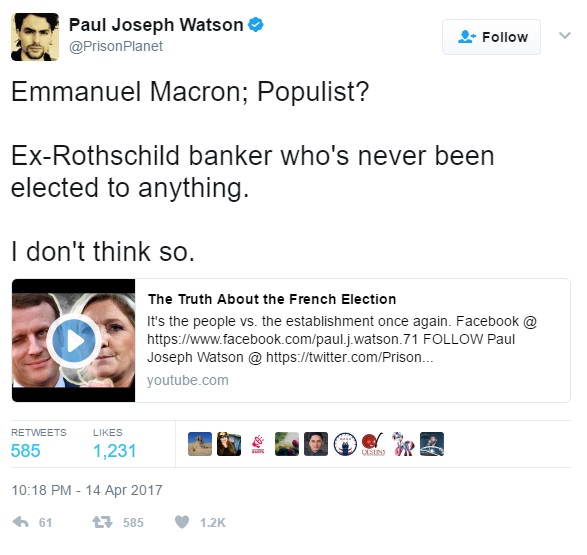
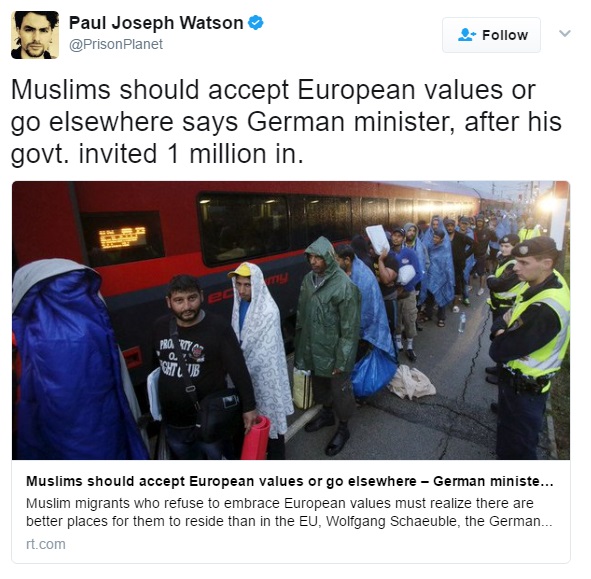
It’s not for me to say whether Russia is orchestrating the far-right resurgence, merely colluding with it, or that alt-right nutsacks like Paul Joseph Watson have simply torn a leaf from Putin’s playbook. But at the very least, the convergence of interests here is extraordinary. Whichever way you slice it, the far right in Europe and America are using Vladimir Putin’s tactics to further Vladimir Putin’s agenda.

There may be no smoking gun as yet, but there are a hell of a lot of fingerprints.

I’ll finish by suggesting a few things we can try to do to stop this in a couple of days. In the meantime, here are some solid reads on related topics.

Five ways to spot fake news
How Trump’s following grew out of a teenage chatroom
Carole Cadwalladr meets Arron Banks, director of Leave.EU
Is someone “Putin” cash in Ukip’s pockets?
Russia accused of clandestine funding of anti-EU parties
The Russian sponsorship of the European far right
The Kremlin’s Trojan horses
Post-truth and the “metropolitan elite” feminist
How Russia is hijacking western politics (read the whole of JJ Patrick’s #Snowman series if you can)
The Russian “firehose of falsehood”

The art of the smear: how the far right destroyed public discourse

Girl throwing stone

Online debates these days unfold with all the dignity and decorum of a stag do at a Reading Wetherspoons

Girl throwing stone
Let him who is without sin …
“Whoever first hurled an insult at his enemy instead of a spear was the founder of civilization” – Sigmund Freud

Insults are nothing new. From the 4th century BC ding-dong between Demosthenes and Aeschines, to Shakespeare’s “You starveling, you elf-skin, you dried neat’s-tongue, you bull’s-pizzle, you stock-fish!”, to Noel Gallagher’s laceration of Robbie Williams as “the fat dancer from Take That”, incivility is as old as civilisation. We start calling each other names in the playground and, if the Leave voters I’ve encountered online are any guide, there’s no upper age limit on abuse.

But suddenly, it’s Ragnarök out there. Get involved in an online discussion about anything from topiary to the Tweenies and the chances are you’ll be set upon within minutes. Political “attack ads” were once frowned upon; now they’re the norm. There’s hardly been a single positive message in the UK general election campaign thus far; it’s just been smear after slur after slight. Most modern debates – usually online, but increasingly in real life – unfold with all the dignity and decorum of a stag do in a Reading Wetherspoons.

It’s all rather odd, because as I’m sure you already know, attacking a person in this way, instead of the substance of what they’re saying (or in the case of political debate, their policies), is a fallacy: a failure of reasoning that renders a claim invalid. In this case – the argumentum ad hominem fallacy – abuse is invalid because the truth of a person’s statement has nothing to do with their character, past behaviour or friends. Just because it’s Tony Blair saying, “Two plus two equals four”, that doesn’t mean the real answer is five. Much as it pains me to quote Margaret Thatcher, on this point, she had it right: “If they attack one personally, it means they have not a single political argument left.”

Civilisation is supposed to be advancing. We are devising ever better theories to explain the world, sending more kids to university, sharing more information, faster, than ever before. The use of logical fallacies should be declining, not increasing.

So why the recent explosion of invective? Some blame the global climate of fear since 9/11 and the ensuing jihadi atrocities. ­­­Some say it’s deindividuation: when we’re online, or part of a large group, we enjoy anonymity; our actions have fewer repercussions for us, either because we are untraceable, or we because we share responsibility with others. When we are at one remove from the consequences, our actions tend to be less inhibited.

Others point to the bubble effect, the fact that people tend to assort themselves into groups of like-minded people. If we spend too long in these echo chambers, hearing only what we want to hear, then we are likely to react more aggressively when someone attacks them.

These theories all have merit, but I don’t believe they are enough to explain the extent of the poisoning of discourse, or the speed with which it’s happened. Echo chambers have always been with us – we’re a tribal species – and abuse is less effective online than in the real world, because while we may be anonymous, our opponents often are too, so we don’t have as much informational ammunition.

There’s something else going on. I have a theory of my own, but before we go into that, it would be helpful to look at abuse in more detail. First, a key distinction. There are two broad classes of ad hominem, which serve different purposes. The first is relatively innocuous and is largely accepted as a legitimate debating tactic.

“You, sir, are drunk.” “And you, madam, are ugly … but at least I shall be sober in the morning.”

Winston Churchill’s zinger to Lady Astor is a regular chart-topper on “Top 10 Putdowns” lists – but like all ad hominems, it’s a fallacy. From a purely logical perspective, Lady Astor is in the right. Churchill’s comeback is fallacious; as well as being offensive, it’s irrelevant. He’s also drawn a false equivalence. While he is quite capable of controlling his level of inebriation, poor Lady Astor has no such dominion over the shape of her face.

But if Astor wins on substance, Churchill wins on style. This is a class of ad hominem that you might call a joust. It’s usually found in the context of the cut and thrust of repartee, and its purpose is to throw the opponent off balance. If your interlocutor has the upper hand in a discussion, a droll, well-targeted personal attack can move the debate to surer ground. Since people’s natural reaction to being attacked is to defend themselves, they’ll often attempt to defend the slight instead of driving home their advantage.

Jousts take place in real life, in real time, in the real world. If they hit the mark, they earn kudos for the wielder. Churchill’s comment may have been mean, but it was quick, it was (presumably at least partially) accurate, and it took some courage – presumably Dutch – because the target of his tongue-lashing was standing right next to him. Above all, it was funny.

Many of the greatest literary minds in history have been able practitioners of the joust. Chaucer, Swift, Pope, Voltaire, Johnson, Twain, Byron (“Posterity will ne’er survey/A nobler grave than this:/Here lie the bones of Castlereagh:/Stop, traveller, and piss”), Wodehouse (“She’s got brains enough for two, which is the exact quantity the girl who marries you will need”), Wilde (“I never saw anybody take so long to dress, and with such little result”) and Orwell (“He is simply a hole in the air”) all earned their stripes partly by tearing others off a strip. We excuse these slights, applaud them even, because they show qualities that we aspire to: intelligence, originality, speed of thought. Besides, there’s often a sense that the target had it coming. Who are you going to side with – the guy who won the second world war, or some judgmental fuddy-duddy?

The second class of ad hominem is the smear. It too is rapidly becoming an ingrained part of public discourse, but it is, I will try to argue, far more dangerous, and has no place there. Smears come in four main varieties.

1) Character assassination

Tweet by wanker about Macron

There’s really only one contender for the title of World’s Bigliest Trash-Talker. As of March 2017, Donald John Trump was estimated to have slagged off no fewer than 320 different people, organisations and … items of furniture. Yeah, he dissed a table.

Trump’s gibes have the same drawback as jousts – they’re irrelevant to the discussion – and none of the merits. They’re not funny. They’re inane, unoriginal, and, as often as not, false. They do not signal a quick wit, because for the most part Trump delivers them via Twitter, or in prepared speeches to adoring crowds. And they are anything but brave, because Trump’s opponents are rarely in the same room when he vilifies them. To compare the US president’s infantile taunts to Shakespeare’s eloquent excoriations is to stick a Lego staircase next to the Taj Mahal.

Trump tweet about reporter
The “reporter who no one has heard of” was David Cay Johnston, winner of the Pulitzer prize for journalism.

And yet here he is, signing poorly drafted executive orders like baseball cards, merrily topping up the swamp with the contents of every septic tank in America, and hooking his drives ever closer to the nuclear bunker. How so?

When you look at the Mango Mussolini’s modus operandi, all becomes clear. Shower your enemies with insults; see which gains the most traction (ie likes and retweets); then use it again and again, until it becomes irretrievably associated with the target. So Hillary Clinton becomes “Crooked Hillary” at every mention; the New York Times “the failing NYT”; and rival for the Republican nomination Ted Cruz “Lyin’ Ted”.

These remarks are not designed to artfully throw Trump’s opponents off balance or to enhance his comic credentials. They’re not really directed at his opponents at all; they’re aimed at the wider world. Trump is not trying to undermine what his rivals are saying now, but everything they have ever said. These are cynical, systematic smear campaigns. And incredibly, through sheer force of repetition, they worked.

Most people are smart enough to realise that, just because a hay clump stapled to an overripe satsuma repeats something over and over again, that doesn’t mean it’s true. Unfortunately, it seems there are just enough credulous idiots out there for Trump’s bullying tactics to pay off. By means of a million gutless, leaden, charmless, bogus backstabs, Trump managed to destroy the credibility of everyone who stood in his way.

TL;DR: Your argument is rubbish because you are rubbish.

2) Tu quoque

Tu quoque tweet

“L’hypocrisie est un hommage que le vice rend a la vertu.” – François VI, Duc de La Rochefoucauld

The tu quoque – Latin for “you also” – is a special case of ad hominem also known as the appeal to hypocrisy. Here, instead of trying to undermine the target’s argument by maligning their character, you are attempting to do so by pointing out things they have said or done in the past that contradict their current position.

A tu quoque often feels somehow more cutting than a basic ad hominem, because, well, no one likes a hypocrite. However, it is just as invalid as a criticism, because it too fails to disprove the premise. Whether your past or current actions are 100% consistent with your view or not is completely immaterial. Let’s take a recent example.

On March 22 this year, the UK’s esteemed prime minister, Theresa May, stood up in parliament and delivered a broadside against Labour frontbenchers who had sent their children to grammar and private schools. The aim, of course, was to expose the hypocrisy of Labour, who as a party oppose the creation of more grammar schools. But as well as being unfair, May’s point is entirely without merit.

We live in a world where personal and public interests do not always align. (This is why we need governments; to balance private freedoms against the general good.) Politicians aren’t just politicians. They are also, despite appearances, human beings, and many of them are parents.

When you’ve got your MP’s hat on, grammar schools are a bad thing. Most studies have concluded that while they might benefit the few who attend them, they have a deleterious effect on other schools; they suck in all the best pupils and the best teachers, and regular schools suffer as a result.

But now look at the question from the viewpoint of the MP as parent. Grammar schools exist. The kids who go there do better. Given the choice between sending them to a grammar or to a comprehensive, which way do you swing? The effect of your decision on other people is infinitesimal – but it could make a huge difference to your child. You’re technically a hypocrite if you choose the grammar, but it doesn’t mean your opposition to the principle of grammars is wrong.

Tweet slagging off Lily Allen

When Lily Allen and Gary Lineker spoke out in defence of refugees last year, they were bombarded with incandescent messages along the lines of “Well, how many are you taking into your mansion?”

Like May’s tirade, the detractors were missing the point. It isn’t Lily Allen’s job to look after refugees. There are lots of childless couples who’d probably be more than happy to take in a Syrian orphan, for example. The alt-right are constantly frothing at the mouth about the atrocities committed by Isis – but how many of them are donning combat fatigues and heading off to the Levant? If Allen and Lineker are hypocrites, so are they.

Few of us have the time, the equipment or the expertise to devote our lives to solving all the world’s problems. There are others better placed to tackle these matters: police, governments, charities. All we can do is flag them up, perhaps donate some cash, or if we’re lucky enough to have a free weekend, organise a trip to Calais to hand out clothes and food.

The fact is, we’re all hypocrites on a regular basis. Have you ever sat in gridlock and moaned about the traffic? You’re part of the problem! Ever merrily sucked on a fag while gravely warning a young relative never to take up the habit? Pot, meet kettle! Worried about overpopulation – and you have two kids? You’re a fine one to talk!

TL;DR: Your argument is rubbish because not every single thing you have ever said and done in your entire life has been 100% consistent with it.

3) Circumstantial ad hominem

The implication that a person has taken a position purely because it suits their agenda; they cannot be trusted on a particular issue because they have a horse in the race, or their judgment is otherwise clouded.

There’s sometimes something to this one. Most prisoners on death row insist that they are innocent, because it’s hugely to their advantage for others to believe them. However, by strict logical criteria, their claim is not automatically untrue simply because it is in their interest. We just need to take it with a healthy pinch of salt.

"You would say that" tweet


TL;DR: Your argument is rubbish because you are biased.

4) Guilt by association

Fucking idiot's tweet

Fetch the Nurofen. We are now entering the realms of spectacularly twisted logic, where the cognitive gymnastics can induce migraines in the unprepared.

4) is essentially 3) on steroids. The association fallacy is the most egregious and toxic of ad hominems, since it attempts to invalidate someone’s point by smearing them on the basis of her membership of, or tenuous association with, a particular group.

It’s become depressingly common practice, in online discussions, for your opponent to try to dig up dirt on you. They’ll read your profile, scan your previous tweets or comments, even Google you in their quest for incriminating evidence. Failing that, they’ll use whatever they find to try to pigeonhole you.

Why? Because then they can write off your opinion on the basis that they have already written off the opinions of everyone in your group. “Aha, you live in London! Of course you’d parrot pro-EU propaganda – membership benefits the metropolitan elite!” (Forty per cent of Londoners voted Leave.)

As well as committing the same logical misstep as the other smears – implying that a person’s identity is somehow relevant to their point – the association fallacy asks us to accept two further false propositions: a) that the entire group’s views and values are without merit; and b) that everyone in that group thinks and acts in exactly the same way.

Loath as I am to cut the hate-fuelled shitrag that is the Daily Mail any sort of slack, the continued attacks over its historic sympathy for Hitler and the Blackshirts make no sense. For one thing, everyone involved with the paper in 1934 is dead. New office, new owner, new staff. The words “the Daily Mail” now refer to a different entity; there is no immortal “Daily Mail soul” that inhabits everyone who sets foot in its offices. (True, the current team is starting to look more and more like its historic incarnation, but from a logical standpoint, there is no reason why this should be so.)

The guilt by association fallacy effectively means that no one can ever be right, because it holds that your view is worthless if you, or any group you have ever been associated with, have ever done anything wrong.

Telltale phrases: “Typical Leaver”, “You liberals are all the same”, “Just what I’d expect from a Muslim”.

TL;DR: your argument is rubbish because I consider (erroneously) that everyone in the group I have assigned you to (erroneously) is wrong about everything.

Another Watson tweet

I used to think that humanity was slowly waking up to the preposterousness of generalisations like “All men are bastards”, “All Jews are stingy” and “All Gypsies are thieves”. But suddenly, writing off entire cross-sections of society at a stroke is enjoying a renaissance.

I picked the Daily Mail example for a reason. Of all the smear campaigns mounted in the last few years, one of the most sustained and successful has been the coordinated effort to discredit the entirety of the world’s journalists – or, to use the dismissive alt-right term, the “MSM” (mainstream media).

Organisations like the Mail, Express and Fox News haven’t helped the cause with their rabidly partisan headlines and editorials, and it’s true that the Independent, for example, has a strongly pro-EU slant. But the far right demagogues would have you believe that every journalist in every media outlet in the world is part of some huge conspiracy to deceive you, to keep a boot on the throat of the working classes and maintain the status quo.

The alt-right pursue this narrative by seizing on any and every mistake, oversight or lapse of judgment from any publication or broadcaster and magnifying it to ludicrous proportions. So, because the Guardian once ran an erroneous story about Jeremy Corbyn sitting on the floor of a train, we now cannot believe any Guardian story we read. Because Buzzfeed runs listicles and fluff pieces on its site, its investigative journalism is worthless. Because the BBC once published a news item about the negative effects of Brexit, it is irredeemably biased in all matters. The fact that Nigel Farage – an MEP for a party with no representation in parliament who only bothers turning up for work to sour the UK’s foreign relations – gets more airtime than any other politician in the UK is neither here nor there.

Yes, the mainstream media have made mistakes. And yes, some lean in a particular political direction. But on the whole, they try to give a reasonably balanced view of things. They are bound by ethical standards and libel laws, and subject to the oversight of a regulator. When they get things wrong, they apologise, they retract, and they print corrections.

Again, most people don’t buy into the alt-right’s absurd narrative. But a small, significant section of society have swallowed the lie, and now routinely reject any facts from mainstream sources as “biased” or “fake news”. To them, all of the media – from the Independent to the Guardian to the Mail to the BBC to ITV to CNN to the Times to Al-Jazeera to Buzzfeed to the South China Morning Post to the Dumfries & Galloway Standard – are all part of some vast conspiracy to prop up the metropolitan elite. We have now reached a point where a Brexiter, in a discussion about Brexit, will demand that you provide evidence to back up your point – and then, when you do, airily dismiss it because it happened to be published in the Sunday Times.

Idiot tweet

So if no conventional news sources can be trusted, who are these people listening to? Who has stepped into the information vacuum to expose The Real Truth? Blow me down with a feather, if it isn’t those selfsame alt-right demagogues! The alt-right demagogues, whose newsgathering resources generally stretch to a Twitter and YouTube account and a camcorder in their mum’s basement. The roving-reporter alt-right demagogues, like Paul Joseph Watson, who openly admits that he hardly ever leaves his Battersea flat, Julian Assange, who has been trapped in the Ecuadorian embassy for five years, and Katie Hopkins, who broke her world exclusive that there were quite a few Asian shops in London by going to the shops.

(This post is plenty long enough without a diversion into the shameless mendacity of the alt-right, but I’ve posted a few examples here, and there are plenty more at Snopes, FactCheck.org and FullFact.)

Farage Breaking Point poster

It wasn’t enough, of course, to smear the media. They are, after all, just mirrors to majority opinion. If a new order is to be imposed, all the traditional institutions must be undermined.

Dominic Cummings’ “Take back control” was very clever. The NHS promise on the bus probably did it for some people. The Breaking Point poster, even though immigration from outside Europe had precisely jack shit to do with the EU, undoubtedly won over a few racists. But for me, the real stroke of genius from the Leave contingent, and the turning point of the whole campaign, was Michael Gove’s “People have had enough of experts.”

Never mind that he was told to say that by one of the exact same metropolitan elite experts he was maligning. Never mind that he apologised abjectly for the comment the next day and retracted it altogether months later. In one pithy phrase, Gove manage to articulate the fury of millions of underachievers. He also single-handedly destroyed the last scrap of trust the public had in the system. Suddenly, the opinion of the man in the street was just as valid as that of someone who had spent years mastering her subject.

Gove’s (or, rather, Cummings’) ludicrous argument, that, because some trusted individuals once made an incorrect prediction, all their predictions are worthless, was the final justification for a Brexit vote among a decisive group of waverers. This arrant nonsense, combined with parallel whispering campaigns – Boris Johnson merrily defaming the EU in his columns for the Telegraph and Spectator, and the relentless demonisation of immigrants and Muslims in the Express, Mail, and far-right “news” sites – was what dragged Leave over the line.

For years, liberals ignored all this mudslinging, I guess because they assumed no one was gullible enough to believe it. Hopefully, they’re waking up to the fact that they can’t afford to ignore it any more.

(I’ve got more to say on this subject, but I’ve already wittered on for too long. Part two will follow shortly.)

1 thought on “The art of the smear: how the far right destroyed public discourse”

  1. “Yes, the mainstream media have made mistakes. And yes, some lean in a particular political direction. But on the whole, they try to give a reasonably balanced view of things. They are bound by ethical standards and libel laws, and most submit to the oversight of a regulator. When they get things wrong, they apologise, they retract, and they print corrections.”

    No, they don’t generally try to give a balanced view. Bias towards establishment politics is very real and *very* bias. That’s not to say the neo-fasc bullshit is true, but that just because the neo-fasc accusations are bs it doesn’t make the MSM unbiased. They’re biased in different ways.

Comments are closed.

Watching the defectives: a fake news diary

Not a Trump protester. A London rioter

A far from comprehensive selection of the hatemongering bullshit being spread by the far right

This isn’t intended to be a fully fledged post – more of a resource. It will never be exhaustive, but I want to keep a record of some of the most spectacular examples of fake news and or/twisted facts circulated by far right and so-called libertarian websites.

I’ll just make the one observation for now: if your cause is really so just, why do you need to make so much shit up?

Watson tweet

The deception: Self-styled alt-right “counterculture” guru Paul Joseph Watson posted this tweet on 16th January 2017. The wording is unambiguous: anti-fascist protesters were plotting an acid attack at an event to celebrate Trump’s inauguration.

The truth: The “acid” in question was butyric acid. The protesters were planning to let off a stink bomb.

Screenshot of fake news website

The deception: A group of Muslim immigrants in Berlin kidnapped a teenage girl and raped her repeatedly for 30 hours.

The truth: The girl, a 13-year-old Russian-German, later admitted making up the story. None of the far-right websites bothered updating their articles or taking them down.

Golding tweetThe deception: Paul Golding, leader of the confederacy of cunts that is Britain First, posted a video on his Twitter account purportedly showing British Muslims celebrating the terror attack in the Champs-Elysees in Paris in April 2017.
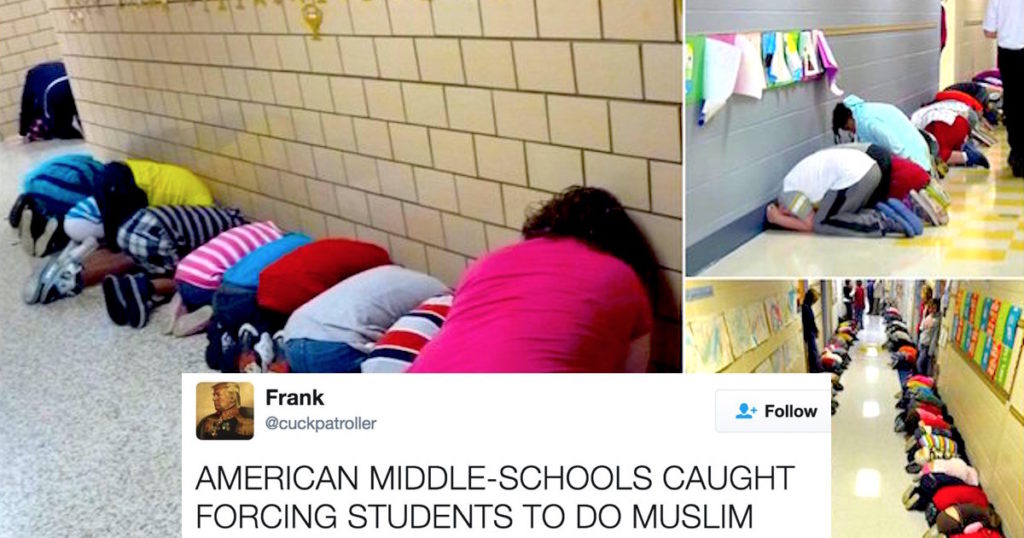
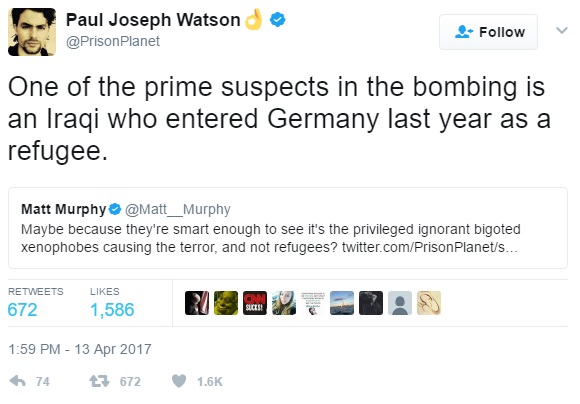
The truth: The video, filmed in 2009, showed Pakistani cricket fans celebrating victory over Sri Lanka, as anyone who watched the video to the end – and saw them shouting “Pakistan” and hugging passing white people – could have worked out.

Not a Trump protester. A London rioter

The deception: Hillary Clinton supporters staged violent riots after Donald Trump won the 2016 presidential election.

The truth: There was some trouble. But a number of far-right websites and Twitter accounts used pictures from the 2011 London riots as “proof” of the violence. (The picture above was used, inter alia, in a Guardian article in June 2016, five months before the supposed riots.)

Not praying to Mecca

The deception: Schools in the US are forcing non-Muslim primary school children to pray to Mecca.

The truth: It was a tornado drill.

Little girl with scar

The deception: A four-year-old boy was beaten by a gang of Muslim immigrants in Sweden.

The truth: The picture the far-right pricks used showed a four-year-old girl savaged by her family’s rottweiler in Cardiff in 2008.

Tweet by prick

The deception: When news broke of an explosion near the team bus of the Borussia Dortmund football team in April 2017, a rumour circulated that Islamic jihadists were responsible. Paul Joseph Watson was quick to point this out to his 573,000 followers on Twitter.

The truth: A few days later, police arrested a German-Russian market trader over the incident. He had carried out the attack in order to drive down Borussia Dortmund’s share price. Did Paul Joseph Watson hasten to convey this rather significant development to his 573,000 followers? Did he fuck.

Crane with people dangling from it

The deception: A few weeks back, a lot of Islamophobes on Twitter circulated the above photo, claiming that it showed a mass execution of gay men in Saudi Arabia (or sometimes Iran). The tweets were all deleted when the con was pointed out, but I saved the photo.

The truth: It was an Icelandic dance troupe rehearsing a performance for the Rekjavik arts festival.

The deception: Muslims never speak out against jihadist terror.

The truth:

Muslims speaking out against terror

If you find any particularly egregious examples of equivocation, misrepresentation, or outright mendacity designed to fuel hatred like this, let me know and I’ll add them to the list. But please make sure it’s all properly sourced.


How are you sleeping, Siobhan?

Mourners with caskets

Fake news is fanning the flames of hatred against minorities. You’re supplying the tinder.

Girl with coffin
A relative of one of the victims of the Quebec mosque shooting in January 2017.

Dear Siobhan McFadyen,

On 31 July 2016, this story appeared on the Sun’s website. The headline was “Hundreds of Syrians in UK arrested over string of offences including rape and child abuse”.

The report went on to explain that in response to Freedom of Information requests, most of the police forces in England and Wales had supplied figures showing that almost 900 people of Syrian descent had been arrested in the UK over the previous year.

Towards the end of the story, the reporter included the line: “In England and Wales the majority of offences that Syrians were arrested for were immigration violations.” The number of actual arrests for rape listed in the story is two.

Two.

Within hours, the Express and the Daily Star had published their own versions of the story. Both took similar lines to the Sun’s. Star: “Hundreds of Syrians arrested in the UK for offences including rape and child abuse”. Express: “Police arrest 900 Syrians in England and Wales for crimes including rape and child abuse”. (But the headline that still appears in Google’s search results – which usually reflects the original – is “Police arrest 900 Syrians in England and Wales for rape, death threats …”)

The Express story – the story that ran, and still runs, under your byline – did not see fit to include the rather pertinent information about most of the arrests being for immigration violations.

On September 30 2016, after a complaint to the Independent Press Standards Organisation pointing out the misleading presentation of the article, the Star amended its headline.

The Express did not.

On 29th January 2017, a 27-year-old Canadian man, Alexandre Bissonnette, walked into a mosque in Quebec and shot dead six innocent Muslims, leaving five others critically injured. Bissonnette was renowned for his far-right views.

On Wednesday 22 February 2017, Adam Purinton, 51, got into an argument with two Indian men in a bar in Olathe, Kansas. He shot them both, reportedly after shouting “Get out of my country”, leaving one, Srinivas Kuchibhotla, dead and his friend wounded.

On 3 March 2017, a Sikh resident of Seattle was shot in the arm by a white American man, who screamed at him to “go back to his own country”.

How do these people form their abhorrent views of racial and religious minorities, I wonder?

On March 11 2017, eight months after the Sun on Sunday story, the far-right, pro-Russia, lunatic conspiracy website Planet Bros ran this “article”, rehashing the information in your report and linking directly to it, with the slightly – but crucially – adjusted headline, “Police Arrest 900 Muslim Migrants In England And Wales For ‘Sickening’ Crimes”. Needless to say, the detail about immigration violations is nowhere to be seen. [Edit, 16/6/17: this story has since been taken down. Which I suppose is to be regarded as a small victory.]

Thousands of people shared it online. It is still being retweeted as I write.

SiobhanCrop

I work in news, so I know it’s highly unlikely that you wrote the headline for the original story yourself. I also know it’s probable that the words you wrote were significantly changed and/or reordered by a desk editor or subeditor. However, your name is the only one publicly associated with the Express story, and so it is to you that I write.

I ask only this. Are you happy with the way your report was presented? Are you happy that your work is actively being used to mislead people, to poison public discourse, and to stir up hatred against an entire race of people, most of whom are guilty of nothing more than overstaying their visa?

Are you happy to be contributing, however indirectly, to the deaths of innocent human beings?

Yours sincerely,

Andy Bodle

Update: Siobhan McFadyen’s response

(Received by email, 16/6/2017, three months after my request)

“I, Siobhan McFadyen, have reported Andy Bodle to police for harassment. Your claims and false, threatening and defamatory.”

I’m extremely curious to see whether writing one blogpost, sending one email and listing some incontrovertible facts constitutes harassment in the eyes of an English court of law.

3 thoughts on “How are you sleeping, Siobhan?”

  1. Fear is the path to the dark side.
    Fear leads to anger.
    Anger leads to hate.
    Hate leads to suffering.
    – Yoda

    For the Quebec mosque shooting, let’s not ever forget the bittersweet aftermath: the eulogy of Imam Hassan Guillethttps://www.theguardian.com/commentisfree/2017/feb/08/quebec-mosque-attack-eulogy-alexandre-bissonnette-victim-too

    1. Grow up? For pointing out that egregiously misleading articles are spreading hatred and resulting in death? Not likely, you fucking vile subhuman.

      The article is eight months old, and as I mention in the post, people are retweeting it again, right now, as propaganda to support the false narrative that all refugees are rapists.

      I can only assume that you’re one of the lizard-brained proto-fascists that fell for it, and the other lies just like it.

Comments are closed.

Project Fear Watch

Fear from Inside Out

Will there come a point when people realise that the cost of Brexit is too high?

Fear from Inside Out
“Project Fear!” he cried, fresh from posting a particularly harrowing still from an Isis video.

A rolling account of the damage done to the UK by the vote to leave the European Union. And remember: we haven’t left yet.

Economy

Few benefits to 15% fall in sterling

Student loan interest rates set to rise by a third

UK labour shortages reported as EU worker numbers fall

Brexit squeeze on living standards intensifies

UK slips to bottom of G7 growth table

Food ‘could rot in fields’ without cheap migrant labour, say farmers

City will relocate up to 9,000 jobs to Europe after Brexit

Hi-tech financial firms flee amid Brexit doubts

Small businesses face £3.6bn shortfall when EU grants are cut off

London ‘no longer best place’ for fintech startups

Brexit will cost UK 30,000 jobs in finance sector

Airlines ‘will have to relocate to Europe after Brexit’

Cosmetics firm Lush to move expansion plans abroad

Leaving with no deal ‘disastrous’, say manufacturers

Brexit-related bank moves could cause financial instability across Europe

Rolls-Royce posts record losses after Brexit

BMW to pull production of E-Mini from UK

UK will lose €40bn of direct EU funding after Brexit

Brexit jeopardises £487bn of US investment in UK

EU and UK ‘heading for economic cold war’

1,000 jobs at risk as shoe retailer Brantano goes into administration

40% of games companies considering relocating to EU

Vote begins to bite as rising food and fuel bills hit retail sales

Portion sizes shrinking to hide rise in import costs

Customs gridlock could damage UK trade

Brexit migration controls could push retirement age beyond 70

Leaving EU could cost UK billions in extra tariffs

Parts of UK that voted Brexit ‘most vulnerable to its effects’

100,000 euro clearing jobs under threat

Brexit-driven inflation rises to highest level in four years

UK loses EU ‘crown jewels’ of banking and medicines agencies

UK needs to renegotiate 759 separate treaties just to stand still

Higher education and research

UK universities tumble in world rankings over Brexit concerns

Applications to UK universities down 7% since Brexit vote

Erasmus scheme may exclude British students after Brexit

Brexit will leave UK bit-part player’ in science

Heriot-Watt University announces axeing of 100 jobs

Britons ‘bumped off’ EU medical research grants

1,400 EU academics have left UK since referendum vote

Health

British children with cancer could miss out on drug trials

Number of EU nurses coming to UK down by 90% since referendum vote

60% of European doctors considering leaving because of Brexit

600,000 people could lose access to clinical trials

Britons likely to lose health cover in Europe after Brexit

Consumer

Apple raises price of apps by 25%

Apple laptops go up by as much as £500

Microsoft PCs rise by up to £400

Toblerone maker reduces weight of bars

The Great Tesco Marmite Shortage Scandal

Price of Guinness, Baileys to rise because of Brexit

Price of chocolate bars set to rocket

Chocolate, drinks portions being reduced with no price drop

Cost of making a car in UK could rise by £2,400

Brexit set to push up price of champagne and prosecco

Beer brands pulled from Tesco shelves over price-rise row

Sound system manufacturer Sonos raises prices by 25%

Brits may have to pay to visit Europe after Brexit

UK tourists will have to pay mobile phone roaming charges after Brexit

Spending on clothing hits five-year low

Mothercare to raise price of clothing and toys

Social

Brexit may be final straw for some couples

Dutch woman who has lived in UK for 30 years may have to leave (one of many such cases)

Applications for Irish passports rise by 42%

3 million EU citizens may face ‘deliberate hostility’ policy

EU citizens face legal limbo after Brexit

Britons living in EU face Brexit backlash

Hard Brexit means hard border for Ireland

Brexit jeopardises Northern Ireland peace process

Damaging Brexit could fuel Welsh independence movement

Brexit threatens territorial status of Gibraltar

Ending free movement is no quick fix for low wages, say Lords

Immigration unlikely to fall by much after Brexit

Sturgeon seeks second referendum on Scottish independence

Politics & global reputation

Transitional deal may need to be ratified by 38 parliaments

Brexit has damaged UK’s reputation among young Europeans

May’s threatening language ‘has made UK a laughing stock in Europe’

Race hate crimes/far right terrorism

No, they’re not “fake news”.

Brexit jeopardises fight against terrorism

Far-right activist’s shocking rant on Channel 4 News: ‘Take in a Syrian refugee, I hope you don’t get raped’

Vile solicitor launches racist tirade at mother and son on train

Man kicks Muslim woman in stomach, causing her to lose unborn twins

Race crimes on underground rise by 57% after Brexit vote

Hate crimes have risen by up to 100% since Brexit

Man kicked to death by gang ‘for speaking Polish’

Gang inflicts serious head injuries on teenage refugee in Croydon

The cowardly, brutal murder of Jo Cox MP

Other

UK’s millionaires believe Brexit will make them richer

End to free movement of animals could threaten endangered species

Warnings of customs chaos at ports in event of hard Brexit

Brexit will overburden already creaking civil service

EU working to push UK out of Euro space agency

Brexit will delay nuclear power stations

Senior civil servants considering stepping down over Brexit tensions

Gibraltar poses threat to post-Brexit aviation access

Ryanair will have to suspend flights in absence of Brexit deal

EU countries line up to host European Medicines Agency

Racing industry concerns over end of free movement for horses

Top orchestra quits Britain over Brexit migration clampdown

UK Sport warned of more Brexit funding cuts

Loss of access to EU talent will damage UK architecture industry

Brexit will damage fight against corruption, OECD warns

Parliament failing to scrutinise legislation properly because of Brexit overload

Denmark will claim centuries-old fishin rights in UK waters after Brexit

Replacing EU workers in hotels and restaurants could take 10 years

Employers struggling to fill vacancies

Top chefs refuse to move to London because of Brexit

Hard Brexit will mean up to 40% tariffs on UK agriculture exports, an end to free healthcare in the EU for UK citizens, loss of passporting rights for the City, and an end to the Free Skies agreement, Davis admits

Since I’m probably not going to be updating this as often as I should, for all the latest on the EU clusterfuck, check out Jon Henley’s excellent weekly Brexit briefing for the Guardian.

NB: The jolly impressive Brexit Shitstorm Forecast is a much more comprehensive resource on the same subject. I don’t want to steal their thunder. However, since it tries to be both compendious and balanced, there’s a lot to get through. My page will just consist of edited lowlights.

1 thought on “Project Fear Watch”

Comments are closed.